


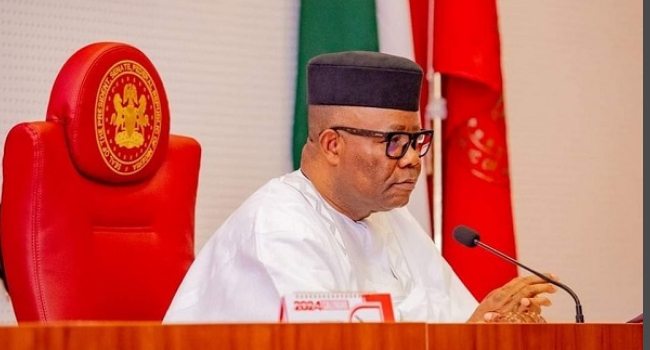
Nigeria’s Senate has announced plans to hold an emergency plenary session on Tuesday following growing public criticism over the recent passage of the Electoral Act (Amendment) Bill, particularly the removal of a provision that would have mandated real-time electronic transmission of election results.
The decision was disclosed in a statement issued Sunday by the Clerk of the Senate, Emmanuel Odo, confirming that all senators have been directed to reconvene for the special session scheduled to begin at noon.
Senate President Godswill Akpabio reportedly ordered the emergency sitting in response to escalating public concern surrounding the controversial amendment.
The development comes as the Nigeria Labour Congress (NLC) warned of possible nationwide protests and even election boycotts, citing what it described as inconsistent and unclear positions from the Senate regarding electronic transmission of election results.
According to the labour union, failure to provide clarity on whether electronic transmission will be mandatory risks eroding public trust in Nigeria’s electoral process. The NLC stressed that Nigerians deserve a transparent system where votes are both counted properly and visibly verified.
Similarly, a coalition of political activists operating under the banner of the Movement for Credible Elections (MCE) criticised the National Assembly’s decision to drop compulsory electronic transmission from the proposed amendment.
The group described the move as a deliberate setback for democratic accountability and announced plans for a protest tagged Occupy NASS in Abuja.
Read also:
- Peter Obi, Aisha Yesufu Lead Abuja Protest Demanding Electronic Transmission of Election Results
- Nigeria Not Prepared for Real-Time Election Result Uploads – Former INEC Commissioner
The controversy stems from the Senate’s passage of the Electoral Act amendment on February 4, during which lawmakers voted against Clause 60(3).
The clause sought to compel presiding officers to electronically transmit polling unit results directly to the Independent National Electoral Commission’s (INEC) Result Viewing Portal in real time.
Proponents of the clause argued that immediate electronic transmission would improve transparency and reduce manipulation during collation.
Instead, lawmakers retained the existing provision that allows electronic transmission only after results have been counted and publicly announced at polling units.
The decision has drawn criticism from civil society organisations, election observers, and opposition figures who view it as a step backward in efforts to strengthen electoral credibility.
Meanwhile, the House of Representatives’ bipartisan Conference Committee on the Electoral Act amendment is expected to meet with its Senate counterpart this week to reconcile differences between the two chambers’ versions of the bill.
A member of the committee, Saidu Abdullahi, who represents Bida/Gbako/Katcha Federal Constituency of Niger State, confirmed that discussions would take place soon to harmonise contentious provisions before final passage by the National Assembly.
The committee, chaired by Lagos lawmaker Adebayo Balogun, was constituted to resolve discrepancies between the Senate and House drafts in line with legislative procedure.
The agitation for clearer electoral laws follows concerns about discrepancies observed in previous elections between polling unit results and electronically uploaded figures.
While the 2022 Electoral Act introduced reforms such as improved timelines for party primaries and strengthened INEC’s independence, stakeholders say ambiguities remain.
NLC President Joe Ajaero emphasised that uncertainty surrounding electronic transmission provisions could undermine confidence in future elections.
He urged the Senate to provide an unambiguous explanation of the bill’s final wording and the rationale behind its decisions.
The labour union warned that legislative ambiguity at a sensitive political period could institutionalize doubt about election integrity.
It also insisted that the amended law must explicitly compel INEC to transmit results electronically in real time or risk triggering mass action.
While several civil society groups and opposition figures have criticised the Senate’s stance, Senate President Akpabio has defended the chamber, maintaining that lawmakers did not reject electronic transmission outright and insisting the Senate will not succumb to intimidation.
Nevertheless, activist groups argue that keeping electronic transmission optional weakens electoral safeguards and could encourage manipulation ahead of the 2027 general elections.
The Movement for Credible Elections said mandatory electronic transmission is essential to prevent result tampering, ballot rewriting, and post-election disputes. The coalition warned that lack of transparency could increase voter apathy and further erode trust in democratic institutions.
Pan-Yoruba socio-political organisation Afenifere also called on the National Assembly’s joint committee to adopt compulsory real-time electronic transmission of election results. The group argued that Nigeria’s democratic future depends on adopting technology-driven electoral reforms.
Afenifere leaders cautioned that failure to embrace transparency could deepen public distrust in governance.
They also criticised the Senate’s rejection of proposals for downloadable electronic voter cards embedded with QR codes, describing reliance solely on physical voter cards as outdated.
According to the organization, many countries now use advanced digital election systems that improve transparency and auditability, and Nigeria risks falling behind global democratic standards if it fails to adopt similar measures.
As lawmakers prepare for the emergency plenary and harmonization talks, pressure continues to mount from labour groups, civil society organizations, and political stakeholders demanding clearer electoral reforms.
With the debate over electronic transmission of results intensifying ahead of future elections, analysts say the outcome of the amendment process could significantly influence public confidence in Nigeria’s democratic system.
The coming days are expected to determine whether lawmakers can resolve the controversy or whether the country will witness broader protests and heightened political tension over electoral transfar