


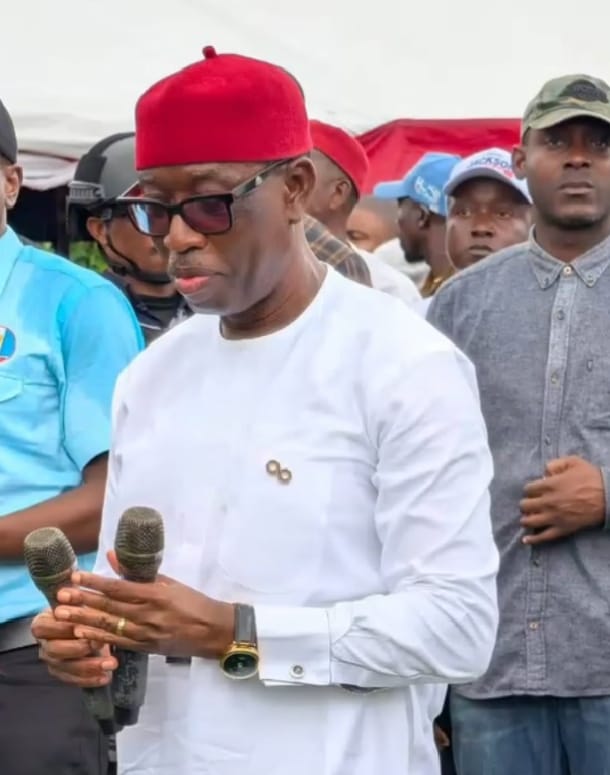
UMUNEDE: The sudden wave of empowerment programmes and political mobilization in Umunede and neighbouring communities in Ika North-East Local Government Area of Delta State has continued to generate questions over the timing, funding and selection of beneficiaries, particularly as political activities ahead of the 2027 elections intensify.
On Sunday, September 6, 2026, hundreds of residents and supporters of the All-Progressives Congress (APC) gathered at Ogbe Model Primary School, Umunede, for an empowerment programme reportedly targeting 400 constituents, with each beneficiary expected to receive ₦50,000.
At ₦50,000 per person, the reported distribution amounts to ₦20 million.
The event, held in an open field in the heart of Umunede, took the appearance of a mini political festival, with hired musical and dance groups entertaining the crowd despite the rain.
Some women appeared in matching outfits popularly known as aso ebi, while men and women also wore T-shirts of different colours as they danced and celebrated.
But beyond the entertainment and colourful gathering, the event has triggered questions about who benefited, how the beneficiaries were selected and whether the programme is primarily an empowerment initiative or part of a wider political mobilisation strategy.
Umunede is identified as Ward 11, comprising two electoral units: DIEC Unit 1, covering Ileje and Ile Quarters, and DIEC Unit 2, covering Obi and Oba Quarters.
According to a member of the APC from Ileje who spoke about the distribution, not every party member benefited from the reported ₦50,000 empowerment.
The party member, who said he had remained loyal to the APC despite following PDP leaders who defected to the APC after the state party leadership structure was collapsed into the APC about two years ago, claimed that the money did not go to all party members within the ward.
He alleged that the distribution was restricted to selected members from particular units.
According to him, Ileje Quarters alone has four polling units, but only about 12 beneficiaries from Ileje were said to have received the empowerment.
When asked how the beneficiaries were selected or how the other quarters shared the money, the APC member reportedly said he did not know how the beneficiary list was compiled.
His account has added another dimension to the debate surrounding the programme.
If the empowerment was designed for constituents generally, residents are asking why some party members reportedly received the money while others did not.
And if the intervention was specifically targeted at APC members, questions remain over the criteria used to determine which members qualified.
Another major question raised by residents concerns the source of the reported ₦20 million.
If the programme is being described as a councillors’ empowerment programme for the people of Umunede, some residents want to know how much the councillors earn monthly and whether their official earnings could support a distribution of ₦50,000 to 400 people.
The arithmetic is straightforward:
This has led to calls for greater transparency over the source of the funds.
Are the councillors personally financing the programme?
Is it being supported by political leaders?
Is the money coming from party structures or another source?
These are questions that residents believe should be answered if the initiative is being presented as a public or community empowerment programme.
The event also reportedly served as a platform for political mobilisation ahead of the 2027 elections.
Former Delta State Governor and Delta North political figure Senator Ifeanyi Okowa was reportedly associated with the gathering, with the political message said to have included calls for voters to support the APC across the ballot—from the presidency to the State House of Assembly.
The development has strengthened the perception among some residents that the empowerment programme is also part of a broader effort to consolidate the APC’s grassroots structure ahead of the elections.
The gathering therefore went beyond the distribution of money, combining entertainment, party mobilisation and political messaging.
Other notable political figures reportedly present included Hilary Ibegbulem, popularly known as The Lion, and Delta State Commissioner for Information, Mr Charles Aniagwu, who hails from Akumazi-Umuocha.
Their presence further elevated the political profile of an event officially described as an empowerment programme.
Among the questions being raised by residents is whether the recent political activities have anything to do with the emergence of Dr Emmanuel Ebite of the NDC as a strong contender in the Ika North-East State Constituency race.
Some residents believe Ebite’s reported growing acceptance across Ika North-East may have created a more competitive political environment and pushed the APC to intensify its grassroots engagement.
The claim remains an opinion within the community and has not been established as the official reason for the APC’s activities.
Nevertheless, the timing has not escaped public attention.
For communities that have complained of marginalisation for years, the sudden combination of empowerment programmes, concerts and political gatherings naturally raises the question
The issue is particularly sensitive in communities that have repeatedly complained about inadequate political attention and development.
The communities associated with the wider engagement include Igbodo, Mbiri, Akumazi, Owerri, Ekwuoma and Umunede, with Umunede hosting the September 6 event.
A similar concert was also reportedly held in Mbiri, a community close to Umunede.
Residents are therefore asking whether the latest interventions represent the beginning of a sustained development programme or whether they are primarily connected to the forthcoming elections.
If the objective is genuine empowerment, many residents would expect the programmes to continue beyond the election season and extend to people regardless of party affiliation.
The debate over the Umunede programme reflects a wider issue in Nigerian politics.
Cash empowerment can provide immediate relief, especially at a time when many families and small businesses are struggling with rising costs.
However, when beneficiary lists are allegedly compiled through political structures, questions about political patronage and selective distribution inevitably arise.
The APC member’s account from Ileje has particularly fuelled this debate.
His claim that only selected members from a particular unit received the reported ₦50,000, while he could not establish how beneficiaries from other quarters were selected, has raised concerns about transparency.
The key issue is not simply whether ₦50,000 was distributed.
It is whether there was a transparent, clearly defined and publicly explainable process for determining who received it.
Another question now being asked across Umunede and Mbiri is whether the intervention will continue.
Will more residents benefit?
Will the programme be extended to people outside the APC?
Will similar amounts be distributed in other communities?
And will the empowerment programmes remain active after the 2027 elections?
For residents who have complained about marginalization for years, these questions are important.
They want interventions that go beyond a one-day event, music, dancing and cash distributions. Sustainable empowerment, they argue, should ideally include skills development, access to business capital, agricultural support, employment opportunities and other initiatives capable of improving household incomes over time.
The Umunede event has consequently become more than an empowerment programme in the eyes of some residents. It has become a conversation about politics, poverty, party loyalty and the timing of government or political interventions.
The reported ₦20 million distribution is substantial enough to attract attention, but residents are demanding to know where the money came from, how the beneficiaries were selected and whether the intervention will continue.
As 2027 approaches and political competition in Ika North-East becomes increasingly intense, grassroots programmes are likely to become more frequent.
The people of Umunede and the wider constituency will therefore be watching whether the latest activities translate into sustained development or remain largely concentrated around political mobilisation.
For now, the questions remain:
Who funded the ₦20 million?
Who compiled the beneficiary list?
Why did some party members reportedly receive the money while others did not?
And if this is genuine empowerment for the people, why has it suddenly become a priority now?


