


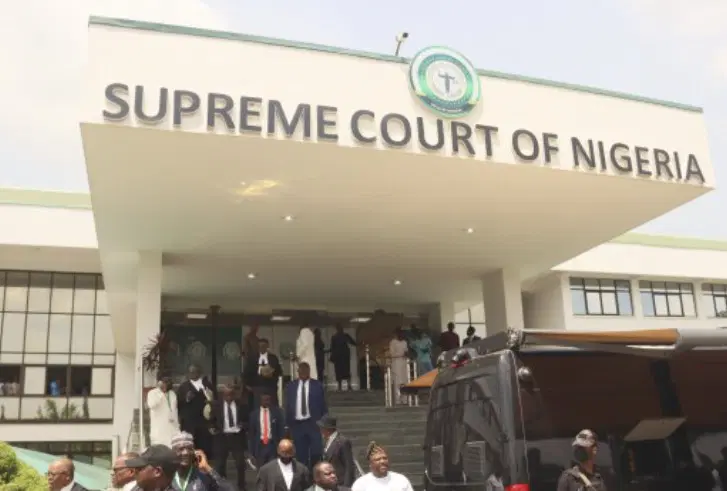
ABUJA: A recent Supreme Court ruling on the Electoral Act 2026 has opened a new legal dimension around the nomination of some political party candidates ahead of Nigeria’s 2027 general elections, particularly those whose party membership and nomination processes could be challenged under the restored provisions of the law.
The ruling, delivered on September 24, 2026, restored Sections 77(5), 77(6), 77(7) and 84(2) of the Electoral Act 2026 after the Supreme Court overturned an earlier Court of Appeal decision that had invalidated the provisions.
However, the judgment did not automatically disqualify any candidate. Instead, it restored statutory requirements that may become relevant in individual cases where evidence shows that a political party failed to comply with the rules governing its membership register or nomination process.
Under the restored provisions, political parties are required to submit their membership registers to the Independent National Electoral Commission (INEC) at least 21 days before a primary, congress or convention.
The law also requires parties to use the register submitted to INEC for those exercises. Section 77(5) limits participation in party primaries, congresses and conventions to members whose names appear on the relevant register, while Section 77(7) provides consequences for parties that fail to submit their registers within the prescribed period.
Section 84(2), meanwhile, provides for the nomination of candidates through direct primaries or consensus.
The restoration of these provisions means that disputes could arise where a candidate’s membership, participation in a primary or the process through which the candidate emerged is alleged to have fallen outside the statutory requirements.
Among the PDP candidates whose nominations have attracted attention are Senator Saliu Mustapha of Kwara Central, Kolo Jiya of Kwara North, Dr Iyabo Obasanjo of Ogun Central and Senator Olubiyi Fadeyi of Osun.
Importantly, the Supreme Court did not make candidate-specific findings against these individuals.
Questions surrounding their nominations are instead linked to issues such as the timing of their membership, the party registers submitted to INEC, any waivers granted and the procedures through which they emerged as candidates.
The Kwara PDP, for instance, has rejected suggestions that the Supreme Court judgment automatically invalidated the candidacies of Mustapha and Jiya, arguing that the relevant membership and waiver requirements were complied with.
Any legal challenge would ultimately depend on the documentary evidence relating to the party register, its date of submission, applicable waivers and the nomination process.
The situation involving former Minister of Communications and Digital Economy, Professor Isa Ali Pantami, is different because his case was already before the courts before the Supreme Court delivered its September 24 judgment.
A Federal High Court had nullified the PDP governorship primary that produced Pantami and ordered the party to conduct a fresh primary in accordance with its constitution, guidelines and applicable electoral laws.
The PDP subsequently scheduled a fresh governorship primary for September 29, 2026.
Pantami’s case, therefore, should not be presented simply as a consequence of the Supreme Court’s restoration of the Electoral Act provisions. It involves a separate Federal High Court order.
Iyabo Obasanjo’s Candidacy Also Under Discussion
The candidacy of Dr Iyabo Obasanjo, the PDP senatorial candidate for Ogun Central, has also generated questions following the Supreme Court ruling.
According to the report, Obasanjo left the APC on May 31, 2026, and returned to the PDP on June 15 before being presented as the party’s Ogun Central senatorial candidate.
The central issue being raised is whether her name appeared on the PDP membership register submitted to INEC within the timeframe required by the Electoral Act.
There is, however, no Supreme Court order identified in the report that disqualifies Obasanjo.
Her media aide, Dr Odun Agbalajobi, rejected suggestions that the Supreme Court judgment had invalidated her candidacy, stressing that she was not a party to the case decided by the apex court.
Fadeyi Rejects Disqualification Claims
In Osun State, Senator Olubiyi Fadeyi has also rejected reports suggesting that the Supreme Court judgment ended his bid to return to the Senate.
Fadeyi maintained that no court had issued an order disqualifying him and defended the process through which he obtained the PDP ticket.
The Supreme Court ruling itself did not make a specific finding on Fadeyi’s membership status or nomination.
Other Parties Could Face Similar Legal Questions
The implications of the judgment are not limited to the PDP.
Candidates associated with parties including the Social Democratic Party (SDP), Allied Peoples Movement (APM), People’s Redemption Party (PRP) and the APC have also been mentioned in connection with possible nomination disputes.
Recent reporting has also highlighted separate questions around candidates from other parties, demonstrating that the restored provisions could become relevant across the political landscape as parties prepare for the 2027 elections.
The key documents in any candidate-specific dispute are likely to include the membership register submitted to INEC, the date it was submitted, records of membership or defection, applicable waivers and documents relating to the primary or consensus process.
The Supreme Court ruling restores the statutory framework, but whether a particular candidate is affected would depend on the facts and evidence of that candidate’s individual case.
Thus, the September 24 judgment should not be interpreted as a blanket disqualification of PDP or opposition candidates. Instead, it reinforces the legal requirements political parties must satisfy when compiling membership registers and nominating candidates for the 2027 elections.


