


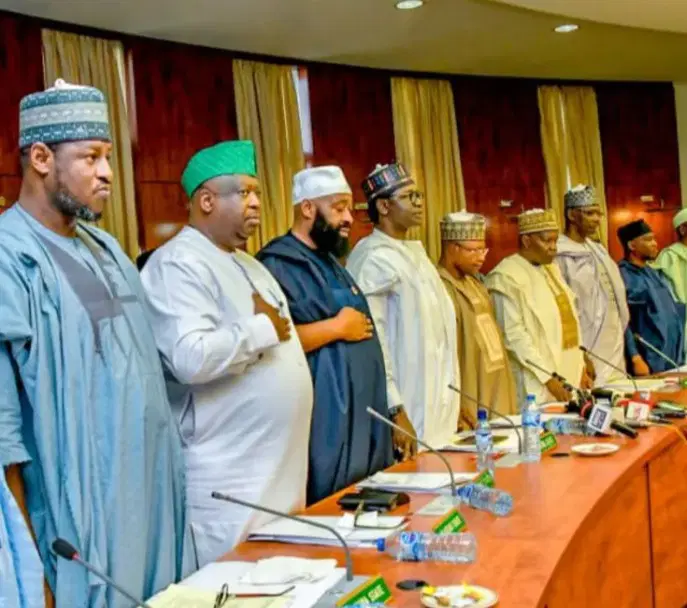
Nigeria’s 36 state governors have renewed calls for the immediate establishment of state police, arguing that the move is critical to tackling the country’s worsening insecurity and strengthening Nigeria’s federal structure.
The governors, under the umbrella of the Nigeria Governors’ Forum (NGF), said any state policing system must be constitutionally backed and designed to protect citizens’ rights while aligning with the principles of federalism.
The governors also reaffirmed their commitment to ongoing power sector reforms aimed at expanding access to affordable and reliable electricity across the country.
The position was contained in a communiqué issued after the NGF’s second meeting held in Abuja between Wednesday and Thursday.
The communiqué, signed by NGF Chairman and Kwara State Governor AbdulRahman AbdulRazaq, disclosed that the governors received presentations from the forum’s secretariat and state attorneys-general on efforts to facilitate the creation of state police.
According to the governors, state attorneys-general will continue consultations on the proposed constitutional amendments and operational framework needed for the new policing structure.
Governors emphasized the need for state police to be constitutionally sound and aligned with federalism and citizens’ rights,the communiqué stated.
The forum added that wider consultations with stakeholders would strengthen the states’ collective position on the issue.
The renewed support comes days after the House of Representatives overwhelmingly approved a constitutional amendment bill seeking to establish state police.
On June 11, 289 out of 290 lawmakers present voted in favour of the bill, while only one member opposed it. The legislation also scaled second reading in the Senate on the same day, marking a major milestone in efforts to address Nigeria’s growing security challenges.
Earlier in April, the governors had endorsed the development of a state police framework by the NGF Secretariat to prepare for the proposed constitutional changes.
The framework outlines governance structures, funding arrangements, recruitment standards, digital infrastructure and oversight mechanisms for state police operations.
Under the proposed amendment, Nigeria will have two separate policing institutions — the Federal Police and State Police.
Each state would be empowered to establish its own police force through legislation passed by its House of Assembly, subject to compliance with national minimum standards set by the National Assembly.
Until a state police outfit becomes fully operational, the Federal Police will continue to handle all policing functions in that state.
The proposal also bars the Federal Police from interfering in state security matters except in special circumstances, including a breakdown of law and order, requests from governors, or when a state police force becomes unable to function effectively.
Beyond security, the governors reiterated their support for ongoing reforms in the electricity sector.
They received a presentation on the National Solar Super-Grid Initiative, a proposal aimed at expanding electricity access through large-scale decentralised solar generation connected to a national high-voltage transmission network.
According to the NGF, the initiative has the potential to boost industrialisation, strengthen energy security, expand state electricity markets and stimulate economic growth.
Governors reiterated their commitment to ongoing power sector reforms and to strengthening collaboration among stakeholders to expand access to reliable and affordable electricity for Nigerians,” the communiqué added.
The governors also pledged support for the National Nutrition 774 Initiative aimed at reducing child malnutrition across the country.
They welcomed ongoing work on the National Nutrition Bill and stressed the need for stronger legal and policy frameworks to improve nutrition governance.
In addition, the forum received briefings from the World Bank on the proposed Country Partnership Framework for Nigeria from 2026 to 2032 and the Sustainable Agricultural Value-Chains for Growth (AGROW) Programme.
The governors endorsed continued collaboration with the Federal Government, the World Bank and other stakeholders to improve agricultural productivity, enhance food security and implement state-specific interventions across sectors including health, education, sanitation and social protection.
The renewed push for state police comes amid mounting concerns over insecurity across the country and growing calls for decentralised policing as a more effective response to local security threats.