


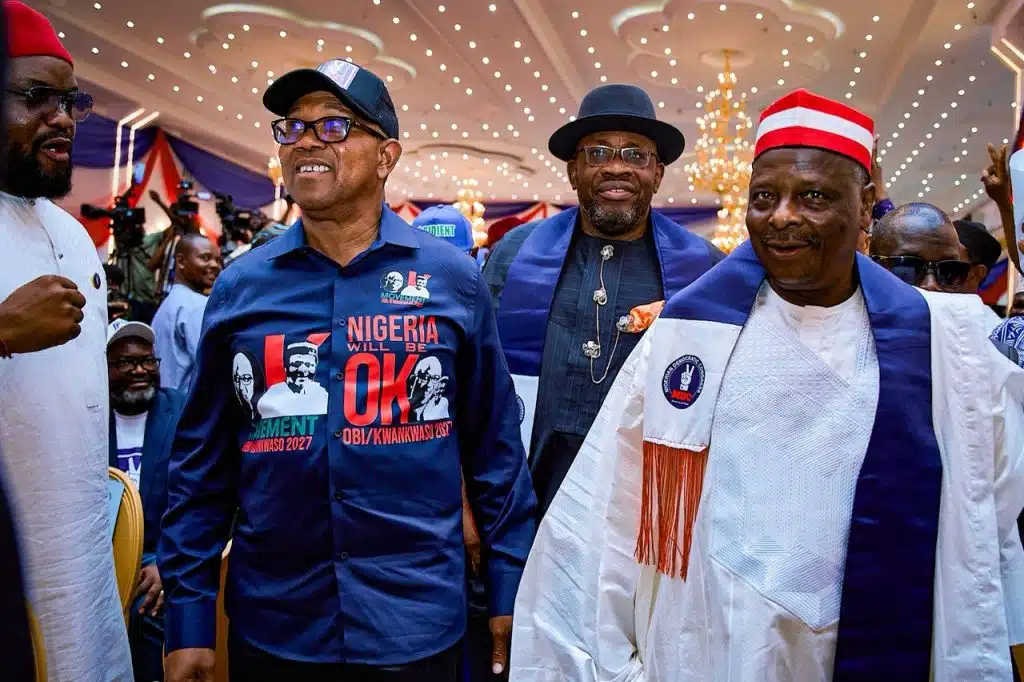
The National Secretary of the Nigeria Democratic Congress (NDC), Ikenna Enekweizu, has explained why the party exempted its presidential candidate, Peter Obi, and his running mate, Rabiu Musa Kwankwaso, from signing its newly introduced anti-defection oath.
Speaking on Channels Television’s Politics Today on Wednesday, Enekweizu defended the controversial loyalty affidavit, insisting that it is constitutional and aimed at preventing elected officials from abandoning the party after winning elections.
According to him, political parties have the right to establish internal regulations that are binding on their members.
First and foremost, a political party is like any other association, and every member who subscribes to the membership of the party is bound by the provisions of the constitution of the party and decisions taken by the party’s properly constituted authorities,” he said.
Within the NDC, the decision to make people sign that affidavit is provided for in our constitution.
Enekweizu argued that existing legal precedents support the principle that members of any association are obliged to abide by its constitution.
Any lawyer would know it is trite law that members of any association are bound by the provisions of that constitution. There are several decided cases on this,” he stated.
You can only test that in the law courts. At this stage, we have not gotten to that point. What we are trying to do is to learn from the mistakes of other parties.”
The NDC recently unveiled the loyalty affidavit policy, saying it was designed to safeguard the party’s integrity and ensure that elected officials remain committed to the platform that brought them to office.
National Chairman Moses Cleopas had earlier said the measure became necessary due to the growing trend of politicians defecting from the parties that sponsored their elections.
Reiterating the chairman’s position, Enekweizu said the party would not allow itself to become a temporary platform used by politicians to secure power before moving elsewhere.
We are trying to prevent a situation where people see our political party only as a special purpose vehicle for winning elections, he said.
“We are trying to build a party that will last and stand the test of time—where people do not just say, ‘Because a particular person is contesting under this platform, let us go there, and the moment we win elections, we all leave.’
“We won’t permit that in our party.
He cited the experience of the Labour Party after the 2023 general elections, noting that several lawmakers elected under the platform later defected to other political parties.
According to him, the NDC wants to avoid a repeat of such developments by introducing safeguards ahead of future elections.
Despite the constitutional provision requiring all candidates to sign the oath, Enekweizu disclosed that the party had taken an administrative decision to exempt Peter Obi and Rabiu Musa Kwankwaso.
The constitution says everybody running under the platform of the party has to sign, but the party has taken the administrative decision that those required to sign in this instance do not include the presidential candidate and his vice, he explained.
He stressed that the party’s major concern lies with lawmakers who defect shortly after being elected.
We are more concerned about those elected to the legislative assemblies who get in there and defect within a year, Enekweizu said.
Our main focus is not the governor; it’s not the president. It’s the national and state assembly members elected on the platform of our party.
The NDC leadership believes the loyalty oath will strengthen party discipline and prevent a repeat of the wave of defections that has weakened many political parties in Nigeria.