


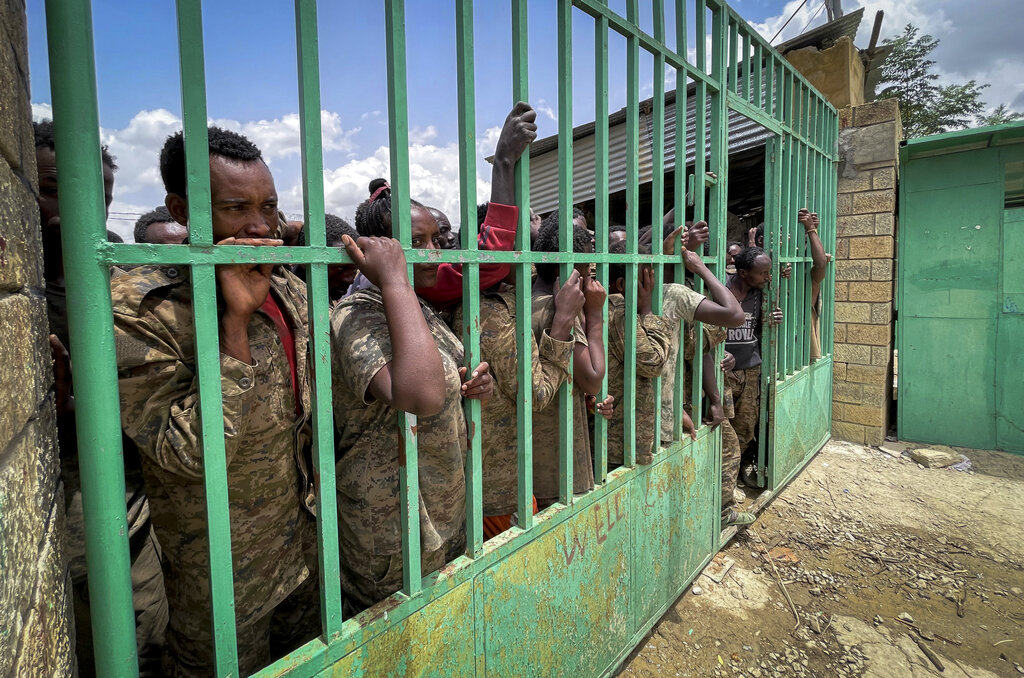
ABUJA:The Federal Government has explained that the recently signed Transfer of Sentenced Persons Agreement with Ethiopia is part of President Bola Tinubu’s Renewed Hope Agenda aimed at protecting Nigerians abroad and ensuring incarcerated citizens serve their jail terms under more humane conditions.
Minister of Foreign Affairs, Ambassador Bianca Odumegwu-Ojukwu, disclosed this in a statement issued on Friday by her Special Assistant on Communication and New Media, Dr. Magnus Eze.
According to the minister, the agreement represents a major diplomatic breakthrough under the administration’s citizen diplomacy framework and underscores the government’s commitment to prioritising the welfare of Nigerians in the diaspora.
Odumegwu-Ojukwu dismissed reports circulating on social media claiming that 136 Nigerians are currently imprisoned in Ethiopia, describing the list as false and misleading.
She clarified that only 98 Nigerians detained in Ethiopia’s Kaliti and Aba Samuel maximum-security prisons are covered by the transfer agreement.
“The list trending online is a made-up list. We don’t have 136 inmates in Aba Samuel and Kaliti prisons. Those that are subject to this agreement are 98 inmates,” she said.
The minister stressed that many of the crimes attributed to the inmates in the viral reports were fabricated and insisted that the government was determined to ensure that affected Nigerians complete their sentences with dignity.
According to the minister, efforts to bring the inmates back to Nigeria had been ongoing for several years, but obtaining accurate records of Nigerians imprisoned in Ethiopia proved challenging.
She revealed that four Nigerian inmates died while both countries were negotiating and finalising the transfer agreement.
Odumegwu-Ojukwu said the affected prisoners had repeatedly appealed to Nigerian authorities to facilitate their return due to harsh living conditions and numerous challenges.
The minister listed several difficulties faced by Nigerian inmates in Ethiopian prisons, including poor feeding, inadequate healthcare, denial of visitation rights, lack of legal assistance and language barriers.
“Some of these young people that I saw when I went into that prison could have been anybody’s brother. Should they be faced with such a precarious situation for one mistake?” she asked.
Under the agreement, convicted Nigerians will be allowed to return home and complete their prison terms in Nigeria.
Odumegwu-Ojukwu dismissed fears that inmates transferred to Nigeria would automatically regain their freedom.
She explained that one of the conditions contained in the Memorandum of Understanding signed by both countries prohibits Nigeria from granting pardon or amnesty to transferred prisoners without the approval of Ethiopia, the sentencing state.
She also rejected claims that the inmates are predominantly from one part of the country.
A lot of them are from the Southeast. There are also those from the Southwest and South-South. Crime has no ethnicity. All these people are Nigerian citizens in a foreign jail,” she stated.
The minister said the Transfer of Sentenced Persons Agreement aligns with President Bola Tinubu’s Renewed Hope Agenda, which places strong emphasis on protecting Nigerians wherever they may be and ensuring their rights and dignity are preserved.