


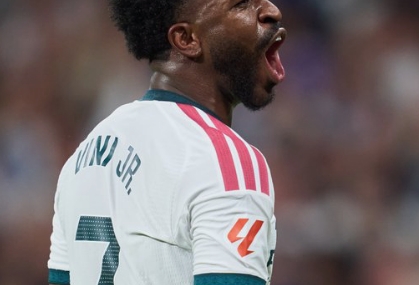
Real Madrid forward Vinícius Júnior is facing increased scrutiny following his controversial red card, with questions mounting over his potential availability for El Clásico against Barcelona. The incident has sparked debate about player discipline, respect for match officials and the Brazilian star’s conduct on the pitch, drawing reactions from football personalities, including José Mourinho and commentator Macknon Twinamatsiko.
The controversy intensified after the referee’s report reportedly described Vinícius’ behaviour following his dismissal as aggressive, alleging that the forward continued protesting the decision and moved towards the official before teammates intervened.
According to the report, Vinícius continued shouting loudly after receiving the red card and approached the referee with what the official described as an aggressive attitude. Teammates reportedly had to restrain the Brazilian, while the referee stated that he could not understand any specific words spoken by the player.
The account has raised concerns about whether Vinícius could face additional disciplinary action beyond the automatic consequences of his dismissal. Any further suspension would depend on the relevant competition regulations and the disciplinary authorities’ assessment of the referee’s report.
For Real Madrid, the possibility of losing one of their leading attacking players ahead of the highly anticipated encounter with Barcelona could become a significant concern.
Football commentator Macknon Twinamatsiko has defended the referee, arguing that match officials must be respected regardless of a player’s reputation, influence or standing in the game.
In a post on X, Twinamatsiko maintained that the referee had done his job properly and that receiving a red card did not give a player the right to confront an official aggressively.
“The referee did his job 100%. You can’t get a red card and then charge at the official shouting loudly with an aggressive attitude and expect to be protected! Rules are rules!” Twinamatsiko wrote.
He also emphasised that respect for referees should remain a fundamental principle of professional football, regardless of the identity of the player involved.
Respect for referees must be non-negotiable, no matter the name on the shirt! he added.
Twinamatsiko’s reaction has brought another perspective to the debate, focusing on the responsibility of players to accept disciplinary decisions and maintain control even when they disagree with a referee.
His position is that football’s rules should apply equally to established superstars and less prominent players, without exceptions based on reputation or popularity.
The controversy surrounding Vinícius goes beyond the red card itself. The referee’s account of the player’s reaction after the dismissal has become an important part of the discussion about whether further punishment could follow.
In professional football, players are permitted to express disagreement with decisions within the boundaries of the game’s disciplinary rules. However, confrontational conduct towards match officials can attract additional sanctions, depending on the circumstances and the applicable regulations.
Twinamatsiko’s comments reflect the view that players must recognise the authority of referees, even when decisions go against them.
The incident also raises questions about the responsibilities accompanying fame in modern football. High-profile players often attract greater public attention, making their reactions during contentious moments subjects of intense debate.
However, the final disciplinary outcome should be determined by the relevant authorities rather than public opinion alone.
While Twinamatsiko focused on respect for the referee, José Mourinho’s reported remarks addressed another aspect of Vinícius’ behaviour: how the Brazilian celebrates spectacular goals.
Mourinho questioned why the forward did not simply celebrate an exceptional goal with joy before returning to the game, suggesting that the celebrations sometimes create unnecessary controversy.
I told him that when you score a goal like that, you just celebrate and walk back,” Mourinho was quoted as saying.
The Portuguese manager reportedly argued that Vinícius should celebrate with the joy associated with some of football’s greatest players, naming Alfredo Di Stéfano, Pelé and Eusébio as examples.
He added that he struggled to understand why the Brazilian’s celebrations repeatedly became a subject of discussion rather than remaining focused on the achievement itself.
Mourinho’s reported comments have renewed debate about the relationship between individual expression, competitive emotion and sportsmanship in modern football.
Goal celebrations are an important part of the game, allowing players to express excitement and connect with supporters. Nevertheless, gestures directed at opponents or actions that intensify tensions can sometimes turn a moment of sporting success into a controversy.
The remarks attributed to Mourinho suggest that a player can celebrate a remarkable achievement enthusiastically while still exercising restraint.
One of the biggest questions facing Real Madrid supporters is whether Vinícius will be available for their next El Clásico against Barcelona.
The possibility of a suspension extending to the fixture depends on the disciplinary decision following his dismissal. While the referee’s report could influence the assessment of the incident, Vinícius’ absence from the match should not be treated as confirmed until the relevant ruling is announced.
A suspension covering the Barcelona encounter would deprive Real Madrid of an important attacking option. Vinícius is known for his pace, dribbling ability and capacity to create opportunities in one-on-one situations, qualities that can be particularly influential in high-pressure matches.
His availability could therefore become a major talking point as the disciplinary process unfolds.
For Barcelona, the prospect of facing Madrid without the Brazilian would alter the opposition’s attacking options, although the eventual team selections and match circumstances would determine the wider implications.
Until an official decision is confirmed, speculation about the length of the suspension remains just that: speculation.
The reactions from Twinamatsiko and Mourinho highlight two related but distinct issues in the Vinícius controversy.
Twinamatsiko has emphasised the authority of referees and the need for players to respect disciplinary decisions. Mourinho’s reported comments, meanwhile, have focused on the way Vinícius celebrates goals and whether his approach sometimes invites unnecessary attention.
Together, the reactions have fuelled a broader conversation about how elite footballers should balance passion, self-expression and discipline.
Football is an emotional sport, and disagreements between players and officials are not unusual. However, the rules governing conduct exist to ensure that disputes do not undermine the authority of match officials or the orderly running of games.
At the same time, criticism of a player’s behaviour should be distinguished from the assessment of his footballing ability. Vinícius remains a prominent attacking talent, but his performances and disciplinary incidents can be examined separately.
The decisive issue in the present case will be the official disciplinary outcome and whether any additional suspension is imposed.
Real Madrid and their supporters will be watching for an official decision on the incident, particularly because of the potential consequences for the team’s upcoming fixtures.
If the disciplinary authorities impose an additional ban, the number of matches covered by the sanction will determine whether Vinícius can play against Barcelona. If no further suspension is imposed beyond the applicable standard punishment, his availability will be assessed accordingly.
Meanwhile, Twinamatsiko’s comments have reinforced the argument that respect for match officials must remain non-negotiable, while Mourinho’s reported remarks have reopened discussion about the Brazilian’s goal celebrations.
The controversy has therefore developed into more than a debate about one red card. It has become a discussion about discipline, accountability and the expectations placed on football’s biggest stars.
For now, the attention remains on the disciplinary decision and whether Vinícius Júnior will be available when Real Madrid face their fierce rivals.


