


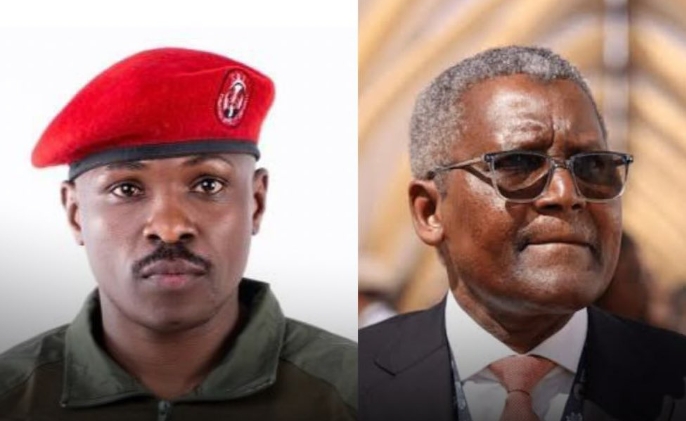
NAIRA: A Kenyan presidential candidate, Patrick Osoi, has issued a bold warning to Nigerian billionaire Aliko Dangote over refinery development in Kenya, declaring that the country should rely on its own entrepreneurs to build the industrial capacity needed to meet domestic demand.
Osoi reportedly made the remarks during a campaign speech in which he addressed Dangote directly, suggesting that the Nigerian industrialist might have little reason to pursue refinery operations in Kenya if local businesses could provide the required facilities.
The candidate also expressed confidence that he would become Kenya’s president and be sworn into office in February 2027, although that timeline represents his stated political expectation rather than a confirmed election outcome.
I want to tell Dangote, please don’t hurry up to start the refinery because by next year February, the time I’m sworn in as the president of this country, you’ll be back going to Nigeria, Osoi said, according to the account of his remarks.
His comments have drawn attention to the debate over local industrial development, foreign investment and the role African entrepreneurs should play in building energy infrastructure across the continent.
Osoi argued that Kenya has the business expertise and industrial potential needed to develop its own refining capacity instead of depending on outside investors to deliver major energy projects.
We have refinery which can do that job. We also have business people in this country who can do that job,” he stated.
The candidate said empowering Kenyan entrepreneurs and strengthening domestic industrial capacity would be central to his proposed administration’s agenda.
His remarks reflect an economic argument often heard across African countries: that governments should create conditions for local businesses to develop strategic industries, generate employment and retain more economic value within their national economies.
However, establishing a commercially viable refinery requires substantial investment, reliable crude oil supplies, suitable infrastructure, technical expertise and access to markets. Whether existing Kenyan facilities could meet the country’s requirements would depend on their operational status, capacity and the scale of domestic demand.
Aliko Dangote is one of Africa’s most prominent industrialists, with investments spanning cement, fertiliser, manufacturing and energy.
His refinery project in Nigeria has become a major part of the country’s efforts to expand domestic petroleum-product production and reduce reliance on imported refined fuels.
The Dangote Petroleum Refinery, located in the Lekki area of Lagos State, was developed to process crude oil into petrol, diesel, aviation fuel and other petroleum products. Its large-scale operations have also placed the facility at the centre of discussions about fuel supply, pricing and energy security in Nigeria and the wider African market.
Dangote’s investments have attracted interest beyond Nigeria because of the potential for large African industrial projects to serve regional markets and reduce dependence on imports from outside the continent.
Osoi’s remarks therefore raise a broader question about how countries can balance opportunities for foreign investment with efforts to develop domestic industrial champions.
Note: The supplied account does not establish that Dangote has formally announced plans to build a new refinery in Kenya. Osoi’s comments should not be interpreted as confirmation that such a project is underway.
For Kenya, expanding domestic refining and energy infrastructure would involve decisions about investment costs, crude oil availability, fuel demand and the commercial viability of processing facilities.
Although the country has previously operated petroleum-refining infrastructure, the status and capability of existing facilities must be distinguished from the capacity required to supply the modern fuel market.
A refinery’s existence alone does not establish that it can meet national demand. Its condition, processing capacity, access to crude oil and ability to produce fuels that meet current specifications are all important considerations.
Osoi’s assertion that Kenya has the capacity to handle the task would therefore require further details about the facilities he referenced and the investment plans his proposed administration would pursue.
Developing local capacity could create jobs, support related industries and strengthen energy security if backed by viable projects. However, such ambitions would also require financing, technical partnerships and a clear long-term commercial strategy.
Osoi’s comments have brought the question of local ownership into focus, particularly as African countries seek to expand manufacturing and reduce their dependence on imported products.
Supporters of local industrial development argue that domestic companies can help retain profits within the economy, create skilled jobs and build technical expertise. Others recognise that large-scale energy projects often require international capital, specialised technology and partnerships that extend beyond national borders.
The two approaches are not necessarily incompatible. Governments can encourage domestic ownership while attracting foreign investors whose capital and expertise help develop strategic industries.
For Kenya, the key question would be whether local entrepreneurs can mobilise the resources and technical capabilities needed to build and operate a refinery competitively.
For Dangote, the wider African market offers opportunities to expand industrial investment, although any new project would depend on commercial considerations, government policy and the availability of reliable supplies.
Osoi’s remarks place refinery development within a wider political debate about economic independence, domestic enterprise and the future of African industrialisation.
However, his stated expectation of taking office in February 2027 does not establish that he will become Kenya’s president. His comments should be understood as part of his campaign message unless supported by verified electoral developments.
The claims about Kenya’s existing refinery capacity and the possibility of local entrepreneurs meeting national demand also require further verification.
For now, the central issue raised by the candidate is whether Kenya should prioritise local businesses in developing strategic energy infrastructure rather than rely on major investors from neighbouring countries.
As African economies pursue industrial growth, the debate over local capacity, foreign investment and energy security is likely to remain significant.


