


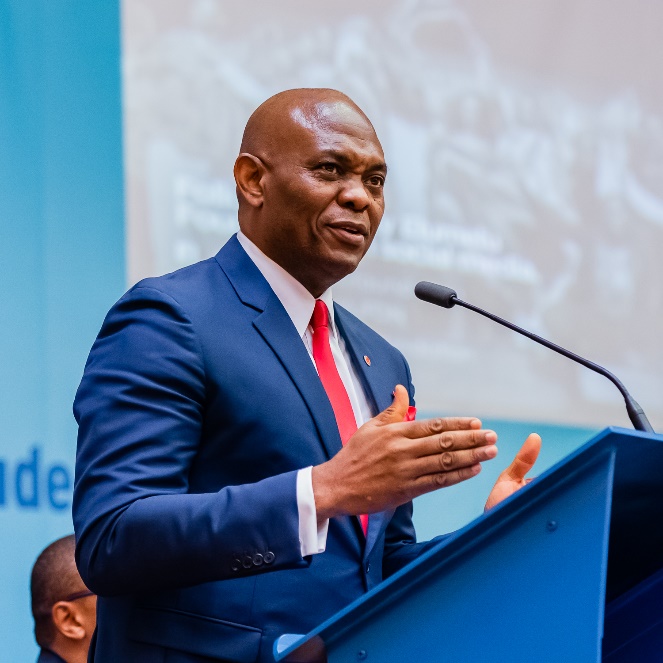
ITALY: Nigerian businessman and billionaire, Tony Elumelu, has declared that Africa will no longer accept an economic relationship with Europe in which the continent supplies raw materials while the processing, manufacturing and major economic benefits are concentrated abroad.
Elumelu made the position known during his keynote address at the Castelfalfi Dialogues 2026, a Europe-Africa strategic forum held in Tuscany, Italy, on Monday, November 16.
The Chairman of Heirs Holdings argued that Europe’s efforts to diversify its energy and critical mineral supplies must translate into meaningful investments in African industries rather than reinforce the continent’s dependence on exporting unprocessed natural resources.
He maintained that Africa’s vast resource wealth, combined with Europe’s financial resources and technological capabilities, could create a more balanced economic partnership capable of delivering jobs, industrial growth and shared prosperity.
Criticising the longstanding extractive relationship between both continents, Elumelu said Africa should not become Europe’s alternative source of raw materials without gaining substantial industrial and economic value from its resources.
“We will not be Europe’s raw-material diversification strategy,” he declared.
He noted that although Europe was seeking alternative energy and mineral supplies following disruptions to its traditional sources, the new relationship must go beyond securing access to African resources.
“The Europe-Africa relationship cannot continue to be one of extractive dependency, with Africa as the reliable supplier of raw materials and little or no value created on the African continent,” he said.
Elumelu identified the Democratic Republic of Congo as an example of Africa’s longstanding challenge in capturing value from its natural resources.
He noted that the country produces approximately 70 per cent of the world’s cobalt, a critical mineral used in battery production, but captures limited economic benefits because much of the refining and processing takes place outside Africa.
He urged European investors seeking reliable supplies of battery materials to establish processing facilities on the continent and ensure that African countries have meaningful equity participation in such investments.
According to him, Africa must move beyond being a source of minerals to becoming an active participant in the global industrial value chain.
The Nigerian businessman also identified natural gas as an immediate opportunity for a stronger Europe-Africa economic partnership.
He pointed to Nigeria’s approximately 200 trillion cubic feet of proven natural gas reserves, arguing that the resource could support far more than the country’s traditional liquefied natural gas exports.
Rather than concentrating exclusively on purchasing Nigerian gas, he called on European companies to invest in fertiliser production, petrochemicals and gas-powered industrial parks.
He cited Heirs Energies, which supplies gas to Nigerian power plants and factories, as an example of how domestic energy resources can support local industrial development.
Elumelu also highlighted unreliable electricity supply as one of the major obstacles preventing Africa from attracting large-scale industrial investments.
He disclosed that Transcorp has approximately 2,000 megawatts of installed electricity generation capacity, contrasting this with the estimated 650 million Africans who still lack access to electricity.
“No one builds a smelter or a data centre where the grid fails,” he said.
He stressed that dependable electricity remains essential for industrialisation, noting that manufacturing facilities, technology infrastructure and mineral processing plants require stable and affordable power to operate efficiently.
Elumelu also pointed to the Dangote Refinery in Lagos as evidence that African countries can establish major industrial facilities and move beyond dependence on imported refined products.
He noted that the refinery has transformed Nigeria’s position in the petroleum market by creating the capacity to process crude oil locally and export refined products to international markets, including Europe.
Data previously reported by Nairametrics showed that Nigeria’s refined petroleum exports to Europe increased by 767 per cent, rising from approximately 15,000 barrels per day in 2023 to 130,000 barrels per day in the second quarter of 2026.
Another report put the value of Nigeria’s refined petroleum exports at $3.94 billion in the second quarter of 2026, representing a 148 per cent year-on-year increase.
The development illustrates the economic opportunities available when African countries invest in processing their own natural resources rather than exporting them in raw form.
Elumelu’s position also reflects the broader industrial development strategy associated with his business interests in energy and power.
In November 2025, the NNPC-Heirs Energies joint venture recorded increased gas production from OML 17, reaching a peak of 135 million standard cubic feet per day.
Heirs Energies subsequently secured a $750 million financing agreement with Afreximbank in December 2025 to support the development and expansion of its oil and gas operations.
Increased domestic gas supply from OML 17 also supported improved electricity generation by TransAfam Power, with output rising from approximately 50 megawatts to more than 180 megawatts.
Through his address in Italy, Elumelu challenged European governments and investors to rethink their engagement with Africa, arguing that the continent’s natural resources should become a foundation for industrialisation, employment creation and long-term economic prosperity.
His central message was that Africa must have a greater stake in the value generated from its resources, while international partnerships should support local production, technology transfer and infrastructure development rather than preserve an unequal economic arrangement.


