


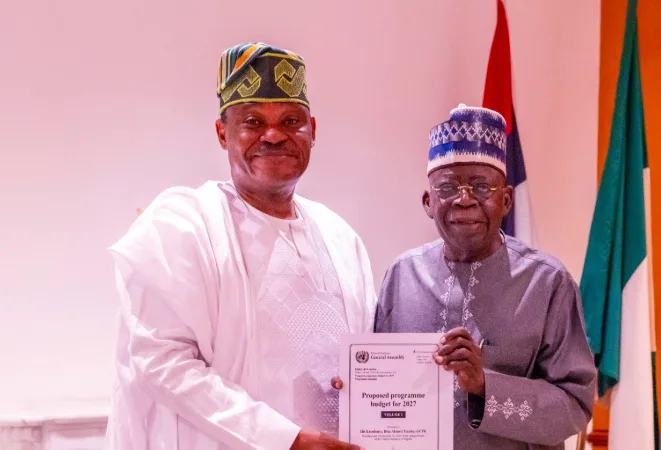
ABUJA: President Bola Ahmed Tinubu has received the proposed 2027 United Nations (UN) budget from Nigeria’s Permanent Representative to the organisation, Ambassador Jimoh Ibrahim, in a development described as a historic milestone for the country.
Ibrahim presented the seven-volume budget document to Tinubu at the State House in Abuja after receiving it through the UN General Assembly’s budgetary process.
Speaking to journalists after the presentation, Ibrahim said the occasion marked the first time in 66 years that a Nigerian president had received the proposed UN budget through the process.
He explained that the document was submitted to Nigeria because the country is a member of the United Nations and plays a role in deliberations on the organisation’s financial and administrative affairs.
“This is the first time in 66 years that Nigeria will share budget in the committee. The first time,” Ibrahim said, describing the presentation as a significant moment in Nigeria’s engagement with the international organisation.
According to Ibrahim, the proposed budget covers the United Nations’ regular activities and peacekeeping operations.
He cited approximately $3.4 billion for the organisation’s regular budget and $8.5 billion for peacekeeping operations, while putting the overall proposed budget at about $14 billion.
However, the two component figures add up to $11.9 billion, leaving a discrepancy of $2.1 billion against the stated total. The figures will require clarification to establish how the overall estimate was calculated and whether other budget components account for the difference.
Ibrahim emphasised that the document remains a proposal and has not received final approval from UN member states.
He said the figures could change during subsequent discussions before the organisation adopts its final budget and authorises spending.
What Nigeria’s Role Means
As a member of the United Nations, Nigeria participates in the organisation’s deliberations on administrative and financial matters.
Ibrahim chairs the UN General Assembly’s Fifth Committee, which handles administrative and budgetary questions. His role places him within the process through which member states examine and negotiate the organisation’s proposed expenditure.
The presentation to Tinubu provided an opportunity to brief the Nigerian government on the proposed financial framework before further discussions and adjustments take place at the international level.
However, receiving the budget document does not mean Nigeria has been awarded the money or that the country will automatically receive a specific financial benefit from the proposed expenditure.
When asked what Nigeria could gain from the budget, Ibrahim said discussions were ongoing and declined to identify any specific benefit
Ibrahim also referred to the construction of a United Nations conference centre in Kenya, reportedly valued at $267 million, as an example of the organisation’s investment in facilities within member states.
The example highlighted how UN-related projects can involve substantial infrastructure expenditure in host countries, although no corresponding project or allocation for Nigeria was announced during the presentation.
The proposed 2027 UN budget will undergo further examination and possible adjustments before member states approve the final figures.
Until that process is completed, the amounts presented remain provisional rather than authorised final spending.
The development underscores Nigeria’s participation in the UN’s budgetary process, while the final outcome will depend on negotiations and decisions by member states.
RapidoSpace News will continue to follow developments concerning Nigeria’s diplomatic engagement and the approval of the United Nations’ 2027 budget.


