


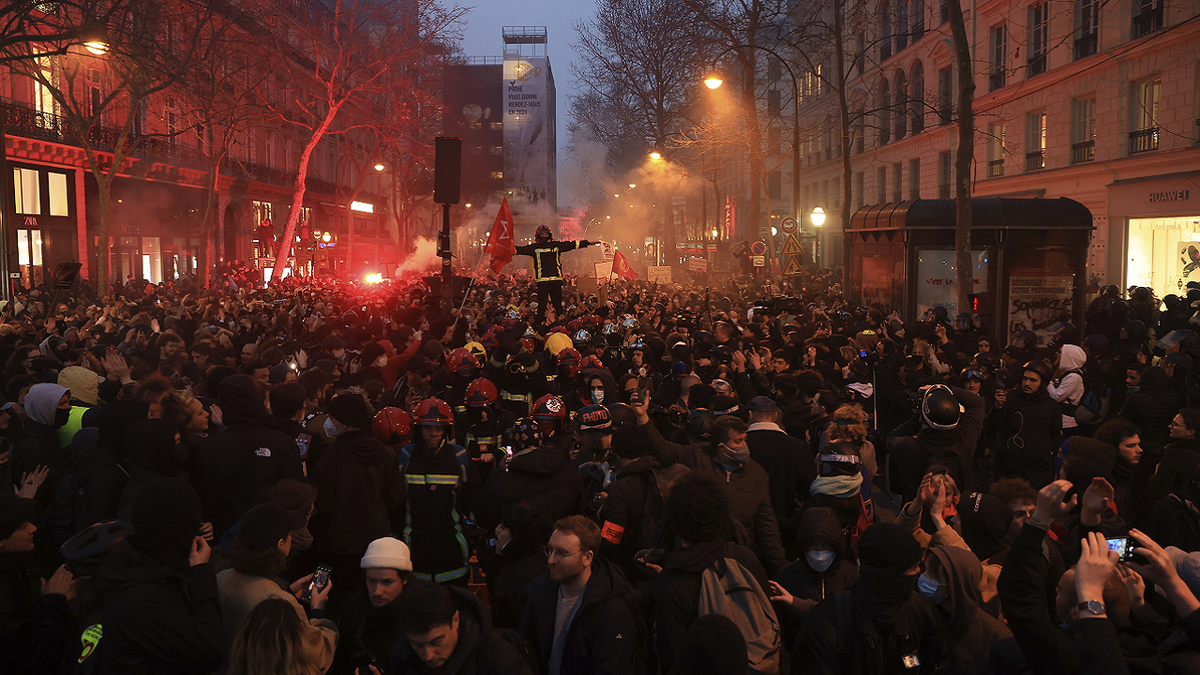
PARIS: French President Emmanuel Macron has called for calm and order after nationwide demonstrations over rising fuel prices, the cost of living and deteriorating public services escalated into riots, looting and arson in several cities.
Macron made the appeal in a national address from the Élysée Palace on Sunday, October 18, 2026, following a major day of protests that left shops damaged, vehicles and buildings on fire, and parts of historic public infrastructure in ruins.
According to reports, approximately 550,000 demonstrators took to the streets on Saturday, with the majority initially participating in peaceful protests against economic hardship and declining public services, including education.
However, the demonstrations later deteriorated into violence in Paris, Marseille, Lille and other French cities, as groups of masked individuals attacked businesses, set fires and clashed with security forces.
Macron acknowledged the anger driving the demonstrations but insisted that peaceful protesters must be distinguished from those responsible for destruction and looting.
We all feel anger and shame,” the French president said, warning those involved in the violence against further escalation.
He maintained that legitimate public grievances did not justify attacks on businesses, public buildings or other property, adding that those responsible would face justice.
France’s Interior Ministry reported that approximately 2,400 people had been arrested in connection with the unrest, while the demonstrations also raised questions about public order and the police response.
Security forces deployed tear gas, stun grenades and water cannon to disperse crowds in several locations. Reports also described officers striking demonstrators with batons during confrontations.
According to figures cited in the report, about 1,000 police officers were injured on Saturday, including seven who sustained serious injuries.
On Sunday, clashes and looting continued on a smaller scale in parts of Paris and Lyon. The Agence France-Presse news agency reported that hundreds of people confronted police in the French capital, with some throwing bottles and rocks at officers.
The scale of the arrests and injuries highlighted the difficulties facing authorities as they attempted to restore order while responding to widespread public dissatisfaction.
Macron said local prefects and mayors would develop measures to protect businesses and public buildings against further attacks.
He also promised full transparency regarding the police response to the demonstrations.
One of the most striking consequences of the unrest was the destruction of the historic town hall in Limoges, where a fire started by rioters on Saturday gutted the 19th-century building.
The blaze caused significant damage, with the building’s roof and clock tower collapsing as the flames spread.
Residents expressed shock and sadness over the destruction of the historic structure, which represented an important part of the city’s architectural heritage.
One resident, identified as Annèyse, described the incident as deeply upsetting, arguing that destroying historic buildings in protest against the government harmed the wider community.
Another resident, who identified himself as Gerrard, said the damage was devastating and that restoring the building to its former condition could take a long time.
The destruction in Limoges added to the damage reported across the country, where businesses were looted, public property was vandalised and emergency services responded to multiple fires.
In Paris, shopkeepers were seen clearing broken glass from their premises early on Sunday as rubbish trucks removed debris from major streets.
The protests began with student demonstrations last month before expanding significantly on Saturday, when trade union members and other anti-government groups joined the movement.
Rising fuel prices, increasing living costs and concerns about deteriorating public services were among the central grievances driving the demonstrations.
The unrest reflects wider frustrations over household expenses and the government’s handling of economic and social issues.
Fuel prices are particularly sensitive in France because transport costs affect household budgets, commuting expenses and the prices of goods and services. For families already facing financial pressure, further increases can intensify dissatisfaction with government policies.
Concerns about schools and other public services have also contributed to the protests, broadening the demonstrations beyond fuel prices alone.
Although the demonstrations were largely peaceful at the outset, the subsequent violence has created a separate challenge for the government: addressing the concerns of protesters while preventing further attacks on businesses, public infrastructure and security personnel.
The unrest has exposed deep political divisions in France as the country prepares for an election in April, which could see candidates from the hard right and hard left competing for power.
Interior Minister Laurent Nuñez defended the right to peaceful protest but accused several thousand far-left individuals of deliberately targeting public buildings and confronting police officers.
He said the violence was later compounded by individuals who looted and vandalised businesses in several cities.
Jean-Luc Mélenchon, leader of the left-wing La France Insoumise party, strongly criticised Nuñez and police chiefs over their handling of the demonstrations.
Mélenchon accused them of incompetence and described their approach as contributing to what he called organised chaos.
Meanwhile, Marine Le Pen, leader of the right-wing National Rally party, condemned what she described as the exploitation of public anger by political forces encouraging violence.
The competing reactions reflect disagreements over the causes of the unrest, the conduct of demonstrators and the government’s responsibility for maintaining public order.
Macron’s appeal for calm comes as authorities face the dual challenge of preventing further violence and responding to the economic concerns that brought hundreds of thousands of people onto the streets.
His government must also address questions surrounding the use of force by police, particularly after reports of injuries among demonstrators and footage of officers striking people during confrontations.
The president’s promise of transparency could become an important part of efforts to establish public confidence in the security response.
At the same time, the destruction of businesses and public buildings has raised concerns about the financial and cultural cost of the unrest for affected communities.
The coming days will be critical in determining whether the demonstrations return to peaceful protest or whether further clashes occur.
For France, the crisis has become more than a dispute over fuel prices and living costs. It has developed into a broader test of public confidence, political leadership and the government’s ability to manage social discontent without allowing violence to spread.


