


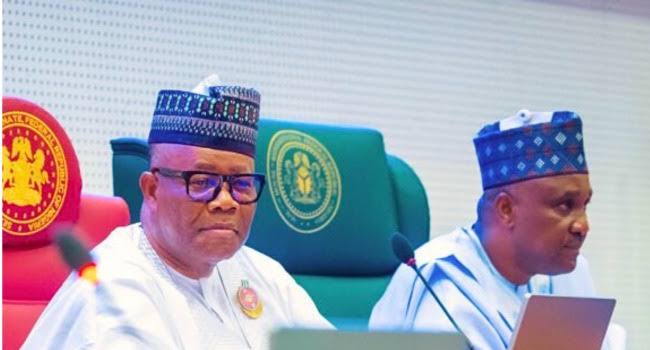
ABUJA: Nigeria moved a step closer to the establishment of state police on Thursday after the National Assembly advanced constitutional amendments aimed at decentralising policing and redefining the responsibilities of federal and state security agencies.
The House of Representatives overwhelmingly approved the proposed legislation, while the Senate passed the bill for a second reading, signalling growing support for what many see as a major solution to the country’s worsening insecurity.
The bill, which seeks to transfer policing from the Exclusive Legislative List to the Concurrent Legislative List, would allow state governments to establish and control their own police formations while maintaining the powers of the Federal Police.
At the House of Representatives, 290 lawmakers attended the plenary session, with 289 voting in favour of the bill and only one member opposing it.
Speaker Tajudeen Abbas announced the result after a manual voting process was adopted due to a malfunctioning electronic voting system.
The proposed legislation, sponsored by Deputy Speaker Benjamin Kalu and 14 other lawmakers, contains 18 clauses and seeks amendments to several sections of the 1999 Constitution, including Sections 214, 215 and 216.
Abbas described the passage of the bill as a major step toward creating a policing system that reflects local realities while preserving the unity of the country.
According to him, security remains the foundation of national development, and the constitutional amendment would make policing more effective and responsive.
Shortly before voting commenced, a mild disagreement erupted when Bashir Zubairu Usman, a lawmaker from Kaduna State, objected that members had only received copies of the amended document on Thursday and had not been given enough time to study it.
However, Speaker Abbas ruled him out of order, a decision that was greeted with approval by most lawmakers.
Despite repeated interruptions and calls for points of order from some members during the reading of the bill, the Speaker proceeded with the voting exercise.
In the Senate, lawmakers also moved the bill forward by passing it for a second reading and referring it to the Senate Ad-hoc Committee on Constitutional Review.
Leading the debate, Senate Leader Opeyemi Bamidele argued that state police had become necessary due to the increasing complexity of security challenges facing Nigeria.
He said decentralised policing would strengthen intelligence gathering because local officers understand the language, culture and social environment of their communities.
According to him, Nigeria currently faces terrorism, banditry, kidnapping, communal conflicts, armed robbery, cybercrime and pipeline vandalism, all of which require a more flexible security structure.
Bamidele stressed that the proposal was not intended to weaken national unity but to strengthen federalism and improve cooperation among different levels of government.
Responding to fears that governors might misuse state police for political purposes, the Senate Leader explained that the bill contains several safeguards.
These include the establishment of State Police Service Commissions, oversight by the Federal Police Service Commission, national policing standards and legislative confirmation of key appointments.
He also noted that state police commissioners would have the right to challenge directives from governors if they violate professional standards, with the National Police Council serving as the final authority.
Under the proposed law, the Federal Police will retain responsibility for national security, interstate crimes, terrorism, organised criminal networks, cybercrime and protection of federal assets.
State police, on the other hand, will handle internal security matters within their respective states.
The Federal Police will only intervene in state affairs when there is a complete breakdown of law and order, when a governor formally requests assistance or when a state police force becomes incapable of functioning.
The bill also provides that state police cannot commence operations until state assemblies enact enabling laws and national standards are certified.
If the amendment eventually becomes law, state governors will appoint commissioners of police based on recommendations from the National Police Council, subject to confirmation by state Houses of Assembly.
Similarly, the Inspector-General of Police will continue to be appointed by the President, with confirmation by the National Assembly.
Removal procedures for both the IGP and state commissioners are also clearly outlined to ensure accountability and prevent arbitrary dismissals.
Meanwhile, figures released by the National Bureau of Statistics showed that Nigeria spent N32.5 billion on arms imports during the first quarter of 2026, representing a 48 percent increase from the N22 billion recorded during the same period in 2025.
Security analyst Chidi Omeje said the rise reflected the growing security threats across the country and called for increased investment not only in weapons but also in personnel training and surveillance technologies.
He also urged the government to strengthen local arms production through the Defence Industries Corporation of Nigeria and private manufacturers.
Retired Assistant Inspector-General of Police Ali Amodu backed the establishment of state police, saying he had advocated decentralised policing since the early 1980s.
Another retired Commissioner of Police, Lawrence Alobi, urged lawmakers to consult experienced security experts to ensure the process does not become politicised.
However, retired Commissioner of Police Ladodo Rabiu opposed the proposal, arguing that many states struggle to pay salaries and may lack the financial capacity to fund police operations, training institutions and logistics.
He also warned of possible conflicts between federal and state police commands.
Ahmed Usman, Special Adviser on Security Matters to the Sokoto State Governor, described state police as one of the most practical solutions to Nigeria’s insecurity.
He suggested that existing police officers should be redeployed to their states of origin, where their knowledge of local languages and terrain would enhance intelligence gathering and improve response times.
With strong support emerging from both chambers of the National Assembly, the push for state police appears to have gained fresh momentum, bringing Nigeria closer than ever to one of its most debated constitutional reforms.


