


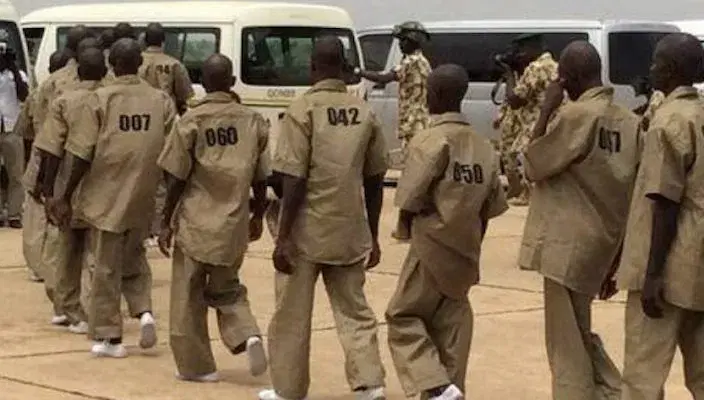
The Nigerian Senate has called on the Federal Government to immediately suspend its policy of rehabilitating and reintegrating former Boko Haram members into society, insisting that terrorists and bandits should instead be prosecuted and made to face the full weight of the law.
The resolution followed a motion of urgent national importance on the worsening security situation across the country, sponsored by the Chairman of the Senate Committee on Army, Senator Abdulaziz Yar’Adua, during plenary on Tuesday.
Lawmakers also expressed deep concern over the rising wave of terrorism, banditry, kidnappings and attacks on both serving and retired military personnel, urging a comprehensive overhaul of Nigeria’s security architecture through modern technology, improved intelligence gathering and stronger oversight.
The upper legislative chamber described the country’s security crisis as persistent, complex and increasingly alarming, noting that violence has spread far beyond the North-East insurgency to virtually every region of Nigeria.
Senators across party lines contributed to the debate, warning that continued attacks on civilians and security personnel threaten national stability and public confidence in government.
The Senate also observed a minute of silence in honour of Major-General Rabe Abubakar (retd.), the former Director of Defence Information, and all Nigerians who have lost their lives to terrorism, insurgency, banditry and kidnapping.
In addition, the Senate resolved to send a delegation to the family of the late general, the Katsina State Government and the Nigerian Army to formally convey its condolences.
Leading the call for a review of the government’s de-radicalisation programme, Senator Joseph Ikpea argued that rehabilitating former Boko Haram fighters has become a major source of public concern.
He urged the Federal Government to discontinue the programme and ensure that convicted terrorists are prosecuted instead of being reintegrated into communities. The issue of insecurity has become something Nigerians are deeply concerned about.
One of the issues we need to look at is the rehabilitation of Boko Haram members. My additional prayer is to stop the rehabilitation of Boko Haram, Ikpea said.
Former Edo State Governor and Senator Adams Oshiomhole strongly supported the proposal, saying it defies logic to pardon and reintegrate individuals responsible for acts of terrorism while victims and families of slain security personnel continue to suffer.
He stressed that government should prioritize justice for victims, accountability for offenders and better welfare for security personnel.
Presenting the motion, Senator Yar’Adua said the killing of retired military officers represents a serious national security concern that requires urgent government intervention.
He warned that retired officers remain attractive targets for terrorists and kidnappers because of their previous operational and intelligence roles.
According to him, attacks on former military commanders weaken troop morale and embolden criminal groups challenging the authority of the Nigerian state.
The senator highlighted several incidents involving retired officers, including:
- Colonel Rabiu Garba Yandoto (retd.), abducted in Zamfara in January 2023.
- Major General Richard Chukwudi Duru, kidnapped and killed in Imo State in September 2023 despite payment of ransom.
- Brigadier-General Uwem Harold Udokwere (retd.), murdered in Abuja in June 2024.
- Brigadier-General Maharazu Tsiga (retd.), abducted in Katsina in February 2025 before regaining freedom after 56 days.
- Retired Major Joe Ajayi, who died in captivity after being kidnapped in Kogi State in May 2025.
- Colonel Joseph Ajanaku (retd.), abducted and later rescued in Plateau State in January 2026.
- Major-General Rabe Abubakar (retd.), abducted alongside his wife in Katsina State in May 2026 before dying in captivity.
Lawmakers said the pattern of attacks has undermined confidence in Nigeria’s security system and raised serious concerns about the safety of those who once defended the country.
Beyond rejecting the rehabilitation programme, the Senate urged security agencies to strengthen intelligence gathering, intelligence sharing, surveillance operations, threat assessment and early warning systems.
Lawmakers also recommended deeper collaboration between security agencies, local communities, traditional rulers and religious leaders to improve community-based intelligence.
The Senate further called on the Federal Government to accelerate investment in modern security technology, including:
- Unmanned aerial vehicles (drones)
- Geospatial intelligence systems
- Integrated command and control centres
- Advanced communication technologies
Senators maintained that embracing technology would significantly improve Nigeria’s ability to combat terrorism, kidnapping and banditry.
Senator Abdul Ningi urged the National Assembly to intensify oversight of security agencies by reviewing casualty figures, operational responses and support provided to families of fallen personnel.
Similarly, Senator Osita Izunaso described the increasing attacks on military officers as unacceptable, stressing that Nigerians expect stronger and more decisive action against terrorists and criminal groups.
Deputy President of the Senate Jibrin Barau, who presided over the session, acknowledged lawmakers’ concerns but noted that terrorism remains a global challenge requiring regional cooperation.
He commended Nigeria’s armed forces and other security agencies for their continued efforts against insurgents and urged Nigerians to support ongoing military operations.
Meanwhile, the Nigerian Army confirmed that two senior terrorist commanders have surrendered to troops of Operation Hadin Kai in Borno State.
The development was disclosed in a statement issued by the Acting Media Information Officer of the Joint Task Force (North-East), Captain Mohammed Goni.
According to the military, the suspects surrendered to troops in Geidam on July 4 before arriving in Maiduguri on July 5, where they are currently undergoing detailed profiling, debriefing and intelligence exploitation.
The Army described the suspects as Munzirs, indicating that they occupied influential leadership positions within the terrorist group and possess valuable knowledge of its operational structure, logistics and command network.
Military authorities said intelligence obtained from the commanders has already provided useful insights expected to strengthen ongoing operations aimed at dismantling remaining terrorist enclaves across the North-East.
The surrender of the two commanders has renewed debate over Nigeria’s approach to handling repentant insurgents.
While the Senate insists that captured terrorists should be prosecuted instead of rehabilitated, the military maintains that senior commanders often provide critical intelligence capable of disrupting terrorist networks before decisions are made regarding their eventual disposition.
The Army stated that debriefing of the two commanders is still ongoing and did not indicate whether they would eventually face prosecution or pass through the government’s rehabilitation programme.
The latest development underscores the growing national debate over balancing intelligence gathering, justice for victims and long-term strategies for ending terrorism in Nigeria as lawmakers continue to push for tougher measures against insurgents.