


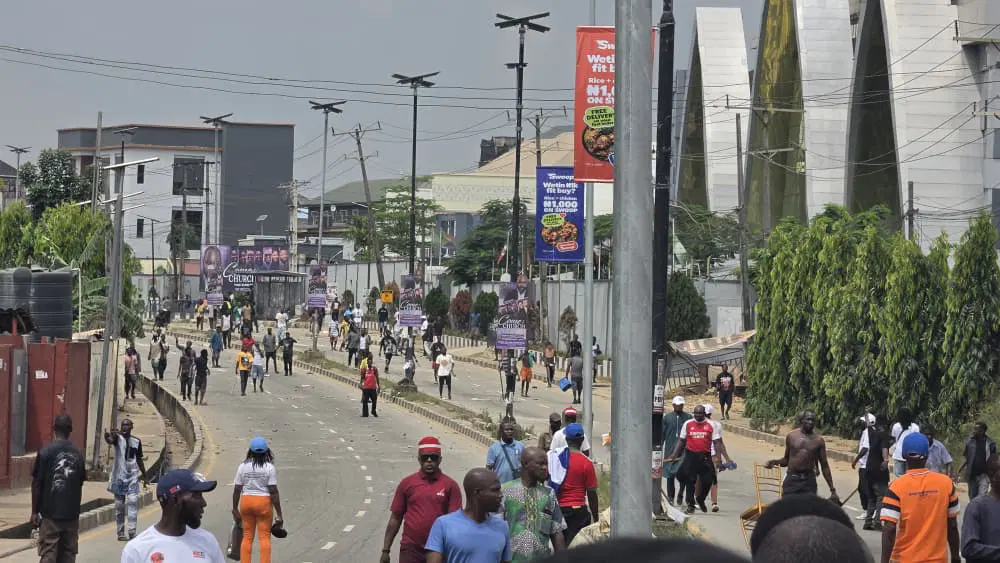
LAGOS: The House of Representatives has resolved to investigate growing reports of political violence, intimidation and disruption of political activities across Nigeria ahead of the 2027 general elections, following an attack on supporters of the Nigeria Democratic Congress (NDC) during a town hall meeting in Lagos.
The resolution came amid mounting concerns over attacks on political gatherings in different parts of the country, with the NDC, the All Progressives Congress Presidential Campaign Council (APC-PCC) and the Lagos State chapter of the APC expressing positions on the incident.
The House adopted a motion of urgent public importance sponsored by Minority Leader, Fred Agbedi, and 16 other lawmakers, condemning violence, intimidation, assault and destruction of property associated with political activities, irrespective of the political parties affected.
Following the adoption of the motion, lawmakers constituted an ad hoc committee headed by the House Leader, Julius Ihonvbere, to investigate the immediate and remote causes of politically motivated violence and submit its findings within three weeks.
The committee comprises the House Leader, Minority Leader, chairmen and deputy chairmen of the House Committees on Police Affairs and National Security and Intelligence, alongside two additional members drawn from the committees.
Presenting the motion, Agbedi warned that the growing incidents of political violence posed a threat to democratic participation and the constitutional rights of Nigerians to freely associate and participate in political activities.
He cited Section 40 of the 1999 Constitution, as amended, which guarantees citizens the right to peaceful assembly and association, including the freedom to form or belong to political parties.
The lawmaker also invoked Section 88(1) of the Constitution, which empowers the National Assembly to investigate matters within its legislative competence and examine the activities of relevant public authorities.
To underscore the seriousness of the situation, Agbedi referenced several reported incidents of political violence in different states.
He recalled the disruption of political meetings in Enugu State on September 12, 2026, during which two attendees were reportedly injured and one person allegedly killed.
He also cited an October 28 attack on APC supporters travelling to a rally in Katsina State, which reportedly resulted in the arrest of 14 suspects.
In Nasarawa State, the Minority Leader referenced an attack on an APC rally in Lafia on November 4, where several people were reportedly injured.
He further mentioned the November 7 political procession violence in Asaba, Delta State, where the police reportedly confirmed that one person was killed and five others sustained injuries.
Agbedi warned that continued attacks on political gatherings could lead to further loss of lives, discourage citizens from participating in elections and undermine confidence in the democratic process.
He, however, stressed that allegations of responsibility must be established through impartial, thorough and evidence-based investigations.
Meanwhile, the NDC has demanded an immediate investigation, arrest and prosecution of those responsible for the reported attack on its supporters during a town hall meeting in Oregun, along Kudirat Abiola Way, Ikeja, Lagos.
In a statement issued on Thursday and signed by the Spokesperson of the NDC National Campaign Council, Dr Chiogo Constance Ikokwu, the party described the incident as an assault on democracy, fundamental human rights and freedom of political association.
The party alleged that suspected political thugs invaded the gathering, insisting that the incident would neither intimidate its members nor discourage Nigerians from participating in the political process.
The NDC maintained that no political party or group had a monopoly on Nigeria, warning against the use of violence and intimidation to silence opposition voices.
“Nigeria is not a conquered territory, and political participation is not a crime,” the party declared.
It further alleged that the attack was part of an attempt to spread fear and discourage Nigerians from participating in the 2027 general elections.
The party also sympathised with those reportedly injured during the incident and called for an end to what it described as the growing culture of political violence in some states.
The Lagos town hall meeting was part of the NDC’s political activities in support of its presidential candidate, Peter Obi, and governorship candidate, Funsho Doherty.
The party urged Nigerians to participate actively in the 2027 elections and vote for the Obi/Kwankwaso ticket, insisting that neither it nor its supporters would be intimidated out of exercising their democratic rights.
In a separate reaction, the APC Presidential Campaign Council condemned the disruption of the NDC town hall meeting in Lagos, alongside other reported attacks on political gatherings in Edo, Cross River and Gombe states.
The council’s spokesperson, Dele Alake, described the incidents as condemnable, regardless of the political affiliations of those affected.
The APC-PCC called on political parties, candidates and their supporters to exercise restraint as political activities gathered momentum ahead of the 2027 elections.
It also urged security agencies to strengthen their response to political violence and ensure that anyone found responsible was arrested and prosecuted in accordance with the law.
The council stressed that political campaigns should focus on issues capable of improving the lives of Nigerians rather than actions that could provoke violence and public disorder.
However, the Lagos State chapter of the APC rejected allegations linking the ruling party to the disruption of the NDC meeting.
The party’s State Publicity Secretary, Seye Oladejo, described the allegation as baseless and challenged the opposition party to provide credible evidence to security agencies.
Oladejo argued that the reported incident in Ikeja coincided with the official flag-off of the APC’s 2027 general election campaign in Epe, where the party’s leadership, elected officials and stakeholders were reportedly mobilised.
He maintained that the Lagos APC neither sponsored, encouraged nor participated in any action capable of undermining the constitutional rights of opposition parties to assemble and canvass for political support.
The party also insisted that its position as the governing party in Lagos did not make it responsible for every breach of public order in the state.
Oladejo urged the NDC to submit any available evidence to the appropriate security agencies, particularly the Lagos State Police Command and the Department of State Services (DSS), for investigation.
He reiterated the APC’s commitment to peaceful and issue-based political campaigns, warning that political ambition should never be used to justify lawlessness.
The latest developments have brought renewed attention to the security of political gatherings as parties intensify preparations for the 2027 general elections.
With the House of Representatives now establishing a committee to investigate reported incidents across the country, attention will be on the findings of the probe and the steps security agencies take to prevent further attacks.
The constitutional right to peaceful political association remains fundamental to Nigeria’s democracy, making the protection of political meetings, rallies and campaign activities essential to ensuring a credible and inclusive electoral process.
The responsibility now rests on security agencies to investigate the reported incidents objectively, identify those responsible and ensure that political disagreements do not degenerate into violence.
-
NDC Supporters Attacked in Lagos: Reps Launch Probe into Political Violence Ahead of 2027
-
2027 Elections: Reps Set Up Three-Week Probe into Political Attacks, NDC Demands Arrests
-
Lagos Political Violence: House of Reps Investigates NDC Meeting Attack as APC Denies Involvement
-
Political Tension Rises as Reps Probe Attack on Peter Obi’s NDC Supporters in Lagos
-
NDC, APC-PCC Condemn Lagos Attack as Reps Move to Investigate Political Violence