


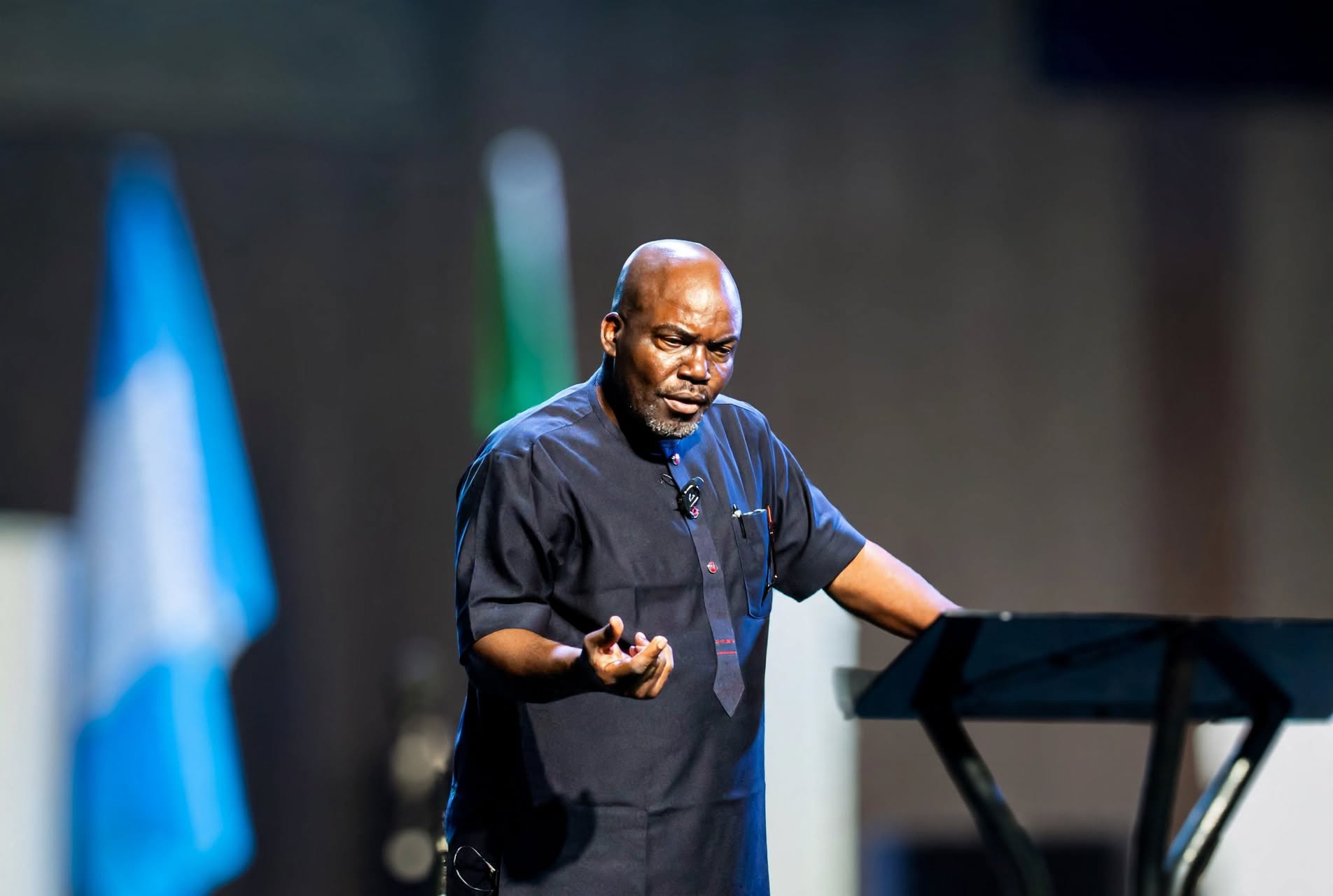
The governorship candidate of the Nigeria Democratic Congress (NDC) in Delta State, Deacon Chris Iyovwaye, has criticised successive administrations in the state over what he described as the failure to translate Delta’s enormous natural resources into economic prosperity, employment opportunities and improved living conditions for residents.
Iyovwaye argued that despite Delta’s vast deposits of oil, gas, solid minerals and agricultural resources, many communities remain underdeveloped, while thousands of young people struggle with unemployment and poverty.
He made the remarks during a town hall meeting with professionals at the Monarchy Event Centre in Effurun, near Warri, where he presented his vision for industrialising the state and creating sustainable economic opportunities.
According to the NDC candidate, approximately 40 industries in Delta State have either collapsed or are struggling to survive, while more than six million residents, particularly young people, face difficult economic conditions.
We want to industrialise Delta. We are not joking. It is something that is possible,” he declared.
The governorship hopeful maintained that Delta’s development challenges were not primarily caused by a lack of financial resources but by what he described as a system of political patronage and appointments based on personal relationships rather than competence.
He argued that public appointments should be determined by professional qualifications, experience and the ability to deliver measurable results.
“The problem of Delta is not money, but patronage. You cannot run a state by who you know. You run it by who can deliver,” he said.
Iyovwaye called for comprehensive reforms in the state civil service, insisting that Delta must adopt professional standards similar to those practised in developed economies such as the United States, European countries and China.
He also criticised the state government’s reliance on cash transfers, arguing that distributing money to residents without building productive economic structures would not deliver sustainable development.
“Development is not how much cash you share. It is how much purchasing power the ordinary man has. It is jobs,” he stated.
He suggested that resources spent on handouts could instead be invested in industries, including palm oil processing factories capable of employing thousands of people and generating foreign exchange.
The NDC candidate also raised concerns over the management of the 13 per cent oil derivation fund, which is intended to benefit oil-producing states and communities.
He questioned why several oil-producing communities in Delta continued to experience poverty, inadequate infrastructure and limited access to basic amenities despite decades of oil exploration and revenue generation.
According to him, some communities have reportedly remained without electricity for as long as 10 years, despite being located in areas with significant gas resources.
“That money must reach the real owners. It must be monitored. It must show on ground,” Iyovwaye said.
He called for greater transparency and accountability in the utilisation of derivation funds, insisting that the benefits must be visible in the communities from which the state’s natural resources are extracted.
Presenting his economic development priorities, Iyovwaye identified oil and gas, solid minerals, agriculture and electricity as four critical sectors capable of transforming Delta into a major industrial and economic hub.
On solid minerals, he identified iron ore, gypsum, silica and clay as resources that remain largely untapped.
He specifically referenced the defunct Delta Glass industry, arguing that the state’s silica deposits could support the revival of glass manufacturing and potentially create opportunities for solar panel production.
In agriculture, he identified cassava, palm produce, groundnuts, fisheries and livestock as sectors with considerable potential for large-scale processing, industrial production and export earnings.
He also maintained that Delta’s abundant gas resources could provide the electricity needed to power industries and stimulate economic activities if supported by adequate infrastructure and effective government policies.
Beyond industrialisation, Iyovwaye advocated full financial and administrative autonomy for local governments, regular audits of public projects and funds, and a stronger approach to tackling insecurity.
He insisted that residents must be able to move freely without fear, while criminal activities must attract appropriate legal consequences.
The candidate also challenged professionals at the gathering to scrutinise his economic blueprint and contribute their expertise, stressing that he was interested in building partnerships based on competence rather than seeking political endorsements through personal relationships.
In a keynote address delivered at the event, a guest lecturer from Niger Delta University, Bayelsa State, Dr Ebipuade Sapae-Obi, criticised Nigeria’s longstanding emphasis on consumption rather than production.
He argued that professionals must play more active roles in governance and national development, drawing attention to China’s model, where technical expertise and professional contributions have helped shape economic policies.
“We have historically focused more on consumption than production. In China, professionals continue to play a key role in how the country is governed. Therefore, I call on our professionals today to emulate that model,” he said.
Sapae-Obi described Iyovwaye as a candidate with the potential to provide the leadership needed to harness the state’s resources and create sustainable opportunities.
Also speaking, the NDC deputy governorship candidate, Godwin Ossai, urged professionals and other stakeholders to embrace continuous learning, strategic thinking and long-term development planning.
Ossai argued that Delta needed a comprehensive development strategy rather than isolated projects and short-term interventions.
He cited China and Singapore as examples of countries that prioritise long-term planning, insisting that Delta must establish clear development targets and measurable indicators for assessing progress.
He identified access to social amenities, population welfare and infrastructure as important indicators of development.
Ossai also questioned the planning approach behind some infrastructure projects, specifically referencing the Agbor flyover as an example of what he described as ad hoc development mentality.
He maintained that Delta possessed sufficient human and natural resources to achieve far-reaching economic transformation if its leadership adopted a more strategic approach.
The NDC candidates’ presentation comes as political activities gradually intensify ahead of the 2027 general elections, with economic management, employment, infrastructure, accountability and the utilisation of public revenue expected to feature prominently in the political debate.
Iyovwaye’s proposals place industrialisation and productive investment at the centre of his campaign message, contrasting them with what he considers an excessive dependence on political patronage and cash-based interventions.
His challenge to the Delta State Government is essentially about converting the state’s natural wealth into measurable improvements in the lives of ordinary residents, particularly young people and communities in oil-producing areas.
Whether the NDC’s proposed economic blueprint can translate into practical policies, sustainable employment and industrial growth is likely to become an important issue as the governorship contest approaches.