


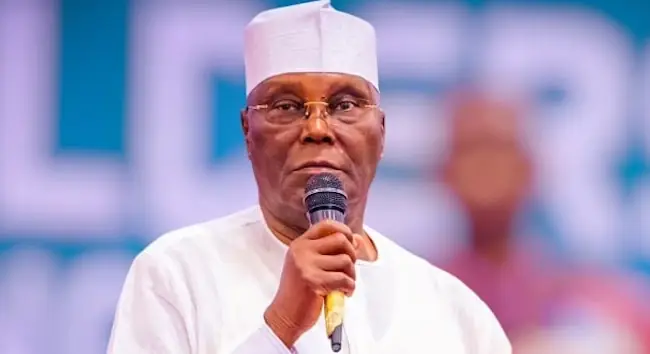
ABUJA: The Presidency has strongly criticized former Vice President Atiku Abubakar over reports that his supporters and lobbying team in the United States submitted petitions to U.S. President Donald Trump and the U.S. State Department concerning President Bola Ahmed Tinubu’s decades-old civil forfeiture case.
In a statement issued by the Special Adviser to the President on Information and Strategy, Bayo Onanuga, the Presidency described Atiku’s alleged actions as inappropriate, unpatriotic and inconsistent with the conduct expected of a statesman.
The statement, titled When Will Atiku Abubakar Report Himself to President Trump? accused the former vice president of allowing his long-standing presidential ambition to overshadow the values of maturity, decorum and patriotism.
According to the Presidency, Atiku’s reported decision to engage foreign lobbyists to revisit issues surrounding President Tinubu’s 1993 civil forfeiture case in the United States amounts to an attempt to internationalise Nigeria’s domestic politics.
Onanuga maintained that the forfeiture matter was resolved more than three decades ago and did not result in any criminal conviction or finding of guilt against Tinubu. He argued that the issue had already been examined extensively during the 2023 presidential election and subsequent legal proceedings.
The matter has been litigated, debated and settled. Nigerians made their choice at the ballot box, and the Supreme Court affirmed that mandate. Attempting to revive the issue abroad serves no national interest, the statement said.
The Presidency further stressed that Nigeria is an independent and sovereign nation whose political disputes should not be exported to foreign governments for intervention.
According to the statement, while lobbying is a recognised feature of the American political system, hiring foreign lobbyists to promote allegations that have already been addressed by Nigerian institutions undermines the country’s sovereignty and democratic processes.
The Presidency said Atiku, as a former vice president and elder statesman, ought to demonstrate greater respect for Nigeria’s institutions and avoid actions capable of portraying the country negatively before foreign governments.
It also questioned reports that approximately $1.2 million was allegedly spent on lobbying efforts in the United States, arguing that such resources could have been deployed towards presenting alternative policy ideas to Nigerians rather than reviving old political controversies.
Beyond criticizing the alleged lobbying campaign, the Presidency turned attention to Atiku’s own legal history in the United States.
The statement referenced the William Jefferson bribery scandal, which led to the imprisonment of former U.S. Congressman William Jefferson. It noted that Atiku and his former wife, Jennifer Douglas, were mentioned during investigations connected to the matter.
Onanuga also cited the 2010 U.S. Senate investigation titled Keeping Foreign Corruption Out of the United States: Four Case Histories, chaired by the late Senator Carl Levin.
According to the Presidency, the report examined allegations concerning offshore companies and financial transactions involving Atiku. It argued that if the former vice president intends to raise issues about President Tinubu before foreign authorities, he should also be prepared to address questions regarding his own past.
The Presidency further alleged that Atiku’s repeated pursuit of the presidency is motivated by personal interests rather than national service, claiming that his renewed political campaign is driven by ambitions extending beyond governance.
It also revisited criticisms of Nigeria’s privatisation programme carried out during the administration of former President Olusegun Obasanjo, when Atiku served as vice president.
According to the statement, the privatisation exercise resulted in the disposal of national assets at undervalued prices, benefiting politically connected individuals while contributing to job losses and financial hardship for many workers.
The Presidency claimed that the consequences of those policies, including unpaid pensions and other liabilities, are among the challenges the Tinubu administration is currently addressing.
Onanuga argued that rather than concentrating on what he described as political theatrics in Washington, Atiku should present practical policy alternatives to Nigerians on issues such as economic growth, national security, infrastructure development and job creation.
He maintained that the country’s numerous socio-economic challenges require constructive engagement and credible solutions instead of campaigns aimed at attracting international attention.
The statement insisted that President Tinubu remains focused on implementing his Renewed Hope Agenda, which the Presidency said is designed to stabilise Nigeria’s economy, improve national security, attract investments and strengthen the country’s international standing.
According to Onanuga, the President is not distracted by what he described as politically motivated campaigns or repeated attempts to undermine his administration through foreign channels.
“The President remains committed to delivering on the promises made to Nigerians and will not be distracted by political actors seeking validation outside the country,” the statement added.
The Presidency concluded by expressing confidence that Nigerians would judge political leaders based on their records, policy proposals and performance rather than renewed allegations surrounding issues that have already been subjected to judicial and electoral scrutiny.
The statement comes amid increasing political activities ahead of the 2027 general elections, with major opposition figures and the ruling All Progressives Congress (APC) intensifying public engagements and political messaging.
The latest exchange underscores the growing political tensions between President Tinubu’s administration and former Vice President Atiku Abubakar as both camps continue to trade accusations over governance, leadership and the direction of the country ahead of another electoral cycle.