


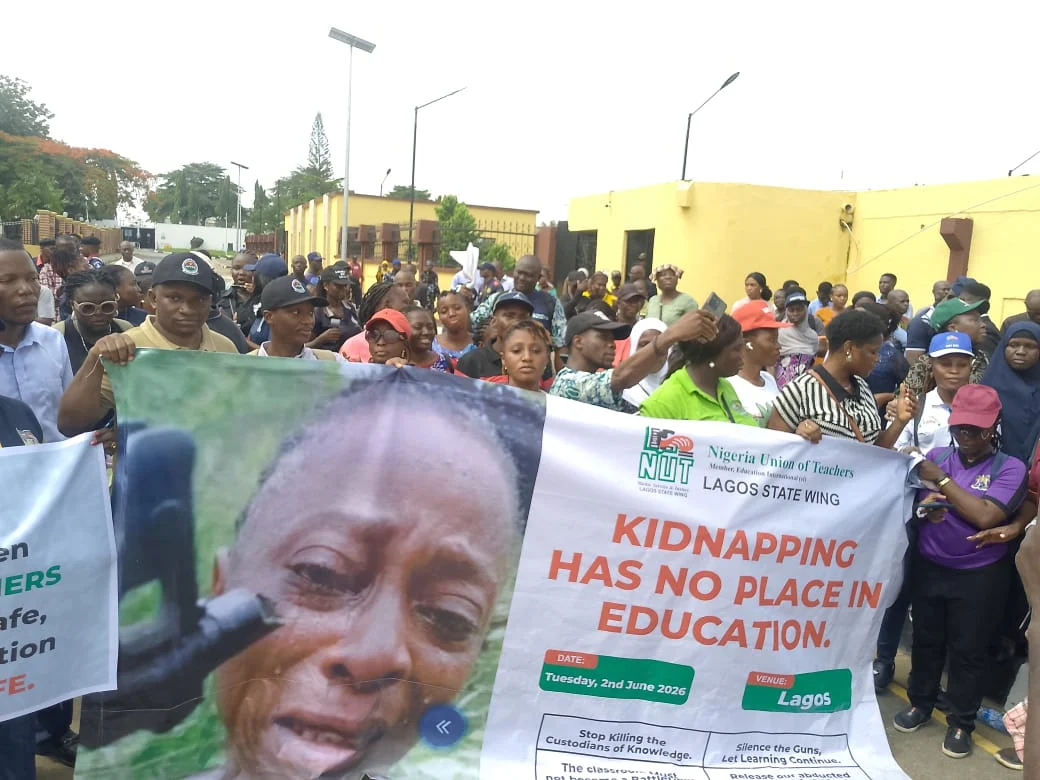
Efforts by the Federal Government to secure the release of dozens of students and teachers abducted in coordinated attacks on schools in Oyo and Borno states have reportedly been slowed by difficult terrain, fears of casualties, and demands by the kidnappers for the release of detained terrorist leaders.
Security and Presidency sources disclosed that the abductors are demanding the freedom of senior Ansaru commanders currently in government custody in exchange for the kidnapped victims.
The Federal Government, however, is said to be reluctant to agree to such a deal despite mounting pressure from families, labour unions, civil society groups and concerned Nigerians.
According to officials familiar with the situation, the kidnappers are seeking the release of Mahmud Muhammad Usman and his deputy, Mahmud al-Nigeri, two high-profile Ansaru leaders arrested during intelligence-led operations in 2025.
A Presidency source revealed that the attacks in Oyo and Borno were carefully coordinated to increase pressure on the government and strengthen the terrorists’ bargaining position.
“The kidnappers are pushing for the release of some of their top leaders who were captured by security agencies. That is the major reason negotiations have reached a standstill,” the source said.
The official added that security agencies are facing operational difficulties because the victims are being held in heavily forested locations that are unfamiliar to security forces.
The two commanders at the centre of the kidnappers’ demands were arrested in a major counterterrorism operation announced by National Security Adviser, Nuhu Ribadu, in August 2025.
At the time, Ribadu described the arrests as one of the biggest blows ever dealt to Ansaru, a terrorist group linked to Al-Qaeda that operates across parts of northern and central Nigeria.
Usman, also known as Abu Bara’a, was identified as the overall leader of Ansaru, while al-Nigeri served as the group’s chief strategist and commander of operations around the Kainji forest region.
Security officials fear that releasing the men could allow them to rebuild terrorist networks and resume violent activities.
These are individuals who were difficult to capture. Releasing them could create even greater security threats in the future, one source said.
The Oyo school attack occurred on May 15 when armed men invaded schools in the Esiele community of Oriire Local Government Area, abducting pupils, students and staff members.
Days later, the kidnappers reportedly killed one of the abducted teachers, Michael Oyedokun, intensifying public outrage.
On the same day, suspected Boko Haram fighters attacked schools in Mussa town, Askira-Uba Local Government Area of Borno State, abducting between 42 and 50 schoolchildren.
Following the incidents, President Bola Tinubu condemned the attacks, describing them as barbaric and assuring Nigerians that the victims would be rescued.
Security sources said rescue operations remain extremely challenging due to the terrain and the risk of casualties during any military intervention.
Officials noted that hostage rescue missions involving large numbers of children require careful planning because any mistake could lead to loss of innocent lives.
The government is trying to avoid actions that may endanger the children and teachers. At the same time, it does not want to negotiate on terms that could strengthen terrorist groups,” another source explained.
According to the officials, intelligence gathering, surveillance and community engagement are continuing as authorities search for the safest way to secure the victims’ freedom.
The United Nations Resident and Humanitarian Coordinator in Nigeria, Mohamed Malick Fall, has called for the immediate and unconditional release of all abducted students and teachers.
Speaking after a meeting with officials of the National Safe Schools Response Coordination Centre in Abuja, Fall described the attacks as a serious threat to education and child protection.
“Schools must remain safe places for learning. Children should never become targets of violence,” he said.
The UN official urged authorities to intensify efforts to secure the safe return of the victims while ensuring that those responsible are brought to justice.
At a national security briefing in Abuja, Information Minister Mohammed Idris said the government had made the rescue of the abducted children and teachers a top national priority.
He stated that the President had directed security agencies to deploy every lawful measure necessary to secure the victims’ release and apprehend those responsible.
According to him, intelligence agencies, the Armed Forces, the police, the Department of State Services, and the National Counter Terrorism Centre are working together on rescue operations.
Idris also disclosed that the government had approved the recruitment of 1,000 forest guards to improve security in vulnerable communities and forest areas.
The minister said military operations across the country have continued to record successes, with hundreds of terrorists neutralised, arrested or forced to surrender.
More than 90 civil society organisations marked the National Day of Mourning by criticising the government over worsening insecurity and increasing attacks on civilians.
The coalition, which includes Amnesty International Nigeria, SERAP, BudgIT, Yiaga Africa and several others, said thousands of Nigerians have been killed or abducted since May 2023.
The groups warned that persistent violence, school attacks and kidnappings demonstrate serious governance and security challenges.
Nigerian lives matter. The country cannot continue mourning victims while failing to protect citizens, the coalition stated.
The National Association of Nigerian Students, led by Akinteye Babatunde, pledged support for ongoing campaigns aimed at securing the release of the abducted students and teachers.
The student body said it would continue working with labour unions, community leaders and security agencies until all victims regain their freedom.
NANS warned that repeated attacks on schools threaten the future of education and create fear among students and parents nationwide.
Meanwhile, the Peoples Redemption Party has called on President Tinubu to resign, accusing his administration of failing to provide adequate security.
The party’s National Chairman, Hakeem Baba-Ahmed, argued that insecurity has spread across the country and that Nigerians are increasingly vulnerable to attacks and kidnappings.
He said the worsening situation reflects a failure of leadership and requires urgent action.
Security professionals have also called for greater use of technology, intelligence sharing and public-private partnerships to combat insecurity.
Speaking ahead of the National Private Security Conference scheduled for June 13 in Abuja, security expert Charles Awuzie said digital intelligence, geolocation tracking and improved information sharing could significantly strengthen Nigeria’s security architecture.
He also stressed the need to address poverty and unemployment, arguing that economic empowerment remains a critical component of long-term security and crime prevention.
As rescue efforts continue, families of the abducted children and teachers remain hopeful that the victims will return home safely, while pressure mounts on the government to end the crisis and prevent future attacks on schools.