


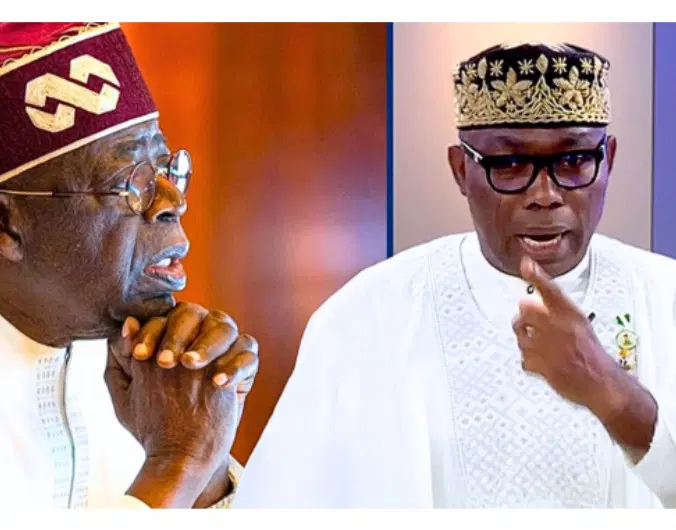
Former presidential candidate of the Social Democratic Party, Adewole Adebayo, has warned that Nigeria is drifting toward a one-man rule rather than a one-party state, amid growing political tension and insecurity.
Speaking after a visit to crisis-affected communities in Plateau State, Adebayo expressed concern over what he described as widespread but underreported violence across the country, blaming leadership failures for worsening insecurity and eroding public trust.
Adebayo said his visit to affected areas revealed deep humanitarian distress and a growing sense of abandonment among citizens.
According to him, beyond widely reported attacks, many smaller-scale killings occur regularly without attention, leaving communities feeling neglected and forced to rely on local survival strategies.
He stressed the need to restore public confidence, noting that government failure should not be mistaken for a failure of the Nigerian state itself.
The SDP chieftain confirmed he will contest the 2027 presidential election, insisting that political ambition does not preclude empathy or responsibility.
He criticised what he described as poor leadership at the highest level, arguing that leaders must demonstrate presence and responsiveness during national crises.
On the state of opposition politics, Adebayo acknowledged concerns over internal divisions, particularly within the African Democratic Congress.
He noted that while parties have the right to challenge institutional decisions, disputes should ultimately be resolved through the courts, especially where the Independent National Electoral Commission is involved.
He urged opposition parties to strengthen internal cohesion, reduce infighting, and position themselves more effectively against the ruling party.
Adebayo dismissed fears that Nigeria is heading toward a one-party system under the All Progressives Congress, arguing instead that the real threat is excessive concentration of power in one individual.
Referring to President Bola Ahmed Tinubu, he warned that such a system could weaken even the ruling party itself by eroding internal democracy and institutional strength.
According to him, low voter turnout in recent elections reflects growing public disillusionment, with many Nigerians disengaging from a political process they no longer trust.
Adebayo also lamented what he described as the collapse of ideology in Nigerian politics, attributing it to the rise of “money politics” and opportunism.
He argued that many politicians now operate without clear principles, switching allegiances based on personal gain rather than conviction.
To address this, he called for the emergence of a new political class driven by values, accountability, and genuine representation.
On the issue of state police, Adebayo said structural reforms alone would not solve insecurity without effective leadership.
He maintained that both the current policing system and proposed alternatives could work if guided by sincerity, professionalism, and accountability.
Adebayo urged Nigerians to remain actively engaged in the democratic process, warning that disengagement would further weaken governance.
He emphasised the need for citizens to hold leaders accountable, reward performance, and reject failure at the ballot box.
According to him, rebuilding Nigeria requires both institutional reforms and a fundamental shift in leadership values.