


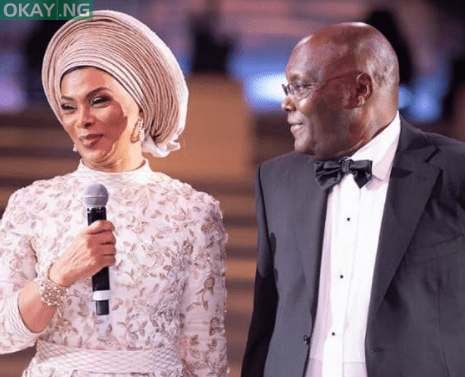
A three-member International Chamber of Commerce (ICC) arbitration tribunal has examined a $500,000 payment made to Jennifer Douglas, the former wife of ex-Vice-President Atiku Abubakar, in January 2003, during negotiations surrounding the disputed Mambilla Hydropower Project.
The payment was made by Leno Adesanya, promoter of Sunrise Power and Transmission Company Limited, through China Castle Investments Limited, an offshore company controlled by him.
According to the final arbitration award reviewed in reports published on Friday, January 30, 2003, the money was transferred into Douglas’ Citibank account in the United States—about four months before Sunrise was purportedly awarded a build-operate-transfer contract for the Mambilla project.
The tribunal, however, did not find that Atiku received a bribe. Rather, it examined whether the payment was connected to the disputed Mambilla contract and whether Adesanya’s explanation for the transaction was supported by evidence.
During the arbitration, Adesanya acknowledged making the $500,000 transfer to Douglas.
He told the tribunal that the money represented dollars purchased for Atiku with naira through his bureau de change business, Moneyline Ventures Limited.
Adesanya maintained that the transaction had nothing to do with the Mambilla project and was simply a foreign-exchange arrangement carried out for Atiku.
However, the tribunal said Adesanya failed to produce key documents supporting that explanation.
The evidence missing from the proceedings included records showing the underlying naira payment, the exchange rate used, instructions from Atiku or his aides, correspondence relating to the transaction and documentation establishing its commercial purpose.
Neither Atiku nor Douglas testified before the tribunal or submitted witness statements corroborating Adesanya’s account.
The tribunal also questioned the circumstances surrounding the companies used to make the payment.
Adesanya said he had operated a bureau de change business through Moneyline Ventures. However, the $500,000 was transferred through China Castle Investments Limited, rather than Moneyline.
The tribunal noted that Adesanya did not establish that Moneyline possessed the relevant bureau de change licence at the time.
It further noted that China Castle itself was not licensed to conduct foreign-exchange transactions and that such transactions were not among the company’s stated corporate purposes.
The tribunal therefore said it could not accept Adesanya’s explanation that the payment was simply a foreign-exchange transaction undertaken for Atiku.
The timing of the transaction was also examined against the history of Sunrise’s involvement in the Mambilla project.
Sunrise and its Chinese partner had begun discussions with Nigerian authorities over the project in 2001.
Atiku, who was vice-president under former President Olusegun Obasanjo, participated in discussions concerning the project and later led a Nigerian delegation to China in 2002, where officials and Chinese companies signed a memorandum covering several power projects, including Mambilla.
Sunrise subsequently submitted its proposal for the project.
A multi-agency technical committee later recommended the company for the 3,960-megawatt project, citing factors including cost effectiveness and its capacity to execute the project.
The $500,000 payment to Douglas was made on January 30, 2003, shortly after Sunrise had presented its tender to the technical committee.
On March 12, 2003, the technical committee recommended Sunrise for the project.
In April, the then Minister of Power, Olu Agunloye, sought approval from Obasanjo to proceed with further steps concerning the proposed concession.
Agunloye subsequently submitted a memorandum to the Federal Executive Council in May 2003.
Sunrise later relied on a May 22, 2003 letter from Agunloye as evidence that it had been awarded the project under a build-operate-transfer arrangement.
Obasanjo, however, maintained that the Federal Executive Council did not approve the contract and that he ordered the memorandum withdrawn.
That disagreement eventually became the basis of Sunrise’s multibillion-dollar arbitration claims against Nigeria.
The tribunal also considered arguments over Atiku’s influence within the federal government at the time.
Sunrise and Adesanya argued that the former vice-president lacked sufficient political influence to affect the purported award.
The tribunal disagreed with that characterisation, pointing to Atiku’s direct involvement in discussions surrounding Mambilla, including meetings with Sunrise and his leadership of the Nigerian delegation to China.
The tribunal also considered a 2003 United States diplomatic cable that described Adesanya as an Atiku insider and an associate of the then vice-president.
Based on the material before it, the tribunal concluded that Atiku had considerable political influence within the federal government during the first half of 2003.
However, that finding was not itself a determination that Atiku received the $500,000 or that the payment constituted a bribe. The tribunal’s assessment concerned the evidence and circumstances surrounding the arbitration dispute.
The ICC tribunal ultimately rejected Sunrise Power’s claims against Nigeria in the long-running dispute over the Mambilla project.
Sunrise had commenced arbitration in 2017, seeking approximately $2.35 billion over an alleged breach of the 2003 agreement.
The parties later entered into a settlement arrangement involving a proposed $200 million payment by Nigeria, but further disagreements resulted in additional claims.
In the latest proceedings, the tribunal rejected Sunrise’s request for Nigeria to pay the disputed settlement amount and an additional default payment.
It also ordered Sunrise and Adesanya to reimburse Nigeria for 75 per cent of its legal fees and expenses, with the recoverable costs reported at approximately $11.82 million.
Atiku has previously denied wrongdoing in connection with the controversies surrounding Jennifer Douglas and the wider Mambilla dispute.
TheCable reported that it contacted Atiku’s media adviser, Paul Ibe, and his senior special assistant on public communication, Phrank Shaibu, for comments on the latest findings.
The significance of the $500,000 payment remains tied to the tribunal’s assessment of the evidence presented in the arbitration. The award did not establish, on the material reported, that Atiku personally received the money or that the payment secured the Mambilla contract.