


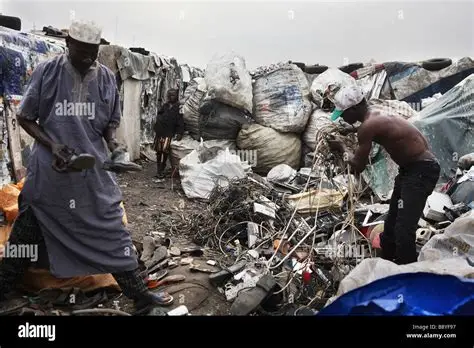
LAGOS: Long before Lagos wakes up to its usual bustle, Abdulrafiu Sadiq is already at work.
Armed with little more than a hooked iron rod and a worn-out sack, he moves through piles of refuse at dumpsites, searching for plastic bottles, sachet-water nylon, food containers and other recyclable materials that can be sold to recycling agents.
The work is dirty, dangerous and poorly paid. Yet, every plastic bottle Abdulrafiu retrieves is one less piece of waste that could end up blocking a drainage channel, polluting a waterway or being burnt in the open.
He may not describe himself as an environmentalist or climate activist, but his daily struggle is contributing to the fight against plastic pollution in Lagos.
I don’t really understand climate change, Abdulrafiu said. But I know that when plastics block gutters, floods will come. And when floods come, poor people suffer first.
His experience reflects the reality of thousands of informal waste pickers operating across Lagos and other Nigerian cities.
Driven largely by unemployment and poverty, these workers spend hours searching through dumpsites, markets, roadsides, drainage channels and refuse collection points for recyclable materials.
For them, the work is primarily about survival. But environmental experts say their contribution to waste management, recycling and climate action is increasingly difficult to ignore.
In Oshodi, 30-year-old Jerry Samuel begins his daily search among crowded markets, bus stops and overflowing refuse bins.
Like Abdulrafiu, Jerry collects discarded plastic bottles and sachet-water nylon and sells them to recycling agents.
However, the job comes with social stigma and physical risks.
Many traders don’t allow us to pick plastics around their shops. Some people call us thieves, while others chase us away, he said.
Jerry, who is originally from Gombe State, holds a diploma in Management Studies from Plateau State Polytechnic. After years of searching unsuccessfully for formal employment, he turned to waste picking as a means of survival.
“What pushed me into this work is a lack of a job, he said.
For more than two years, recyclable plastics have provided his main source of income. On a good day, he earns about N3,000.
But the income is barely enough to cover his basic needs.
How is it sustainable?” he asked. What I earn is hardly enough for breakfast, not to talk of lunch and dinner.
His hands carry visible scars from the job.
You can see my hands, he said, showing cuts on his palms. “Sometimes something sharp cuts you. There is the smell, the dirt and everything.
Jerry said the demanding nature of the work has also affected his health.
I have fallen sick many times. Most times I become feverish because of the sun, the stress and the nature of the work.
Despite the risks, he said he has never received gloves, safety boots, health insurance or other protective support from the government or private organizations.
For one day, I have not received anything, he said.
For 35-year-old Ibrahim, waste picking became necessary after his family’s financial situation became difficult.
Every morning, he leaves home with his sack and moves through Lagos streets looking for plastic bottles and other recyclable materials.
“We needed something to survive, he said.
At first, I was ashamed because people looked down on us. Later, I realised that honest work is better than begging.
Ibrahim often leaves home before sunrise and returns after sunset.
There are days I leave before 6 a.m. and don’t get back until evening, he said.
If I don’t collect enough plastics, there may not be enough money to feed.
Like many other waste pickers, he works without gloves and safety boots.
I have stepped on broken bottles several times, he said. But what choice do we have? We have to keep working.
Their stories reveal a difficult contradiction at the heart of Lagos’ waste management system.
The people performing some of the dirtiest and most dangerous work in the recycling chain are simultaneously helping to solve one of the city’s growing environmental problems.
Nigeria’s plastic waste challenge has grown alongside rapid urbanization, population growth and increased consumption of packaged products.
According to figures cited by the United Nations Development Programme, Nigeria generates more than 2.5 million tonnes of plastic waste annually, while less than 10 per cent is recycled.
A significant proportion of the remaining waste ends up in dumpsites, drainage channels, rivers, lagoons and the ocean. Some is also openly burnt, releasing pollutants and greenhouse gases.
The consequences are particularly serious in densely populated cities such as Lagos.
Plastic waste that finds its way into drainage channels can restrict the flow of stormwater and worsen flooding during heavy rainfall.
The problem is not limited to visible litter. Plastic waste can also break down into smaller particles that contaminate soil and water and threaten aquatic ecosystems.
For years, plastic pollution was largely treated as a sanitation problem.
Environmental experts, however, increasingly argue that the issue must also be viewed through the lens of climate change.
The President of the Africa Environmental Health Organisation, Afolabi Abiodun, said plastic pollution has climate implications throughout its life cycle.
“Plastic pollution is not just a sanitation problem; it is a climate issue,” he said.
According to him, plastics are produced largely from fossil-fuel-based materials, meaning their environmental impact begins before they become waste.
The open burning of plastics further compounds the problem by releasing carbon dioxide and other harmful pollutants into the atmosphere.
Environmental expert Abeeb Ajagbe similarly noted that plastic production is closely linked to the oil and gas industry.
He explained that burning plastics releases carbon dioxide and black carbon, which contributes to atmospheric warming.
Ajagbe also warned that plastic pollution can damage ecosystems that play important roles in absorbing carbon.
“As plastics break down into microplastics, they contaminate rivers, oceans and soils, disrupting natural systems that help absorb carbon,” he said.
The spread of microplastics also poses risks to aquatic organisms and can eventually introduce plastic particles into the human food chain.
The plastic waste problem is particularly significant in Lagos because of the state’s coastal location, dense population and rapid urban development.
The state faces increasing pressure from flooding, rising temperatures, unpredictable rainfall and other effects associated with a changing climate.
The spokesperson for the Lagos State Ministry of Environment and Water Resources, Kunle Adeshina, said plastic waste accounts for about 10 per cent of municipal solid waste generated in Lagos.
He said the consequences extend beyond unsightly streets and blocked gutters.
“Plastic waste is a major contributor to flooding in Lagos because it clogs our drainage channels, canals and stormwater systems, preventing the free flow of rainwater,” he said.
According to him, when heavy rainfall occurs, blocked drainage systems can cause water to accumulate on roads and in communities, increasing the severity of urban flooding.
Plastic waste that reaches rivers and lagoons can also affect water quality and aquatic ecosystems.
At a climate discussion in Lagos, the Team Lead of the Salata Institute for Climate and Sustainability at Harvard University, Prof Emmanuel Akyeampong, warned that the city faces serious environmental challenges, including land subsidence and rising climate risks.
He stressed the need for urgent interventions to protect Lagos from worsening environmental threats.
Although most waste pickers do not consider themselves climate workers, environmental experts say their activities provide an important environmental service.
Oluwaseyi Jesuton, an international development professional, environmentalist and Executive Director of U-recycle Initiative Africa, described waste pickers as informal climate workers because of the role they play in reducing plastic pollution.
She explained that there may be no formal occupation officially designated as a “climate worker,” but the environmental contribution of waste pickers is significant.
Waste pickers recover plastic bottles from streets, drainage channels, markets, homes and other public spaces before the materials become environmental hazards.
In a city like Lagos, this helps prevent environmental pollution, severe flooding, malaria, public health problems and road obstruction,” she said.
Jesuton noted that plastic bottles can take hundreds of years to decompose, making their early recovery and recycling particularly important.
After collection, waste pickers sell recyclable materials to aggregators and recycling companies, where the plastics are processed into raw materials for new products.
Because many households and businesses do not separate recyclable materials before disposal, waste pickers often undertake the difficult task of manually sorting mixed waste.
Despite their low visibility, informal waste workers occupy a critical position in Nigeria’s recycling value chain.
A Lagos-based recycler, Sola Adeyemi, said recycling companies depend heavily on materials collected by informal waste pickers.
More than 70 per cent of our raw materials come from scavengers,” he said.
If they stop working today, many recycling plants will struggle because they provide the materials we depend on.
The irony, however, is that the workers who perform much of the difficult collection work often receive the smallest share of the economic value generated by recycling.
“They do the hardest work but earn the least, Adeyemi said.
This imbalance has renewed calls for greater investment in the informal recycling sector and better integration of waste pickers into the formal waste management system.
For years, waste pickers have operated largely outside formal waste management structures.
Adeshina acknowledged that the activities of many informal waste pickers remain unregulated.
“Their operations are largely unregulated and often undermine the objectives of the state’s waste management strategy,” he said.
However, he said the Lagos State Government was considering measures to integrate waste pickers into the formal waste management system.
Such measures could include registering waste pickers, improving occupational safety, strengthening relationships with recycling companies and creating more organised opportunities within the recycling value chain.
Formalisation could also make it easier for the government to understand the size and structure of the sector.
Jesuton said proper registration and organisation would provide reliable data for government agencies, development organisations and private investors.
It could also help attract investment into recycling infrastructure and improve the overall efficiency of waste collection.
The environmental contribution of Lagos waste pickers comes at a significant personal cost.
Many operate in worn-out clothes and without gloves, boots, masks or protective overalls.
Jesuton said she had repeatedly witnessed the poor conditions under which informal waste workers operate.
Many of these scavengers look hungry, poorly dressed and are not properly equipped for the job, she said.
She noted that some waste pickers walk long distances while carrying heavy sacks because they lack appropriate transportation and collection equipment.
She recommended the provision of gloves, safety boots, overalls, waste collection tools, tricycles, health insurance, financial literacy programmes and adult education.
Regular training on waste management and occupational safety would also help reduce workplace injuries.
The health consequences of informal waste picking are another area requiring urgent attention.
A Professor of Public Health at the University of Port Harcourt, Prof Best Ordinioha, warned that waste pickers face several occupational hazards.
Cuts from broken bottles and sharp metals can become infected and expose workers to diseases, including tetanus.
Continuous exposure to smoke from burning waste and toxic gases from decomposing refuse can also increase the risk of respiratory illnesses, poisoning and asthma.
Ordinioha warned that prolonged exposure to carcinogenic substances could increase the risk of cancer.
He added that heavy metals present in some waste streams could damage vital organs, including the kidneys.
To reduce these risks, he recommended industrial gloves, face masks, safety boots and protective clothing.
He also called for waste separation at source in homes, schools, markets and offices so that recyclable materials can be separated from hazardous waste before disposal.
One of the simplest ways to improve the safety and efficiency of waste picking is to separate waste at the point of generation.
If households, offices, schools and businesses separate plastic bottles and other recyclable materials from hazardous waste, waste pickers would spend less time sorting through dangerous materials.
It would also make recycling more efficient and reduce the risk of injuries.
Experts believe public education must therefore become a major component of Lagos’ response to plastic pollution.
Residents can contribute by reducing their dependence on single-use plastics, reusing containers where possible and disposing of waste responsibly.
Adeshina urged residents to take practical steps to reduce plastic pollution.
These include separating recyclable materials from general household waste, using available recycling collection services and choosing reusable bags, bottles and containers instead of disposable alternatives.
He also warned residents against dumping waste on roads, in drains and waterways.
Community clean-up activities and environmental sanitation initiatives can further help keep public spaces free of waste.
Lagos has also introduced measures aimed at reducing plastic pollution, including restrictions on certain single-use plastic products.
However, experts say government action alone will not be enough.
Businesses, households, recycling companies, civil society organisations and informal waste workers must all be part of a coordinated approach.
Every day, thousands of waste pickers leave their homes before sunrise to recover recyclable materials.
Most carry little more than a sack and a metal hook.
For them, survival often comes before safety.
Jerry’s scarred hands provide a physical reminder of the dangers involved.
Sometimes something sharp cuts you. There is the smell, the dirt and everything,” he said.
Abdulrafiu faces similar risks.
“There are days I cough badly. But if I don’t come to work, my family won’t eat,” he said.
Their experiences demonstrate that the environmental benefits of informal waste picking cannot be separated from the social and economic challenges facing the workers.
A sustainable recycling system must therefore protect both the environment and the people who work within it.
The future of Lagos’ recycling sector could depend on how successfully the government and private sector integrate informal waste pickers.
Instead of treating them solely as scavengers or unauthorised operators, experts believe they should be recognised as important participants in the recycling economy.
Formal registration, protective equipment, health insurance, training, access to finance and stronger links with recycling companies could significantly improve their livelihoods.
It could also increase the amount of recyclable waste recovered from the environment.
A properly organised waste-picking sector could generate employment, strengthen recycling, reduce plastic pollution and contribute to Lagos’ climate resilience.
As Lagos continues to battle flooding, plastic pollution, rising temperatures and other environmental pressures, thousands of waste pickers continue their work largely unnoticed.
They receive little public recognition and often have no employment benefits or occupational protection.
Yet, every bottle they recover can help prevent plastic waste from entering a drainage channel, river or lagoon.
Their work also provides valuable raw materials for recycling companies and reduces the volume of waste that ultimately ends up in landfills or is burnt.
The climate response in Lagos is therefore not limited to government offices, environmental conferences or international climate summits.
It is also happening in dumpsites, markets, drainage channels and busy streets.
It is happening in the hands of workers who often have no formal environmental training but understand the consequences of leaving plastic waste on the streets.
For Abdulrafiu, Jerry, Ibrahim and thousands like them, waste picking is simply a means of survival.
But for Lagos, their daily labour represents something more: an overlooked contribution to cleaner communities, a stronger recycling economy and the fight against plastic pollution and climate change.
Recognising, protecting and properly integrating these workers could be one of the most practical steps Lagos can take towards building a cleaner, safer and more climate-resilient city.