


Nigeria’s democratic journey is once again confronted with an uncomfortable question: can a political party that aspires to govern a country demonstrate the capacity to govern itself?
The unfolding crisis in the African Democratic Congress (ADC), involving former Vice-President Atiku Abubakar, former Senate President David Mark, former Osun State Governor Rauf Aregbesola and Nafiu Bala Gombe, has exposed institutional weaknesses that continue to undermine political party administration in Nigeria. What began as a dispute over party leadership has escalated into a legal confrontation with potentially far-reaching consequences for the party’s participation in the 2027 presidential election.
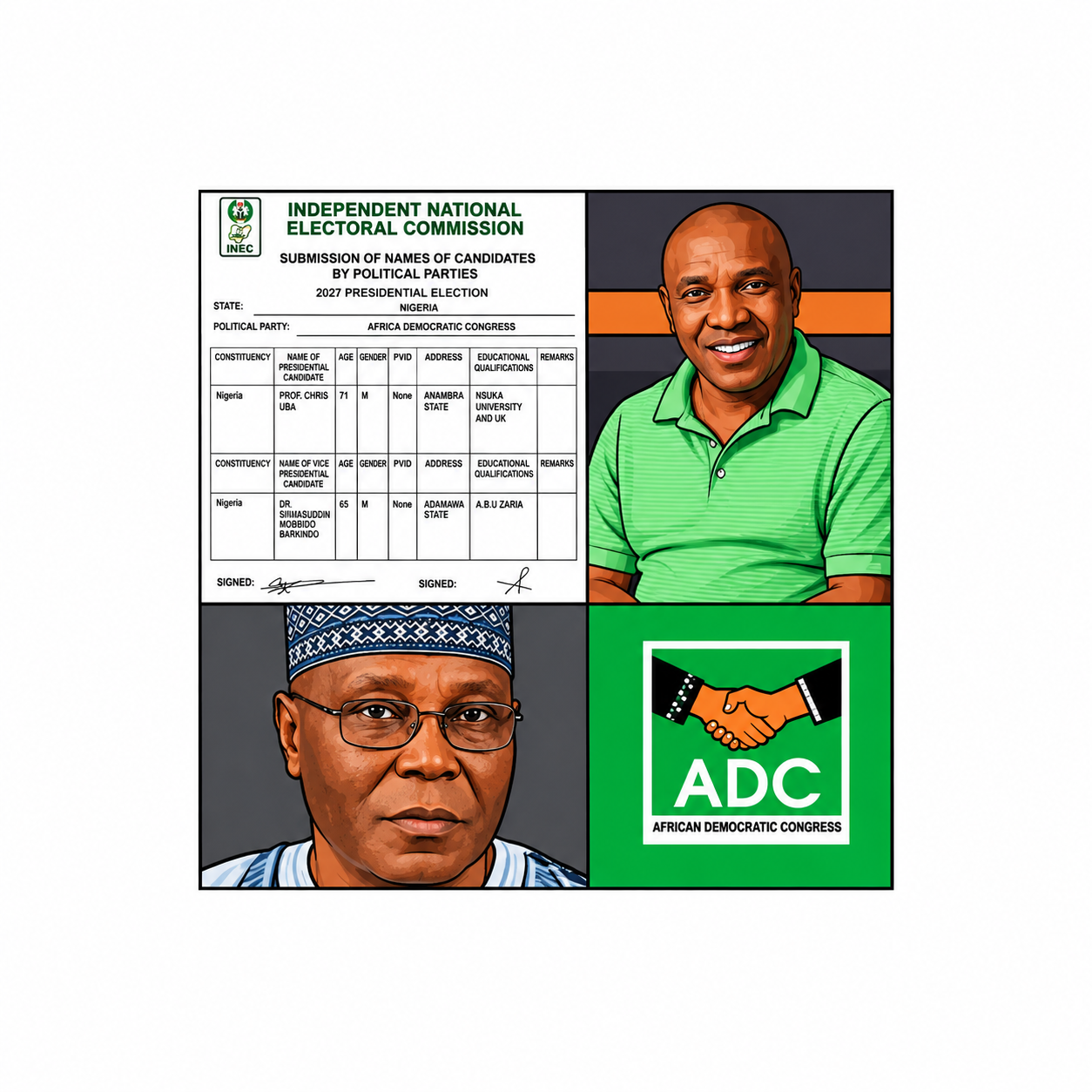
The controversy has also generated an intriguing social-media narrative suggesting that the Independent National Electoral Commission (INEC) has deleted Atiku Abubakar’s name from its portal and replaced it with Professor Chris Uba, with Dr Shamsuddin Modibbo Barkindo as his running mate.
That claim is misleading. The document being circulated originated from the rival Nafiu Bala faction’s earlier attempt to advance its own candidates. It is not evidence that INEC has formally recognised Chris Uba as Atiku’s replacement.
Yet, beneath the misinformation lies a genuine political and constitutional crisis that deserves serious examination.
The real story is not simply whether Atiku will remain the ADC’s presidential candidate. It is whether a political party can survive a prolonged contest over its leadership, the legitimacy of its decisions and the authority under which it conducts its electoral affairs.
THE ORIGINS OF THE ADC LEADERSHIP CRISIS
The ADC leadership dispute predates Atiku’s presidential ambition and arose from disagreements over the transition following the resignation of the party’s former National Chairman, Ralph Nwosu, in 2025.
David Mark and other prominent political figures subsequently emerged as leaders of the party, with Rauf Aregbesola becoming National Secretary.
Nafiu Bala Gombe, a former Deputy National Chairman of the ADC, challenged the legitimacy of this transition. His argument was that, following Nwosu’s resignation, the party’s constitutional arrangements entitled him to assume the leadership position rather than the emergence of the caretaker leadership headed by Mark.
The dispute eventually produced competing claims before the courts and attracted INEC’s attention.
The important point is that the controversy did not originate from Atiku’s nomination. His presidential ambition became entangled in an institutional dispute that was already in existence.
TWO JUDGEMENTS AND THE QUESTION OF JUDICIAL CONSISTENCY
An important dimension of the controversy is the existence of two Federal High Court judgments concerning different proceedings connected with the ADC leadership crisis.
On 2 July 2026, Justice Musa Liman of the Federal High Court, Abuja, delivered judgment in a suit instituted by House of Representatives member Leke Abejide.
According to published accounts, the court upheld preliminary objections challenging the jurisdiction of the court, the plaintiff’s standing and his failure to exhaust the party’s internal dispute-resolution mechanisms. The court also resolved the substantive issues in favour of the defendants, affirming the legitimacy of the transition that produced David Mark and Rauf Aregbesola as the party’s National Chairman and National Secretary.
That decision was an important development in the party’s leadership controversy.
However, another proceeding instituted by Nafiu Bala Gombe continued before the Federal High Court.
The history of that litigation is particularly significant.
In April 2026, the Supreme Court, in Senator David Mark v Nafiu Bala Gombe & 4 Ors, reported as SC/CV/180/2026, set aside the Court of Appeal’s preservatory order that had affected the recognition of the Mark-led leadership and directed that the substantive dispute return to the Federal High Court for determination.
The Supreme Court’s intervention did not finally determine who was entitled to lead the ADC. Rather, it restored the matter to the trial court for the substantive issues to be determined.
Following subsequent procedural developments, the case was reassigned to Justice Peter O. Lifu for accelerated hearing.
On 5 November 2026, Justice Lifu delivered judgment in favour of Nafiu Bala Gombe. Published reports indicate that the court invalidated the Mark-led leadership structure, set aside decisions taken under that leadership and directed INEC not to recognise decisions arising from the disputed 99th National Executive Committee meeting of July 2025.
The judgment also affected the party’s nominations, including the presidential primary that produced Atiku Abubakar as its candidate for the 2027 election.
It is important to distinguish these proceedings. The July judgment arose from Abejide’s separate suit, while the November judgment arose from Bala Gombe’s leadership challenge. They cannot automatically be treated as contradictory judgments in the same case.
Nevertheless, their respective reasoning, orders and implications raise legitimate questions about the relationship between the two proceedings, the scope of the issues determined and the legal consequences of the subsequent judgment.
Without the complete certified judgments, it would be premature to pronounce on whether the November decision conflicts with any binding determination in the earlier proceedings.
What is clear, however, is that the ADC now faces a judicially complicated leadership crisis with direct consequences for its electoral preparations.
THE NEW ELECTORAL ACT 2026: A LEGISLATIVE COMPLICATION
The ADC controversy has acquired another dimension with the enactment of the Electoral Act 2026.
Section 83(5) provides that, subject to subsection (3), no court in Nigeria shall entertain jurisdiction over any suit or matter pertaining to the internal affairs of a political party.
Section 83(6) further provides for restrictions on interim and interlocutory injunctions, accelerated hearing and substantial costs against litigants and their counsel in proceedings brought in violation of the provision.
These are significant legislative restrictions.
An examination of the previous Electoral Act 2022 reveals that its section 83 did not contain equivalent provisions. The new jurisdictional restrictions were introduced by the 2026 legislation.
This creates an important transitional-law question because the Bala litigation commenced in September 2025, before the enactment of the new legislation.
Can a jurisdictional restriction introduced after the commencement of proceedings be applied to a matter already pending before the courts?
Section 6(1)(e) of the Interpretation Act, which deals with the preservation of legal proceedings and remedies following the repeal of legislation, becomes relevant to this inquiry.
However, its application cannot be assumed. The nature of the rights asserted, the procedural history of the litigation, the repeal and savings provisions and the precise scope of the new enactment must all be considered.
There is also section 88(2) of the Electoral Act 2026, which expressly permits an aspirant who complains of non-compliance with the Act or party nomination guidelines in the selection or nomination of a candidate to approach the Federal High Court for redress.
The relationship between this specific statutory remedy and the general restriction on judicial intervention in party affairs under section 83(5) is another question requiring judicial interpretation.
It is particularly important to distinguish an aspirant’s complaint about nomination irregularities from a dispute over party leadership succession.
Nafiu Bala’s principal claim concerns the latter.
These statutory provisions raise questions that go beyond the immediate ADC dispute. Their interpretation could shape the future relationship between political party autonomy, access to justice and judicial supervision of electoral processes in Nigeria.
PARTY AUTONOMY AND THE LIMITS OF JUDICIAL INTERVENTION
Political parties are voluntary associations governed by their constitutions, rules and internal procedures. Their members are expected to resolve disagreements through established institutional mechanisms.
However, party autonomy does not confer absolute immunity from the law.
Political parties operate within the constitutional and statutory framework of the Federal Republic of Nigeria. Their constitutions and internal regulations must be consistent with applicable legislation.
Where allegations arise concerning breaches of statutory provisions, constitutional requirements or legally enforceable rights, the question of judicial intervention becomes relevant, subject to the jurisdiction conferred on the courts by law.
The ADC litigation therefore raises a fundamental question: where does legitimate judicial supervision end and impermissible judicial interference in the internal affairs of a political party begin?
The answer cannot be determined merely by invoking party autonomy or judicial authority. It requires an examination of the cause of action, the reliefs sought, the applicable legislation and the jurisdiction of the court.
The courts must also guard against becoming instruments through which political factions transfer their internal power struggles into prolonged judicial battles.
At the same time, political parties must not use the language of internal autonomy to shield unlawful conduct from legitimate judicial scrutiny.
The challenge is to preserve both institutional independence and the rule of law.
THE ATIKU QUESTION: CAN A PRESIDENTIAL AMBITION SURVIVE A PARTY’S INSTITUTIONAL CRISIS?
For Atiku Abubakar, the immediate challenge is more complicated than a contest for the ADC presidential ticket.
His emergence as the party’s presidential candidate depended on the authority of the leadership that organised and conducted the relevant nomination process.
If that leadership is ultimately held to have acted without lawful authority, the validity of the decisions taken under it becomes a legitimate subject of judicial determination.
Atiku has rejected the implications of the judgment and expressed determination to remain in the 2027 presidential contest.
However, political determination and legal entitlement are two different considerations.
His political standing cannot, by itself, cure any legal defect that may be established in the nomination process. Conversely, a judgment delivered by a court of first instance remains subject to the appellate process and must be considered in the light of the grounds upon which it is challenged.
The same caution applies to Chris Uba and the Nafiu Bala faction.
The invalidation of one leadership structure does not automatically establish the legal validity of every action or nomination advanced by another faction.
A competing political claim is not a judicial determination.
It is therefore premature to declare Chris Uba the recognised replacement for Atiku or to conclude that the legal contest over the ADC’s presidential ticket has been finally resolved.
INEC: BETWEEN JUDICIAL AUTHORITY AND ELECTORAL RESPONSIBILITY
INEC occupies an important position in this unfolding controversy.
The Commission is constitutionally responsible for regulating political party activities within the framework of the Constitution and electoral legislation. It must therefore act in accordance with valid court orders and applicable electoral laws.
Following the November judgment, INEC indicated that it had not received the Certified True Copy of the decision and would not act merely on information circulating on social media.
The ADC also complained that, despite applying and paying the prescribed fees for the certified judgment, it had not received the document.
This development raises an important procedural concern.
Access to a judgment is not a favour extended to litigants. It is an essential component of the administration of justice, particularly where the decision affects the rights and interests of the parties and may be challenged on appeal.
The prompt availability of certified judgments is important to the effective exercise of the right of appeal and public confidence in judicial administration.
That said, the reported delay should not, without further evidence, be interpreted as proof of deliberate obstruction or judicial misconduct.
INEC must equally exercise caution. It cannot substitute its interpretation of a judgment for the decision of the court, nor should it act on an unofficial description of orders it has not formally received and examined.
Its responsibility is to act lawfully, impartially and transparently.
DOES AN APPEAL AUTOMATICALLY SUSPEND A JUDGEMENT?
Following the 5 November judgment, the ADC announced that it had filed a Notice of Appeal on 6 November and an application for stay of execution.
The party also notified INEC and requested that the Commission refrain from taking consequential action while the appellate proceedings were pending.
This raises another important legal question.
Under Nigerian law, the filing of an appeal does not automatically operate as a stay of execution. An application for stay must be considered on its merits and granted by the appropriate court.
The Supreme Court’s decision in Vaswani Trading Company v Savalakh & Company (1972) 12 SC 77 remains an important authority on the principles governing applications for stay of execution.
The courts must balance the successful litigant’s right to enjoy the fruits of a judgment against the need to ensure that a successful appeal is not rendered nugatory.
Consequently, the ADC cannot assume that filing an appeal automatically restores the Mark-led leadership or reinstates Atiku’s nomination.
Equally, the judgment of the trial court should not be treated as beyond appellate scrutiny.
The determination of the appeal and the application for stay will be crucial to the next phase of the controversy.
THE BIGGER PROBLEM: POLITICAL PARTIES WITHOUT INSTITUTIONAL DISCIPLINE
Beyond the immediate legal contest, the ADC crisis presents a broader challenge to Nigeria’s democratic development.
Political parties are indispensable institutions in representative democracy. They aggregate interests, develop policy alternatives, recruit political leadership and provide the platforms through which citizens participate in the governance of their country.
Yet Nigerian political parties frequently appear to function more as vehicles for the political ambitions of influential individuals than as enduring institutions governed by predictable rules and procedures.
Leadership succession becomes contentious. Party constitutions are interpreted to suit competing interests. Internal disagreements are allowed to deteriorate into factional confrontations, while courts are increasingly called upon to resolve disputes that should ordinarily have been addressed through credible internal mechanisms.
This is not peculiar to the ADC.
The recurring instability in several Nigerian political parties suggests a structural weakness in our party system.
The problem is not merely the existence of disagreements. Disagreements are natural in democratic organisations. The problem is the apparent inability to resolve them through trusted institutions and transparent procedures.
A political party that cannot manage its internal affairs without recurrent litigation may struggle to convince the electorate that it possesses the institutional discipline required to manage the affairs of a country.
The ADC crisis is therefore an opportunity to reflect on the character of political parties as democratic institutions rather than personal political platforms.
What should happen next?
There are several institutional responsibilities that must now be discharged.
First, the Federal High Court should make the certified judgment available to the parties without unnecessary delay. The precise terms of the orders must be known before their legal consequences can be properly assessed.
Second, the Court of Appeal should be afforded the opportunity to examine the grounds of appeal and determine the relevant applications in accordance with the law.
Third, INEC must discharge its constitutional and statutory responsibilities without favouring any faction or allowing political pressure to dictate its decisions.
Fourth, the ADC must confront the institutional weaknesses exposed by the crisis. Even if the appellate proceedings ultimately resolve the immediate dispute in favour of one faction, the party will still need to rebuild confidence in its internal democratic processes.
Finally, political leaders must recognise that political parties are institutions, not personal estates. Their constitutions are not decorative documents, and their procedures cannot be subordinated indefinitely to individual ambitions.
CONCLUSION: DEMOCRACY MUST BEGIN AT HOME
The ADC controversy is bigger than Atiku Abubakar, David Mark, Nafiu Bala Gombe or Professor Chris Uba.
It is a test of the institutional foundations of political party administration in Nigeria.
The right to political association carries responsibilities. Leadership must derive its legitimacy from lawful procedures. Candidate selection must reflect established rules. Judicial authority must be respected, while judicial decisions must remain open to legitimate appellate scrutiny.
For a country seeking to consolidate democratic governance, the credibility of political alternatives matters as much as the credibility of the government in power.
Nigerians deserve political parties that can demonstrate internal democracy, institutional discipline and respect for the rule of law before asking for the opportunity to govern the nation.
Ultimately, the strength of a democracy cannot be measured only by the conduct of its general elections. It must also be measured by the democratic character of the institutions that produce the candidates who contest those elections.
A party that cannot govern itself must first answer the question of how it intends to govern a nation
Frank Odion Apokwu is a Public Affairs Analyst Democratic Reforms and Inclusive Development Advocate management consultant writing from Asaba, Delta State.