


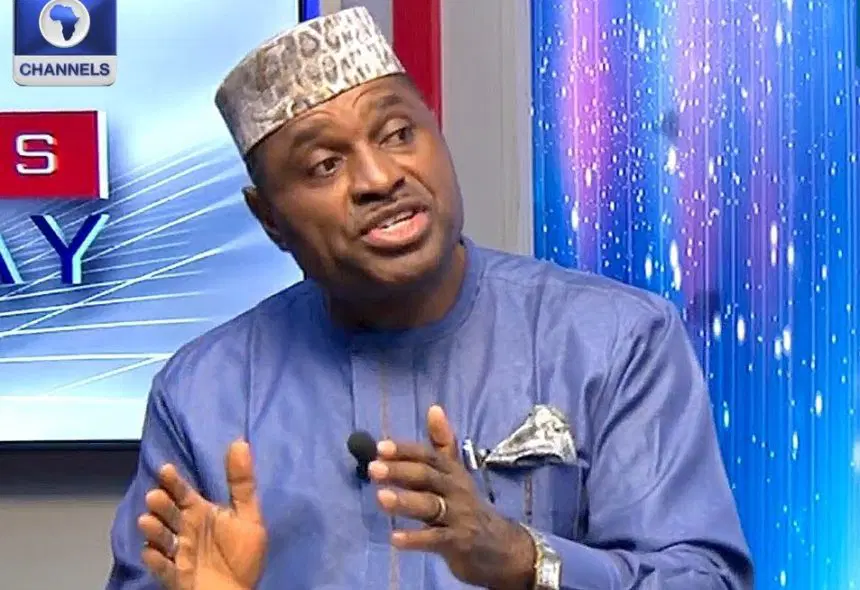
The spokesperson for the presidential campaign of the African Democratic Congress (ADC), Kenneth Okonkwo, has explained why the party did not choose a vice-presidential candidate from Nigeria’s South-East, saying no politician from the region met the legal requirements to be considered at the time of the party’s primary election.
Okonkwo made the clarification while responding to criticism over the emergence of former Minister of Transportation, Rotimi Amaechi, as the running mate to the ADC’s presidential candidate, Atiku Abubakar.
His comments come after reports suggested that he had opposed Amaechi’s nomination and vowed not to campaign for the party because the vice-presidential slot was not given to the South-East.
Speaking during a television interview, Okonkwo dismissed claims that he rejected Amaechi’s selection, insisting that his earlier comments had been misunderstood.
He explained that his position was based on the principle of regional balance rather than opposition to any individual.
According to him, he had merely expressed the belief that, ideally, the vice-presidential candidate should have emerged from the South-East.
“I never opposed Rotimi Amaechi as a person,” he said, stressing that the former Rivers State governor became the legitimate choice of the party after the internal selection process.
Okonkwo noted that every loyal party member is expected to support the decision reached by the ADC.
The former Labour Party chieftain said the provisions of the Electoral Act 2026 played a decisive role in determining who could be considered for the vice-presidential position.
He explained that anyone seeking to contest under the ADC platform must have been a registered member of the party at least 21 days before its presidential primary.
According to him, many of the South-East politicians he would have preferred were not members of the ADC within the required period, making them ineligible under the law.
He said this legal restriction significantly narrowed the party’s options during the selection process.
Okonkwo revealed that the leading figures who had shown interest in contesting the ADC presidential ticket included Atiku Abubakar, Rotimi Amaechi, Mohammed Hayatu-Deen and Peter Obi.
However, he noted that Peter Obi’s departure from the party altered the political dynamics in the South-East, leaving the region without a strong contender eligible for consideration.
He added that Amaechi had secured more than 500 votes during the party’s primary election, making him a major stakeholder whose supporters could not be ignored.
According to Okonkwo, overlooking Amaechi after such a strong showing would have risked creating unnecessary divisions within the party.
Despite accepting the party’s decision, Okonkwo maintained that the ADC leadership should have consulted political leaders from the South-East before announcing the vice-presidential candidate.
He argued that such engagement would have helped explain the legal and political constraints facing the party and prevented feelings of exclusion among people in the region.
According to him, open dialogue would have enabled South-East stakeholders to understand why the party could not field one of their own for the position.
Okonkwo also disclosed that Atiku Abubakar was outside Nigeria when the announcement of the vice-presidential candidate was initially made.
He said the former Vice President moved quickly to engage party stakeholders upon his return, leading to fresh consultations aimed at addressing concerns raised over the decision.
Describing Atiku as a committed democrat, Okonkwo said the presidential candidate suspended further actions until discussions were held with key stakeholders, a move he believes demonstrated the party’s willingness to build consensus.
He expressed confidence that the ADC would remain united ahead of the 2027 general election despite the controversy surrounding the choice of its vice-presidential candidate.