


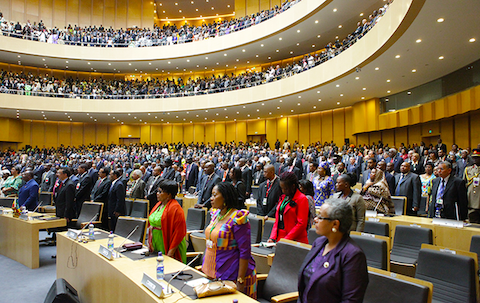
Accra: Ghanaian President John Dramani Mahama has intensified calls for the African Union (AU) to urgently address the growing wave of anti-immigrant violence in South Africa, warning that the crisis threatens the ideals of African unity and continental integration.
Speaking on Thursday, Mahama said the recent attacks against foreign nationals in South Africa have reached an alarming level and deserve formal discussion at the AU’s next summit scheduled for February 2027.
The Ghanaian leader revealed that he recently met with AU Commission Chairperson Mahmoud Ali Youssouf during an African Union meeting in Accra, where both leaders acknowledged the urgency of placing the matter on the continental body’s agenda.
Placing this on the AU agenda gives South Africa a formal, constructive platform to share its perspective, and together, as a continent, work toward a lasting solution,” Mahama said in a statement shared on social media.
South Africa has experienced weeks of demonstrations and unrest targeting documented and undocumented migrants, with local groups accusing foreign nationals of taking jobs, housing, and other economic opportunities.
According to reports, more than 160,000 foreign nationals have left South Africa over the past two months, while several people have reportedly been killed amid the violence. The unrest has increased diplomatic tensions between Pretoria and several African countries whose citizens have been affected.
Mahama expressed concern over what he described as an inadequate response by South African authorities.
It doesn’t appear that the South African authorities are responding to the magnitude that one would expect them to, he said while addressing journalists on the sidelines of the AU gathering.
He further alleged that individuals allegedly financing the attacks are widely known but have not been held accountable.
The persons who are funding these xenophobic attacks are known, and they have been left free to continue to do what they want to do, Mahama stated.
The Ghanaian President stressed that the issue goes beyond bilateral relations and requires a united African response.
According to him, the persistent attacks on fellow Africans have the potential to undermine decades of efforts aimed at promoting African solidarity, regional cooperation, and economic integration under the African Union.
“We must protect everything we have worked for regarding African solidarity and African integration, Mahama emphasized.
Despite his criticism, Mahama reiterated that Ghana harbours no hostility towards South Africa, insisting that the objective is to find a lasting continental solution rather than isolate Pretoria.
Meanwhile, two Ghanaian citizens have reportedly submitted a petition to the International Criminal Court (ICC) requesting an investigation into what they described as repeated xenophobic attacks against African migrants in South Africa.
South African authorities, however, have dismissed the petition as opportunistic, maintaining that the country’s institutions are capable of addressing criminal acts committed during the unrest.
Earlier this month, Ghana postponed a planned state visit by South African President Cyril Ramaphosa following the killing of a Ghanaian national in South Africa. Although South African officials maintained that the death was unrelated to the recent anti-immigrant protests, the incident heightened public concern in Ghana.
The latest developments have renewed calls across Africa for stronger regional mechanisms to safeguard the rights and safety of African citizens living and working in other member states.