


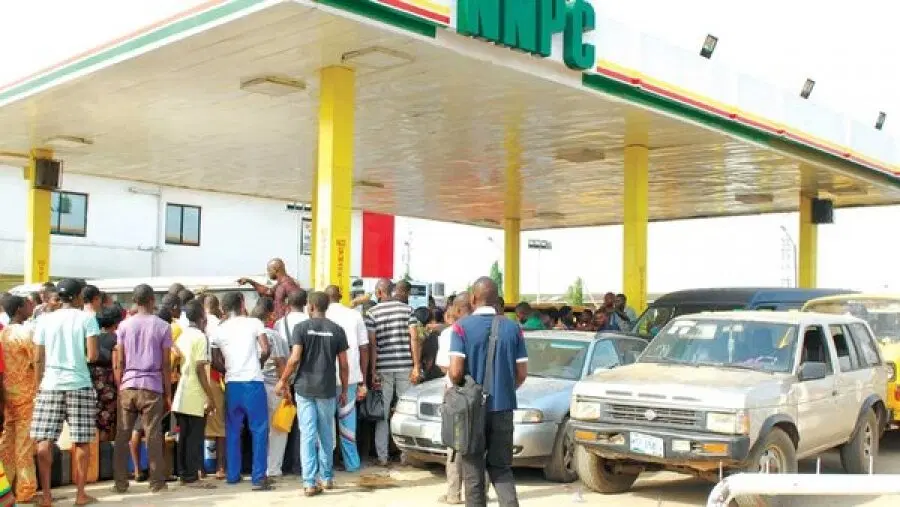
ABUJA: The Federal Government has announced a 30-day petrol price relief programme through Nigerian National Petroleum Company Limited (NNPC) retail outlets, with petrol expected to sell at ₦1,350 per litre under the proposed arrangement.
The Minister of Finance and Coordinating Minister of the Economy, Taiwo Oyedele, announced the measure in Abuja, explaining that the initiative was designed to cushion the impact of global crude oil price fluctuations on Nigerian households and businesses.
According to the minister, the arrangement will initially run for 30 days, with the price reviewed monthly. Commercial transport operators will receive priority under the programme to help reduce transportation costs for Nigerians.
Oyedele stressed that the intervention should not be regarded as a return to the nationwide fuel subsidy regime removed by President Bola Tinubu’s administration.
Instead, he said NNPC would forgo its retail profit margin and sell petrol at cost to provide temporary relief to consumers.
The announcement has, however, triggered strong reactions from opposition political parties, with former Vice-President Atiku Abubakar and the Nigeria Democratic Congress (NDC) describing the measure as inadequate, while the African Democratic Congress (ADC) accused the government of attempting to influence voters ahead of the 2027 general elections.
Oyedele said the government was exploring measures to protect consumers from sudden increases in petrol prices caused by movements in international crude oil prices and foreign exchange rates.
He disclosed that the government was also considering forward-sale arrangements for crude oil supplied to domestic refiners, although the timing and pricing details had yet to be determined.
According to him, such arrangements could provide greater certainty for refiners, protect government revenue and reduce the pressure on consumers whenever global oil prices fluctuate.
The minister added that the government was negotiating a price ceiling of ₦1,350 per litre at the ex-gantry or landing-cost level as part of efforts to promote price stability.
He maintained that the removal of fuel subsidy did not mean the government had abandoned efforts to reduce the economic hardship experienced by Nigerians.
Oyedele also warned that proposals to restore fuel subsidies could create serious economic consequences, including pressure on government revenue, the naira and inflation.
He argued that a return to the former subsidy system could weaken investor confidence, increase borrowing costs and undermine recent gains in the country’s economic reforms.
The minister further claimed that the exchange rate could approach ₦3,000 to the dollar within months under such a scenario, while petrol prices could rise to at least ₦2,000 per litre.
These figures were presented as the government’s projections of the possible consequences of restoring fuel subsidies.
The Federal Government also pointed to its investments in alternative energy and transportation as part of its response to the rising cost of living.
Oyedele said more than 120,000 vehicles were operating on compressed natural gas (CNG), supported by over 400 conversion centres, 96 refuelling stations and 18 liquefied-to-compressed natural gas facilities.
He added that more than 550 CNG-powered buses had been deployed, claiming that fares on routes where they operate had fallen by between 30 and 50 per cent.
The government, he said, had also removed certain taxes on electric vehicles and solar equipment and reduced import duties on vehicles to encourage the adoption of alternative transportation options.
Oyedele further disclosed that the administration was investing in a National Strategic Fuel Reserve to protect households and businesses against future energy supply disruptions.
Under the proposed arrangement, refined petroleum products would be released into the market under established rules whenever global supply disruptions or hoarding threatened availability and price stability.
He said the initiative was intended to prevent artificial scarcity, discourage market manipulation and strengthen Nigeria’s long-term energy security without restoring a blanket fuel subsidy.
The Presidency has confirmed that President Bola Tinubu approved the NNPC petrol discount arrangement.
In a statement, the President’s Special Adviser on Information and Strategy, Bayo Onanuga, said the intervention should not be interpreted as an attempt to reverse the government’s fuel subsidy removal policy.
According to the Presidency, the objective is to provide targeted assistance to vulnerable Nigerians while preserving the broader economic reforms introduced by the administration.
It argued that restoring a blanket subsidy could recreate problems associated with fuel scarcity, smuggling, pressure on the national currency and the country’s public finances.
The Presidency maintained that the government was committed to ensuring that the benefits of its economic policies reached Nigerians more quickly and in more practical ways.
It also disclosed that the Federal Government was working on a broader package of fiscal measures aimed at bringing inflation down to single digits sustainably.
However, the restriction of the discount to designated NNPC retail outlets has raised questions about the programme’s nationwide reach and the extent to which consumers will benefit.
Former Vice-President Atiku Abubakar has rejected the 30-day petrol discount, describing it as a temporary intervention that fails to address the underlying causes of Nigeria’s economic hardship.
In a statement issued by his Director of Strategic Communications, Phrank Shaibu, Atiku questioned what would happen when the relief period expires.
He argued that Nigerians struggling with high transportation costs, rising food prices and declining purchasing power could not be expected to regard a one-month discount as a lasting solution.
Atiku also faulted the decision to restrict the arrangement to NNPC stations, questioning how much motorists would save per litre and whether commercial transport operators would pass the savings on to passengers.
He maintained that the government had not provided sufficient guarantees that the intervention would translate into lower transport fares and food prices.
The former vice-president reiterated his proposal for production support tied to petrol refined in Nigeria, arguing that a properly designed and budgeted arrangement could support local refining while offering more sustainable relief to consumers.
Atiku said Nigerians needed long-term solutions rather than temporary relief measures that would expire while the underlying economic challenges remained unresolved.
The Nigeria Democratic Congress has also criticised the government’s announcement, describing the proposed discount as inadequate and an attempt to mislead Nigerians.
In a statement signed by its National Publicity Secretary, Osa Director, the party argued that the administration had failed to introduce sufficient measures to cushion the effects of fuel subsidy removal.
The NDC questioned the limited duration of the intervention and raised concerns about the number of NNPC retail outlets available to serve the country’s large population.
It also warned that concentrating demand at designated filling stations could create difficulties for motorists if the programme was not properly implemented.
The party accused the government of introducing a subsidy-style intervention through the back door, despite its earlier defence of subsidy removal.
The NDC further called on Nigerians to support its political platform, expressing confidence in Peter Obi’s leadership ahead of the 2027 general elections.
The party’s position reflects the growing political debate over fuel pricing, economic reforms and the appropriate measures needed to reduce the cost of living.
The African Democratic Congress Presidential Campaign Council has also condemned the petrol discount, describing it as an attempt to win public support ahead of the 2027 elections.
In a statement issued by its Director of Media and Publicity, Kola Ologbondiyan, the campaign council argued that the government should have introduced meaningful relief measures earlier instead of offering a temporary discount after years of economic hardship.
The ADC questioned whether petrol prices would return to their previous levels once the 30-day period ended.
It also accused the administration of responding to public suffering only after the economic consequences of its policies had become politically difficult to ignore.
The campaign council maintained that Nigerians required sustained reductions in the cost of living rather than short-term interventions that might be reviewed according to changing political circumstances.
The government has, however, defended the initiative as a temporary measure intended to protect consumers from global energy market volatility without abandoning its broader economic reform programme.
The debate over the petrol discount has also renewed calls for presidential candidates to place the economy and citizens’ welfare at the centre of their 2027 campaign promises.
Some Nigerians who spoke to Vanguard said candidates should move beyond political rhetoric and present practical plans to address insecurity, unemployment, inflation, electricity shortages, healthcare challenges and declining purchasing power.
Journalist Uche Ruth Ogbonnaya called for clear policy directions, honest communication and national unity. She also highlighted the importance of judicial independence, an autonomous Independent National Electoral Commission and reforms to the use of security votes by state governors.
Entrepreneur Romoke Olisa said presidential aspirants should explain how their proposed policies would be implemented, funded and measured, rather than making promises without clearly defined strategies.
Another entrepreneur, Gbenga Komolafe, argued that addressing Nigeria’s petroleum industry challenges and reducing energy costs should be priorities. He also called for measures to support the informal economy through access to credit, social protection and improved infrastructure.
Endurance Ibhadore emphasised the need to tackle insecurity and reduce the cost of food, fuel and electricity, while journalist Francisca Ogar said candidates without clear plans to address economic hardship and insecurity should reconsider their approach to governance.
Communications expert Oputa David similarly called for practical policies, accountability and leadership capable of uniting the country.
The Federal Government’s petrol discount announcement has placed fuel affordability back at the centre of the national political debate.
While the administration says the initiative will provide temporary relief without undermining economic reforms, opposition parties have questioned its duration, scope and political implications.
Important questions remain about the implementation of the programme, the number of participating NNPC stations, the actual savings available to motorists and the extent to which commercial transport operators will reduce fares.
The monthly price review will also be crucial in determining whether the arrangement offers meaningful protection against fluctuations in global oil prices.
For millions of Nigerians facing rising living costs, the central issue is whether the intervention will translate into affordable transportation, lower food prices and lasting improvements in household welfare.
As the 2027 elections approach, the controversy is likely to intensify the debate over fuel subsidy policy, domestic refining, economic management and the competing promises of Nigeria’s political parties.