


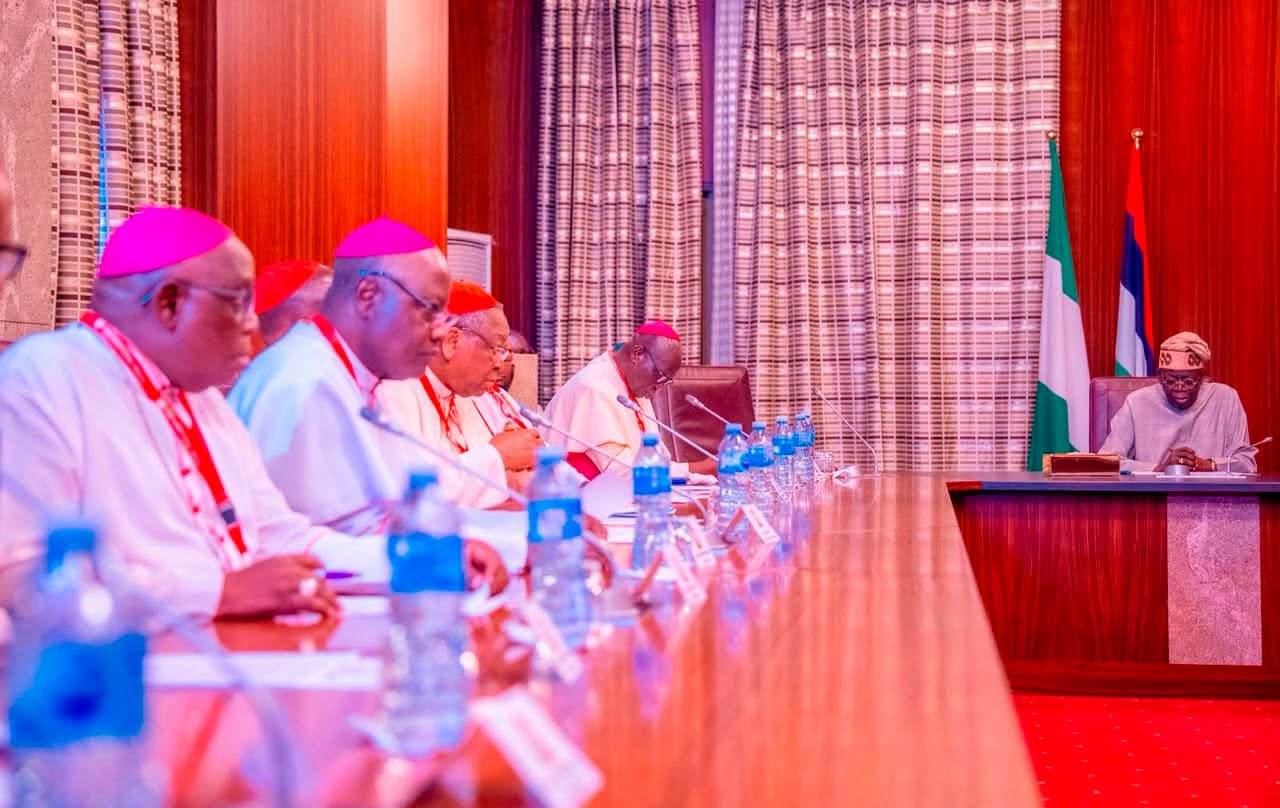
There is something fundamentally inappropriate about Cardinal John Onaiyekan granting a television interview to offer his personal interpretation of what transpired during the private meeting between the Catholic Bishops’ Conference of Nigeria and President Bola Tinubu. In my view, it amounted to an abuse of clerical privilege.
The Catholic bishops requested an audience with the President, and he graciously granted it. During the meeting, they presented their assessment of Nigeria’s economic, social, and security challenges.
Apart from acknowledging the positive impact of the Nigerian Education Loan Fund (NELFUND), they were largely dismissive of what they considered the administration’s achievements. Their presentation was candid and, at times, sharply critical. President Tinubu listened patiently and responded to every concern they raised.
Ordinarily, that should have marked the end of the engagement. The issues raised by the bishops are neither beyond public scrutiny nor immune from rebuttal. Their assessment does not constitute scripture or an article of faith; it is simply one perspective among many, and like any opinion, it can be challenged with facts and evidence.
President Tinubu did precisely that. He addressed each issue individually, offering explanations and counterarguments. On the bishops’ appeal for the return of mission schools to their original owners, the President expressed surprise that the matter was presented to him, noting that it falls within the constitutional jurisdiction of state governments.
He advised the bishops to engage state governors directly, while reminding them that he returned mission schools during his tenure as Governor of Lagos State.
The President also argued that the bishops’ portrayal of Nigeria’s current realities was incomplete and, in some respects, inaccurate. While acknowledging that the nation continues to face serious economic and security challenges, he maintained that significant progress has been recorded.
According to him, Nigeria has emerged from a dark tunnel, with his administration laying the groundwork for recovery. The next phase, he stressed, is ensuring that the benefits of ongoing reforms are increasingly felt by ordinary Nigerians.
What many clerics often overlook in such interventions is that governing a nation is fundamentally different from shepherding a church. In a democracy, every interest group including the Catholic Church has every right to hold government accountable and demand better governance. That is the essence of democratic engagement.
However, leading a nation of over 200 million people requires making difficult choices every day. Those decisions involve balancing competing interests, managing limited resources, and selecting among imperfect options.
Inevitably, some constituencies will be dissatisfied. No president whether Bola Tinubu or any future leader can erase decades of accumulated national challenges overnight.
It is relatively easy to compile a catalogue of Nigeria’s problems. It is considerably more difficult to acknowledge the crises that have been averted. Whatever one’s opinion of President Tinubu’s economic reforms, it is difficult to ignore the severe fiscal challenges his administration inherited, and the steps taken to pull the country away from the brink of financial collapse.
Even the bishops should recognise that one visible outcome has been improved fiscal stability across many states.
For years, countless civil servants and pensioners endured delayed salaries and unpaid pensions. Today, many of those obligations are being met more consistently. This was certainly not the reality in several states between 2014 and the years that followed. Even as recently as four years ago, about 27 state governments struggled to meet their basic financial commitments. Many of those workers and retirees are faithful members of Catholic congregations.
Their lived experiences not official government statements confirm that regular salary and pension payments have brought measurable relief. While this does not erase the hardship many Nigerians continue to face, it would be unfair to dismiss these improvements or pretend they do not exist.
Therefore, when President Tinubu reminded the bishops of these developments during the meeting, he was not being dismissive or aloof, as Cardinal Onaiyekan later suggested. Rather, he was presenting evidence in support of his argument that Nigeria is making measurable progress. A disagreement over facts should not automatically be interpreted as arrogance.
The same reasoning applies to the issue of security. The bishops declared that Nigeria is bleeding, while the President presented a more nuanced assessment. He did not deny the seriousness of the security challenges confronting the country. Instead, he acknowledged the difficulties while highlighting operational successes recorded by the Armed Forces and intelligence agencies across different theatres of conflict.
As Commander-in-Chief, President Tinubu receives classified intelligence reports, operational briefings, and battlefield assessments that are unavailable to the general public. The bishops, like most Nigerians, rely largely on media reports and publicly available information. While this does not make the President infallible, it does mean he has access to a broader range of information that naturally informs his perspective.
Cardinal Onaiyekan’s interview on Arise News also reflected a common misconception among many ideological and professional critics the belief that only critics speak truth to power, while everyone around a president merely echoes what he wants to hear. It is a compelling narrative, but it is rarely an accurate one.
What truth does anyone imagine President Tinubu does not already know? As President, he has multiple channels through which he monitors national sentiment. He reportedly reads an average of ten newspapers daily, watches television discussions, and receives regular security, economic, and social intelligence briefings prepared specifically to aid decision-making.
These reports are neither sanitised nor sugar-coated. Earlier in the week, he even referenced a sharply critical opinion article written by Dr. Chidi Amuta in ThisDay, demonstrating that he remains attentive to dissenting voices.
Beyond official channels, the President also maintains relationships with friends, associates, professionals, and political actors from diverse backgrounds who provide candid informal feedback.
Against this backdrop, the suggestion that only the Catholic Bishops can acquaint him with the realities facing Nigerians is an overstatement. They are undoubtedly an important moral voice, but they are not the exclusive custodians of the nation’s conscience or public opinion.
To assume that public criticism is the only genuine form of truth-telling is to misunderstand how modern governance operates. Presidents are exposed daily to conflicting advice, competing intelligence, uncomfortable assessments, and difficult realities. The central issue is not whether they know the truth but how they respond to it.
The Catholic Bishops fulfilled what they considered their moral responsibility by presenting their concerns directly to the President. In return, President Tinubu accorded them respect by granting the meeting, listening attentively, and responding to every issue raised. That exchange reflected the civility expected in a constitutional democracy.
Reciprocity, however, should have required that the confidentiality and dignity of the engagement be preserved. It was therefore inappropriate for one of the participants to appear almost immediately on national television to provide his own account of what was essentially a private conversation with the President.
Clerical office carries significant privileges, but it also demands corresponding responsibilities. Scripture calls bishops to exhibit temperance, maturity, self-restraint, and wisdom—qualities that become even more essential when engaging matters of state. Public influence is most effective when exercised with discretion, not by transforming privileged access into a platform for post-meeting commentary.
.


