

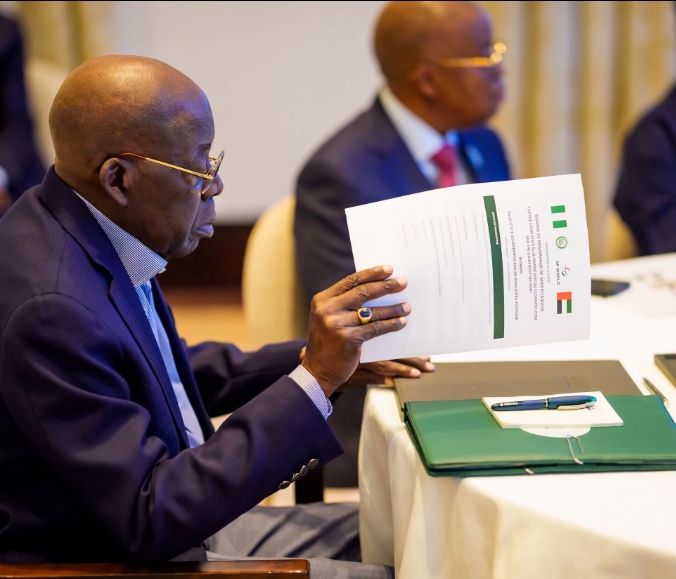
President Bola Ahmed Tinubu has assured domestic and international investors that the Federal Government will continue to provide regulatory clarity, policy stability and a predictable business environment to encourage long-term investment and strengthen Nigeria’s position as a major destination for global capital.
President Tinubu gave the assurance in Paris, France, during the signing of Memoranda of Understanding between the Ogun State Government and DP World, one of the world’s leading port and logistics operators, for the development of the Ogun State Blue Marine Special Economic Zone and the Gateway Deep Seaport.
The agreements represent a major step in Ogun State’s plans to establish an integrated maritime, industrial and logistics hub capable of attracting large-scale investments, supporting manufacturing and exports, creating employment and improving Nigeria’s access to international markets.
Governor Dapo Abiodun led the Ogun State Government delegation to the signing ceremony.
Members of the delegation included the Secretary to the Ogun State Government, Tokunbo Talabi; the Commissioners responsible for Finance, Works, Industry, Trade and Investment, and Transport; as well as a representative of the host community.
The event also brought together senior Nigerian government officials and representatives of the international investment and logistics community.
Those present included the Minister of Marine and Blue Economy, Adegboyega Oyetola; Nigeria’s Ambassador to France, Emmanuel Ayodele Oke; the Managing Director and Chief Executive Officer of the Nigerian Ports Authority, Dr Abubakar Dantsoho; Group Chief Executive Officer of DP World, Yuvraj Narayan; Managing Director of SkyKapital, Karim Noujaim; and Senior Vice President, Business Development, Sub-Saharan Africa Regional Office of DP World, Mohammed Rashid Ismail.
Speaking at the ceremony, President Tinubu described the agreements as an important convergence of government vision, private-sector expertise, financial resources and implementation capacity.
The agreements before us bring together vision, expertise, capital and execution capacity. I particularly welcome DP World, one of the world’s leading port and logistics operators.
I also acknowledge our financial advisers, Sky Capital, and all the investors and partners whose commitment has brought us to this important stage, the President said.
President Tinubu assured investors that the Federal Government would provide the necessary regulatory, institutional and administrative support required to ensure that the projects move smoothly from the agreement stage into actual implementation.
He said the government would also ensure that all parties involved remained accountable for their respective commitments under the agreements.
According to the President, the projects represent an important milestone in Nigeria’s ongoing efforts to attract foreign direct investment, expand productive capacity, diversify the economy away from excessive dependence on oil, and establish the country as a major regional centre for maritime trade, logistics, manufacturing and exports.
The proposed Gateway Deep Seaport at Ogun Waterside is expected to play a significant role in addressing some of the long-standing infrastructure and logistics challenges confronting Nigeria’s maritime sector.
According to the Federal Government, the proposed port will have a four-kilometre berth and an 18-metre draft, allowing it to accommodate larger and deeper-draft vessels used in modern international shipping.
The project is also expected to help decongest the Lagos port corridor and reduce pressure on existing facilities, particularly the Apapa and Tin Can Island ports.
For businesses involved in importing and exporting goods, improved port capacity could help address some of the delays and additional costs associated with congestion and limited vessel-handling capacity.
The proposed deep seaport is also expected to strengthen Nigeria’s position within the African Continental Free Trade Area by providing a competitive trade and logistics gateway capable of serving a much larger regional market.
The President noted that the port would provide infrastructure that could support Nigeria’s ambition to serve a continental market estimated at approximately 1.4 billion people.
The project, therefore, is being positioned not merely as another port development, but as part of a wider industrial and commercial ecosystem linking maritime transportation, manufacturing, logistics, trade and exports.
The proposed Ogun State Blue Marine Special Economic Zone is planned to cover approximately 10,000 hectares, creating a large industrial and commercial environment around the proposed port infrastructure.
The zone is expected to provide space for manufacturing companies, processing industries, logistics operators and other businesses that can benefit from proximity to a deep seaport and integrated transport infrastructure.
President Tinubu disclosed that the projects envisage an initial investment of more than $7 billion in the Nigerian economy.
At full development, the projects are projected to create more than 50,000 direct jobs, in addition to a potentially much larger number of indirect employment and business opportunities across different parts of the value chain.
The Federal Government also expects the projects to contribute significantly to non-oil export earnings by enabling Nigerian businesses to process raw materials, manufacture finished products and access international markets more efficiently.
These agreements envisage an initial investment of more than $7 billion in the Nigerian economy.
At full development, the projects are projected to create more than 50,000 direct jobs and many additional indirect opportunities, while generating substantial non-oil export earnings from Nigerians’ creativity and productivity across the value chain, President Tinubu said.
He described the investment as an example of how Nigeria’s economic diversification objectives could be translated into major physical infrastructure and industrial development.
This is economic diversification made tangible. This is industrialisation made visible. This is Renewed Hope in action,he said.
President Tinubu commended Governor Dapo Abiodun and the Ogun State Government for creating the conditions that enabled the proposed investment to progress.
He specifically acknowledged the state government’s efforts in securing the required land, developing the investment framework and reducing risks associated with the project in order to make the opportunity more attractive to international investors.
I commend Governor Dapo Abiodun and the government and people of Ogun State for securing the land, structuring the investment framework and reducing project risks for global investors, he said.
The President described the partnership between the Federal Government and Ogun State as an example of cooperative federalism, in which subnational governments develop initiatives while the Federal Government provides the necessary support and national-level facilitation.
This is cooperative federalism as envisaged by our Constitution: subnational vision supported by federal facilitation,” Tinubu said.
He further assured the investors and the Ogun State Government that the Federal Government would facilitate critical infrastructure required to make the projects commercially viable.
We will facilitate road, rail and power connectivity; strengthen investment security and our maritime domain; and remove unnecessary bureaucratic obstacles, he said.
According to President Tinubu, the proposed Blue Marine Special Economic Zone is already attracting interest from major global manufacturing and industrial companies.
He said the development of the zone would provide opportunities for imported inputs to be transformed into finished products within Nigeria, while locally sourced raw materials could be processed and exported to international markets.
The President also placed emphasis on employment opportunities for Nigerian youths, particularly within manufacturing, logistics, maritime services, processing and related industries.
Within the zone, imported inputs will be transformed into finished goods, Nigerian raw materials will be processed for export and, most importantly, our young men and women will find dignified, productive and sustainable employment,” he said.
Tinubu described the proposed Gateway Deep Seaport as critical infrastructure for the success of the economic zone.
The Gateway Deep Seaport is the critical infrastructure that will support the zone’s viability. A port moves cargo; a port integrated with a special economic zone helps to build an economy. Each reinforces the other,” he said.
The President said the combination of port infrastructure and industrial development could create a more efficient environment for businesses by bringing manufacturing, processing, logistics and international shipping closer together.
President Tinubu said the Federal Government would continue to cooperate with Ogun State and other subnational governments to remove unnecessary bottlenecks and create an environment where productive investments can deliver value to Nigerians.
He, however, stressed that such cooperation would remain within the framework of Nigeria’s laws and regulatory requirements.
The President said strengthening the maritime economy was an important component of the Federal Government’s broader economic diversification strategy.
He urged the Ogun State Government, DP World and other investors and partners involved in the projects to maintain the momentum generated by the signing ceremony and move quickly towards implementation.
According to Tinubu, Nigeria’s geographical position gives it a strategic advantage in West African trade, but the country has historically faced challenges arising from port congestion, inadequate draft capacity and logistics bottlenecks.
“Nigeria lies at the heart of West African trade. Yet, our strategic advantage has been constrained by port congestion, inadequate draft capacity and logistics bottlenecks that increase the cost of doing business.
These projects respond directly to those constraints,” he said.
The President said the proposed developments were consistent with the government’s approach of delivering infrastructure as interconnected systems rather than isolated projects.
“This is how modern infrastructure should be delivered: as an integrated ecosystem, operated to world-class standards and supported by a serious and responsible government. This is nation-building in its most practical form, he said.
President Tinubu also highlighted the importance of the Lagos-Calabar Coastal Highway to the commercial viability of the proposed Ogun maritime and industrial corridor.
He said the 28-kilometre Ogun State section of the approximately 700-kilometre coastal highway, which is scheduled for completion before the end of 2026, would provide an important transport connection for the proposed economic zone and deep seaport.
According to the President, the road infrastructure is particularly important because it would help connect the coastal development to Lagos, the Nigerian hinterland and wider markets across the African continent.
“The Lagos–Calabar Coastal Highway is central to this corridor’s commercial viability. The 28-kilometre Ogun State section of this 700-kilometre artery, scheduled for completion before the end of this year, will provide a vital transport link for the zone and port,” Tinubu said.
He added that without the road connection, the economic potential of the coastline would remain difficult to fully realise.
“Without it, the coastline would have remained rich in potential but without access. With it, the zone and port will connect more effectively to Lagos, the Nigerian hinterland and markets across the African continent, he said.
The President further explained that the proposed projects would form part of a broader strategic corridor that could connect maritime infrastructure with Nigeria’s energy and gas-export ambitions.
He said the industrial cluster would be located near the proposed Nigerian Navy Operating Base and Dockyard as well as the OK LNG Project.
The proximity of these developments, according to the President, could support the creation of an integrated economic corridor combining maritime operations, industrial production, energy infrastructure, logistics and exports.
“These projects will also anchor a broader strategic corridor near the proposed Nigerian Navy Operating Base and Dockyard and the OK LNG Project, connecting this industrial cluster to our energy and gas-export ambitions,” the President noted.
The signing of the agreements in Paris marks another stage in the Federal Government’s efforts to attract international capital into major infrastructure projects while encouraging stronger partnerships between federal and state governments.
For Ogun State, the proposed Gateway Deep Seaport and Blue Marine Special Economic Zone are being presented as major components of its long-term industrial and maritime development plans.
For the Federal Government, the projects form part of a wider strategy to improve trade infrastructure, expand non-oil exports, create jobs, support manufacturing and strengthen Nigeria’s role in regional and international commerce.
The success of the projects will ultimately depend on the implementation of the agreements, the delivery of supporting infrastructure, financing arrangements, regulatory coordination and the ability of the participating institutions and investors to meet their respective commitments.
The Federal Government has reiterated its commitment to providing the policy and institutional environment required to move the projects from agreements to implementation.
Bayo Onanuga
Special Adviser to the President
(Information & Strategy)
September 24, 2026