
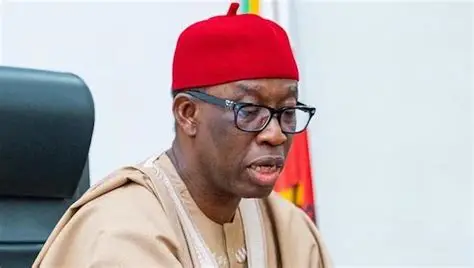
ASABA: There are growing political rumours across Delta State that former governor Sen. Ifeanyi Okowa may attempt a return to the Senate in the 2027 general elections. Okowa previously represented Delta North Senatorial District during the 7th Assembly before becoming governor of Delta State.
However, despite his political experience and strong grassroots network, several factors suggest that Delta North, popularly known as Anioma, may not unanimously support him, even if he secures the senatorial ticket of the All-Progressives Congress (APC).
Below are some of the major issues shaping the debate within the Anioma political landscape.
Questions Over His Previous Senate Performance
One of the concerns frequently raised by political observers in Delta North relates to Okowa’s earlier tenure in the Senate. Some critics argue that during the four years he spent at the National Assembly, there is no visible federal projects or major developmental initiatives directly linked to his representation.
Although supporters insist he contributed through legislation and policy discussions, the perception among some voters remains that his Senate tenure did not significantly transform the district. This lingering sentiment could influence voters who may prefer a different candidate in 2027.
Strong Support from the Ika Nation
Despite the criticisms in some quarters, Okowa continues to enjoy strong support in the Ika nation, his political base. Many people in the Ika communities appreciate his grassroots political style and the benefits they received during his time as governor.
Among the major projects credited to him is the establishment of the University of Delta, whose campuses were located in parts of the Ika area, including Owa-Alero, his hometown.
In addition, many Ika politicians were empowered through appointments and political opportunities during his tenure as governor. Because of this, Okowa is still regarded by many Ika people as a political leader who uplifted their community.
However, this strong support within Ika may not automatically translate into widespread backing across the entire Anioma region.
Concerns About Political Dominance in Ika
Another issue generating debate is the perception that Okowa’s political influence has been heavily concentrated within the Ika axis.
Critics point to several developments:
- His daughter, Marilyn Okowa‑Daramola, currently serves in the Delta State House of Assembly representing Ika North-East.
- Some of his political protégés are believed to hold key positions in Ika North-East and Ika South local governments.
- His political influence is also perceived in determining leadership positions at the local government level.
Because of these developments, some communities have raised concerns about concentration of political power within one political family or structure.
Many critics now ask a recurring question:
Why should one political leader dominate several political offices at the same time and still seek another major position?
This perception could influence voters who may prefer a fresh political face rather than another Okowa return to the Senate.
The Rising Political Profile of Ned Nwoko
Another factor that could significantly shape the 2027 senatorial contest is the influence of Ned Nwoko, the current senator representing Delta North.
Nwoko has gained substantial political attention for his advocacy for the creation of Anioma State out of the present Delta State and parts of Edo State.
If the agitation for Anioma State gains momentum before the 2027 elections, it could dramatically reshape political alignments in the region.
Many communities see the creation of Anioma State as a long-standing aspiration that could bring greater political autonomy and development to the people of the area.
The Edo Ika Factor
The proposed Anioma State also includes Ika-speaking communities in Edo State. These communities have historically complained of marginalization within Edo politics.
If the Anioma state creation campaign becomes a dominant political issue before the elections, many observers believe these communities could strongly support leaders championing the cause.
In such a scenario, Senator Nwoko’s advocacy for the new state may boost his popularity among voters who see the project as a historic opportunity.
Regional Voting Patterns in Anioma
Delta North is made up of several ethnic and cultural groups, including:
- Aniocha
- Oshimili
- Ika
- Ukwuani
Historically, these groups often rally around leaders from their own sub-regions.
For instance:
- The Aniocha and Oshimili areas may favour candidates from their axis.
- Ika communities are more likely to support Okowa.
- The Ukwuani people may become the deciding bloc, with their votes possibly split between major contenders.
Because of these dynamics, the Anioma region may unite behind Sen, Ned Nwoko, making the 2027 contest highly competitive.
Possible Influence of Governor Sheriff Oborevwori
Political analysts also believe that if Okowa decides to contest, he could still secure the APC ticket with the support of the sitting governor, Okawa’s political godson Rt Hon. Sheriff Oborevwori, who is believed to maintain strong political influence within the state’s political structure and the present Delta APC
However, winning the party primary does not necessarily guarantee victory in the general election.
Threat from Other Political Parties
Another factor that could complicate Okowa’s potential Senate bid is the emergence of strong candidates from other political parties, particularly the African Democratic Congress (ADC) or other opposition platforms.
If a popular candidate emerges from another party with strong grassroots appeal, the election could become a highly competitive multi-party contest.
While Ifeanyi Okowa remains one of the most influential political figures in Delta State, several political realities could shape the outcome of the 2027 Delta North senatorial race.
These include:
- lingering criticism of his previous Senate tenure
- concerns about political dominance within the Ika axis
- the growing influence of Ned Nwoko
- the momentum behind the proposed Anioma State
- regional voting dynamics across Anioma communities
- and possible competition from other political parties.
Ultimately, the 2027 senatorial race in Delta North may depend on how candidates build alliances across the various Anioma communities and address concerns about fair representation and development.