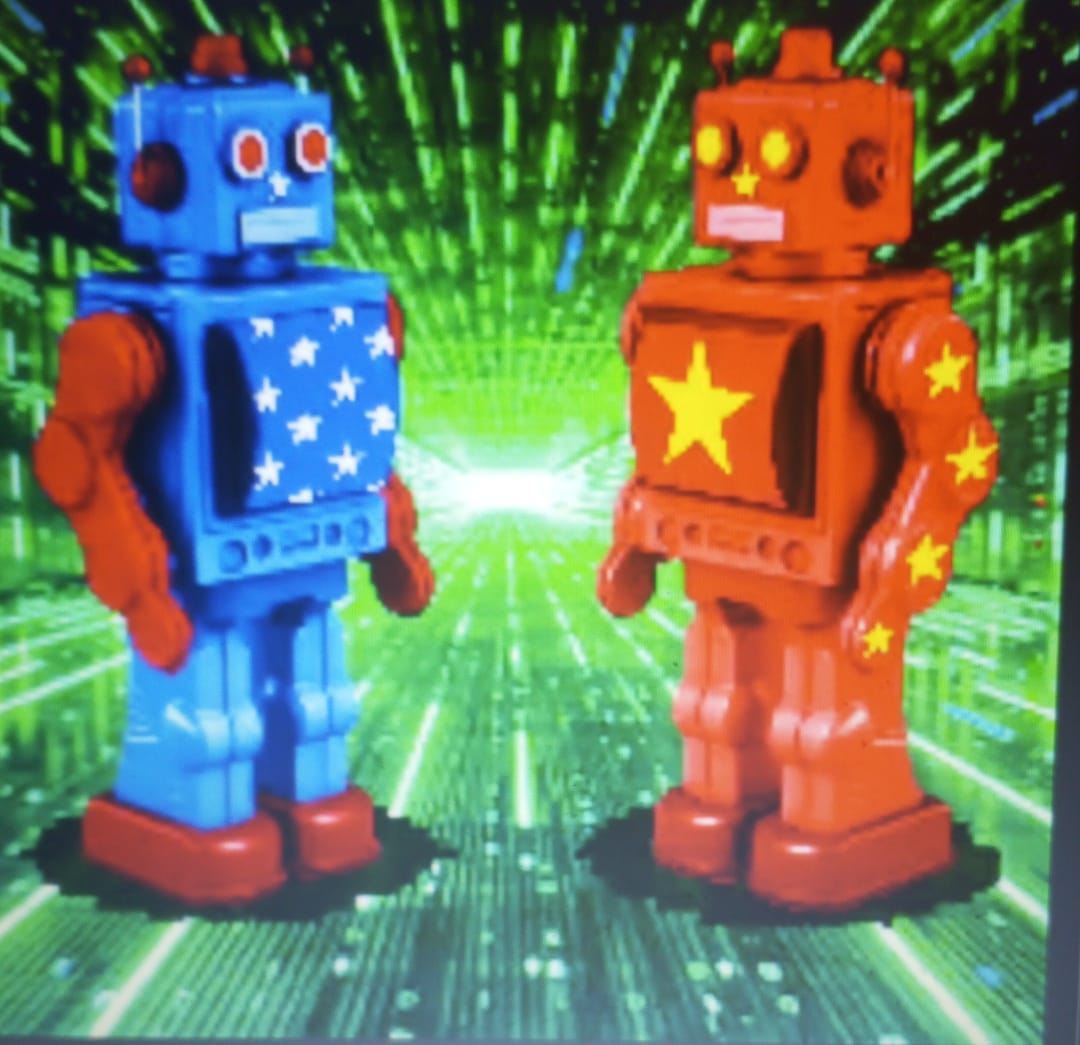
The growing competition between the United States and China over artificial intelligence is increasingly shaping technology policy, national security debates and the future direction of the global AI industry.
At the centre of the debate is a warning from Anthropic CEO Dario Amodei and other Silicon Valley figures that the United States cannot afford to fall behind China in the development of advanced artificial intelligence.
The argument has gained renewed attention as governments and technology companies debate how quickly AI should be developed, how much regulation is necessary and whether restrictions on advanced technology could give China an advantage.
US President Donald Trump has also framed the issue as a strategic competition, saying America must maintain its lead in AI because the country that dominates the technology could gain significant economic and geopolitical influence.
For years, major US technology companies have described AI development as a competition between Washington and Beijing.
Amodei has taken one of the strongest positions, arguing that the United States and its allies should continue advancing AI while preventing China from gaining access to technologies that could dramatically accelerate its capabilities.
His concern is not limited to economic competition. Amodei has warned that highly advanced AI controlled by an authoritarian government could eventually be used for military applications, surveillance and domestic repression.
He has described a future in which extremely powerful AI systems could enable large-scale autonomous weapons and sophisticated tools of state control.
At the same time, Amodei has supported efforts to slow the development of frontier AI when necessary to address safety concerns. His position is that any slowdown must not allow China to overtake the United States.
Anthropic has increasingly linked AI safety with maintaining American technological leadership.
The company’s head of public policy, Sarah Heck, said this week that the United States needs to remain ahead in AI and argued that safety efforts would be difficult if America were no longer leading the field.
That position illustrates a broader tension within the AI industry.
Companies are calling for safeguards and greater oversight because of the potential dangers associated with increasingly powerful AI systems. At the same time, some of those same companies are resisting policies they believe could slow American development relative to China.
The debate has therefore expanded beyond traditional questions about AI regulation to include national security, international competition and control of critical technologies.
Amodei is not the only influential technology figure concerned about China’s AI ambitions.
A number of technology executives, investors and policy experts have argued that the United States should take stronger measures to prevent China from obtaining the most advanced AI chips and equipment.
Some have also proposed government-backed programmes designed to accelerate the development of artificial general intelligence, commonly known as AGI.
Leopold Aschenbrenner, a former OpenAI researcher, has argued that achieving superintelligent AI could provide major economic and military advantages and that the United States should work to reach that point before China.
Other prominent technology figures have approached the issue from a military and geopolitical perspective.
The Guardian report notes that Google co-founder Eric Schmidt, Scale AI founder Alexander Wang and Center for AI Safety director Dan Hendrycks previously outlined a strategy comparing AI competition to Cold War nuclear deterrence.
Their proposal suggested that the United States and China could attempt to discourage each other from seeking an AI monopoly through the threat of cyberattacks and other forms of retaliation.
One of the most significant areas of disagreement is over advanced semiconductor exports.
Amodei has supported restrictions on the sale of sophisticated AI chips and semiconductor manufacturing equipment to Chinese companies, arguing that limiting access to these technologies could slow China’s ability to develop cutting-edge AI.
Nvidia CEO Jensen Huang has taken a different position, criticising US export controls and arguing that restrictions could ultimately undermine American competitiveness.
The disagreement reflects a wider debate in Washington and Silicon Valley over whether restricting China’s access to advanced technology will strengthen US national security or encourage the development of a more independent Chinese technology ecosystem.
The debate has also attracted more extreme arguments from some figures associated with the AI safety movement.
Eliezer Yudkowsky, an early and prominent AI safety advocate, has previously argued that governments should consider extraordinarily aggressive measures to prevent potentially catastrophic AI development by rival countries.
His proposals have included the possibility of military action against foreign AI data centres and accepting significant geopolitical risks in pursuit of an international AI moratorium.
Such arguments remain highly controversial and are not representative of the entire technology industry.
The US framing of the AI race does not necessarily match the way Chinese officials and technology companies view the issue.
Experts cited in the report say Chinese discussions around AI have traditionally focused more heavily on domestic stability and social control than on the existential risks frequently highlighted by American AI safety advocates.
China has also viewed some US calls for AI safety cooperation with suspicion, particularly when those calls are accompanied by restrictions on Chinese access to advanced chips and technology.
Chinese state-backed media have criticised Amodei’s position, accusing him of promoting a Cold War-style approach to AI competition.
Analysts say the combination of export restrictions and calls for international AI safety agreements could make cooperation between Washington and Beijing more difficult because Chinese officials may interpret safety proposals as another mechanism for limiting China’s technological development.
The disagreement comes at a time when the potential risks of advanced AI are becoming increasingly difficult for governments to ignore.
Experts have raised concerns about autonomous weapons, cyberattacks, large-scale surveillance and other applications of increasingly capable AI systems.
The challenge for policymakers is balancing those risks against the economic and strategic advantages that countries could gain by developing the technology faster than their competitors.
The result is an increasingly complicated debate: slowing AI development could reduce some risks, but US technology leaders fear that doing so without similar restrictions in China could shift the balance of power.
The United States and China are expected to discuss AI cooperation as part of broader diplomatic engagement between the two countries.
The discussions are likely to face significant challenges because the two sides have different approaches to technology, national security and economic competition.
For Silicon Valley’s China hawks, maintaining US leadership is a central component of AI safety and national security.
For critics of the industry’s approach, however, invoking competition with China could also become a way of resisting domestic regulation and allowing AI companies to continue expanding rapidly.
As governments grapple with the technology’s potential, the central question is becoming increasingly difficult to separate from geopolitics: Can countries reduce the risks of artificial intelligence without turning the race to develop it into an even more dangerous global competition?