


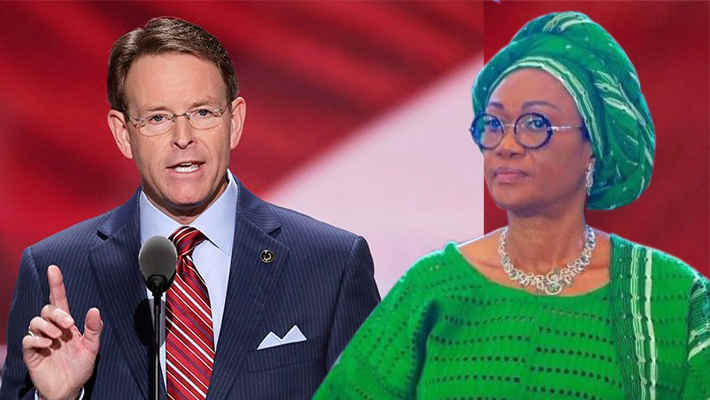
WASHINGTON: An American conservative broadcaster, Tony Perkins, has publicly revealed that he refused a request from Nigeria’s First Lady, Senator Oluremi Tinubu, to appear on his television programme to discuss religious freedom in the country. Perkins said he did not want his platform used to cover up what he described as the ongoing persecution and killing of Christians in Nigeria.
Perkins, host of the political talk show Washington Watch and a prominent U.S. evangelical figure, made the disclosure during a February 4 broadcast with U.S. Congressman Chris Smith, a long-time advocate for international religious freedom.
The First Lady of Nigeria was here this week, and in fact, they wanted to come on the programme to talk about religious freedom, Perkins said.
And I said, I’m not gonna meet with them or have a meeting with anybody. I’m not gonna give them a platform to cover up what they’re doing in Nigeria.
The disclosure has intensified scrutiny of Nigeria’s handling of religious violence, particularly allegations that Christian communities are being targeted.
Congressman Smith criticized the Nigerian government for allegedly downplaying attacks against Christians while privately engaging lobbyists in Washington to improve the country’s image.
Perkins’ account suggests that efforts by the Tinubu administration to manage international perceptions may face resistance from influential voices in the U.S., particularly those concerned about religious freedom violations.
As of reporting, Senator Oluremi Tinubu has not responded publicly to Perkins’ remarks. The lack of response has fueled criticism from opposition figures and civil society groups, who argue that the Nigerian government continues to be evasive about the true scale of religiously motivated violence.
Government supporters, however, maintain that Nigeria’s security issues are primarily driven by banditry, insurgency, and criminality, not religious persecution. They argue critics oversimplify the crisis for political or ideological purposes.
The First Lady’s visit to the U.S. coincided with her attendance at the National Prayer Breakfast in Washington, D.C., a high-profile gathering of political leaders, clergy, and diplomats.
While former President Donald Trump publicly acknowledged her presence, Perkins’ refusal indicates that not all U.S. influencers share the same optimism about Nigeria’s image.
The U.S. designated Nigeria a Country of Particular Concern in November 2025 over alleged violations of religious freedom, a decision rejected by Abuja.
Critics argue the Nigerian government’s lobbying efforts in Washington cannot substitute for addressing domestic security challenges and protecting vulnerable communities.
Perkins’ stance has been praised by Christian advocacy groups in Nigeria and abroad, who describe it as a demonstration of moral clarity.
Conversely, supporters of the government warn that framing the situation as “genocide” is inflammatory and could further strain Nigeria-U.S. relations.
The incident highlights Nigeria’s growing image challenge internationally. With ongoing insecurity and mounting criticism from U.S. lawmakers, the Tinubu administration faces mounting pressure to convincingly demonstrate its commitment to protecting all citizens, regardless of faith.