


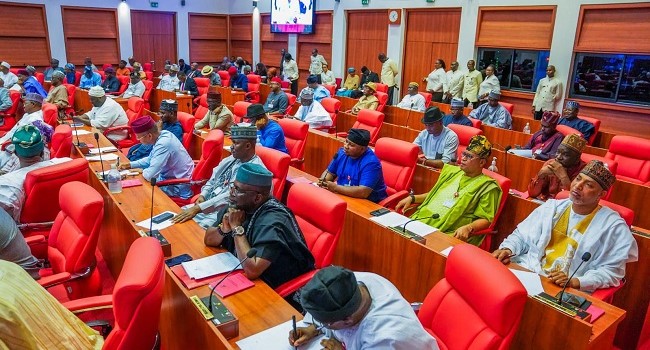
ABUJA: The Senate on Tuesday constituted a 12-member conference committee to interface with the House of Representatives on the Electoral Act Amendment Bill, following intense deliberations and sharp disagreements during plenary over key provisions of the proposed legislation.
Senate President Godswill Akpabio announced the committee during an emergency session, stressing the urgency of concluding legislative work on the electoral reforms to enable timely presidential assent.
The Senate delegation will be chaired by former Plateau State Governor, Senator Simon Lalong. Other members include Senators Orji Uzor Kalu, Tahir Monguno, Adamu Aliero, Abba Moro, Asuquo Ekpenyong, Aminu Iya Abbas, Tokunbo Abiru, Niyi Adegbonmire (SAN), Jibrin Isah, Ipalibo Banigo and Onyekachi Nwebonyi.
Akpabio explained that the committee membership was increased from nine to twelve after consultations with Senate leadership to ensure broader representation and faster resolution of contentious issues.
He urged the lawmakers to treat the assignment with dispatch, expressing optimism that the harmonised bill could reach President Bola Tinubu for assent before the end of February if deliberations are concluded within days.
The plenary, however, turned tense when Senate Chief Whip Tahir Monguno raised a motion seeking rescission of the chamber’s earlier approval of Clause 60(3) of the Electoral Amendment Bill.
Monguno anchored his motion on Orders 1(b) and 52(6) of the Senate Standing Orders (2023 as amended), arguing that the clause required further legislative clarity. His motion was seconded by Senator Abdul Ningi (PDP, Bauchi Central).
Trouble began when Monguno read the clause without the phrase “real-time,” substituting transmission with transfer, a move that immediately drew protests from several lawmakers.
Senator Enyinnaya Abaribe (APGA, Abia South) led the opposition, insisting that removing “real-time electronic transmission” could undermine electoral transparency. He repeatedly raised points of order, prompting loud exchanges across party lines.
Abaribe cited the Senate Committee on Electoral Matters report, which clearly states that polling unit results should be electronically transmitted to the Independent National Electoral Commission’s Result Viewing Portal in real time after due certification by presiding officers and party agents.
At the peak of the dispute, Abaribe invoked Order 72, demanding a formal division of the chamber to determine lawmakers’ positions on the contentious clause.
Several senators contributed to the debate, reflecting divergent positions:
-
Pro-amendment lawmakers argued that retaining flexibility in transmission methods would safeguard elections against technical failures and logistical constraints, particularly in remote areas.
-
Reform advocates, however, maintained that real-time electronic transmission remains essential for credibility, transparency and public trust in Nigeria’s electoral process.
-
Some senators called for a balanced approach, suggesting a hybrid system combining electronic transmission with manual backup to prevent disputes.
The exchanges created a charged atmosphere in the chamber before Senate leadership moved to restore order and proceed with the constitution of the harmonisation committee.
Despite the disagreements, Senate leaders emphasised the importance of concluding work on the Electoral Act amendment ahead of future electoral cycles.
Akpabio reassured lawmakers that the joint committee would carefully review all disputed clauses and ensure the final legislation reflects national interest while strengthening electoral integrity.
The harmonised bill, once finalised by both chambers, will be transmitted to President Tinubu for assent.