


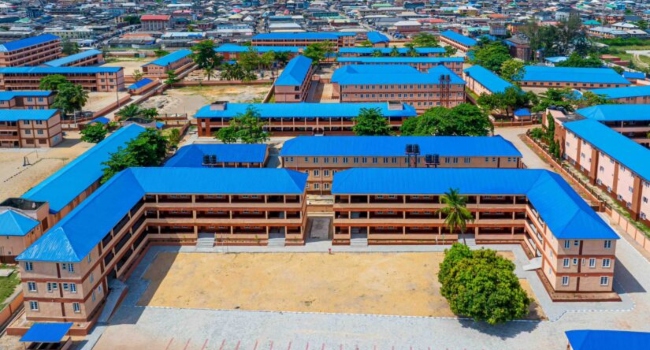
The Lagos State Government has unveiled the newly regenerated Tolu Schools Complex in Adekunle, marking a significant milestone in its drive to deliver quality and inclusive education across the state.
The sprawling complex, built on approximately 11.7 hectares of land, comprises 36 public schools, including 31 secondary schools and five primary schools, making it one of the largest education clusters in Nigeria.
Speaking at the commissioning ceremony, Governor Babajide Sanwo-Olu described the project as a bold reimagining of public education in a modern African city.
“This is not just a facelift or cosmetic upgrade,” the governor said. “What we have delivered here is a full transformation—a school system designed for the 21st century.”
He emphasised that the project reflects a broader commitment to ensuring that every child, regardless of background, has access to world-class education.
Today, we are fulfilling a covenant between the government and the people—that no child will be denied the dignity of quality education, he added.
The redeveloped complex features state-of-the-art infrastructure aimed at equipping students with both academic knowledge and practical skills.
Key facilities include:
- An ICT and robotics hub
- Fully equipped science laboratories for physics, chemistry, and biology
- A four-storey vocational skills acquisition centre
- Newly constructed classroom blocks with 18 classrooms each
- Renovation of 24 existing classroom structures
According to Governor Sanwo-Olu, these facilities were deliberately designed to prepare students for a rapidly evolving global economy.
“We are building not just schools, but environments where students can thrive, innovate, and compete globally, he said.
The event was attended by top government officials, including Senate President Godswill Akpabio, who represented President Bola Ahmed Tinubu.
Akpabio commended the Lagos State Government for what he described as a bold investment in human capital development.
Education must be seen not just as a social service, but as a key driver of economic growth, he said.
He noted that the project aligns with the Federal Government’s development agenda, which prioritises access to quality education and skills acquisition.
Also speaking, Minister of Education Tunji Alausa praised the project as a model of collaboration between state and federal governments.
He said the Tolu Schools Complex reflects the broader educational priorities of the current administration, particularly in preparing students for a competitive global economy.
“This project demonstrates what is possible when leadership is purposeful and when governments work together with a shared vision,” Alausa stated.
The Tolu Schools Complex has a long history dating back to 1981, when it was originally established under the administration of former Lagos State governor Lateef Jakande as part of a mass education policy.
The site itself was reclaimed from the Lagos Lagoon, transforming it into a major educational hub in Ajegunle.
Further expansion came during the tenure of President Bola Ahmed Tinubu as Lagos governor between 1999 and 2003, including the construction of the Bola Ige Millennium Secondary School within the complex.
The latest phase of redevelopment, which began in early 2024, represents the most comprehensive upgrade in the institution’s history.
One of the core objectives of the regeneration project is to address overcrowding in public schools and create a more conducive learning environment.
By expanding classroom capacity and modernising facilities, the Lagos State Government aims to improve both teaching quality and student outcomes.
Education stakeholders say the project could serve as a blueprint for similar large-scale school upgrades across Nigeria and other African cities facing rapid population growth.
The unveiling of the Tolu Schools Complex underscores Lagos State’s ambition to position itself as a leading education hub in Africa.
With continued investment in infrastructure, technology, and skills development, the state is seeking to build a workforce capable of driving innovation and economic growth in the years ahead.
For residents of Ajegunle often referred to as “AJ City”—the project represents more than just new buildings. It is a renewed promise of opportunity, access, and a better future for the next generation


