


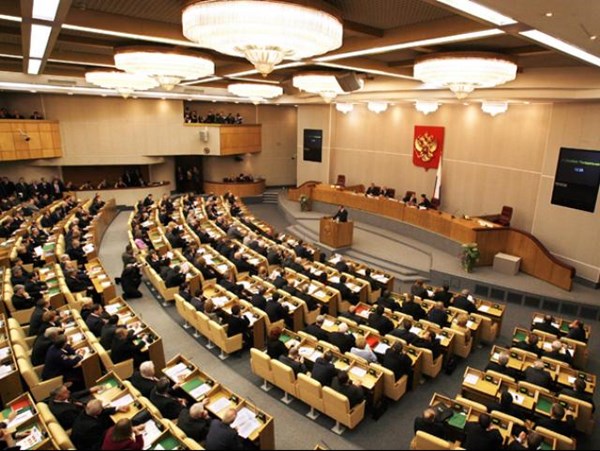
Russia’s ruling United Russia party has reportedly demanded corrections from media organisations over reports claiming that 86 participants in Russia’s war against Ukraine had secured seats in the country’s State Duma following the latest parliamentary election.
The dispute emerged on Monday, September 21, 2026, after a report containing the figure was removed from a Russian media website following what was described as a request from United Russia’s press service.
The removal reportedly followed a clarification of the data, adding to uncertainty over the actual number of war participants who will enter the ninth convocation of the State Duma under the United Russia banner.
The controversy followed comments attributed to Vladimir Yakushev, secretary of United Russia’s General Council.
Speaking at a press conference reported by TASS, Yakushev initially said that 86 participants in the war against Ukraine representing United Russia had won seats in the State Duma.
He also said two members of the party’s youth organisation, Young Guard, would become Duma deputies.
Yakushev described the election of war participants as a significant contribution and said United Russia had supported them through the process of becoming candidates and subsequently winning positions at different levels of government.
However, a different figure later emerged.
According to reports, TASS subsequently published another account in which Yakushev was quoted as saying that 49 war participants would receive United Russia mandates in the State Duma.
The conflicting figures have raised questions about how many military personnel and war participants actually secured parliamentary seats.
The independent Russian outlet Agentstvo reportedly drew attention to the discrepancy after noting that TASS did not publish the original report containing Yakushev’s statement about 86 war participants.
A report carrying the same figure was also reportedly removed from another website.
The explanation given for the removal was a request from United Russia’s press service following a clarification of the data.
The episode has consequently become part of the broader debate surrounding the composition of Russia’s incoming parliament following the election.
Earlier figures released by United Russia also differed at various stages of the election campaign.
According to the reported data, the party said in June that 76 participants in the war against Ukraine would contest the State Duma election as United Russia candidates.
That figure reportedly included at least 26 people described as government officials who had visited the war zone but were not involved in combat.
By September 18, the party had reportedly fielded 80 war participants as candidates.
The distinction between combat participants, personnel who served in the war zone and officials who visited occupied or frontline areas is significant because different definitions could account for some of the discrepancies in the figures being United Russia Leads Parliamentary Vote
Russia’s Central Election Commission announced preliminary results showing United Russia well ahead of the other parties in the parliamentary election.
With almost 97 per cent of ballots processed, United Russia had received 57.82 per cent of the vote, according to the reported CEC figures.
The Communist Party of the Russian Federation was second with 13.76 per cent, followed by the Liberal Democratic Party of Russia with 9.01 per cent.
New People was reported to have received 7.96 per cent.
A Just Russia initially stood below the five-per-cent threshold required for parliamentary representation, with 4.96 per cent after more than 95 per cent of ballots had been counted.
However, after 96.95 per cent of ballots were processed, the CEC reported that the party had reached exactly 5 per cent, allowing it to qualify for representation in the new State Duma.
The CEC reported voter turnout at 59.32 per cent.
The three-day parliamentary election also included voting in areas of Ukraine that Russia has occupied and claimed as part of its territory.
Ukraine and many Western governments do not recognise Russia’s sovereignty over those territories.
The election has also attracted criticism from Germany and the European Union, which questioned the legitimacy and conduct of the vote, particularly in the occupied Ukrainian territories.
Yabloko, a prominent Russian party that has opposed the war, was barred from participating in the election.
The disagreement over the number of war participants entering the State Duma comes as Russia continues to give prominent political attention to military personnel and veterans of its war against Ukraine.
United Russia has presented the inclusion of war participants among its candidates as part of efforts to bring people with military and frontline experience into government.
However, the conflicting figures released in connection with the election have created uncertainty over the exact number of such candidates who ultimately secured parliamentary mandates.
Further official clarification from United Russia or the Central Election Commission would be needed to establish the final number.


