
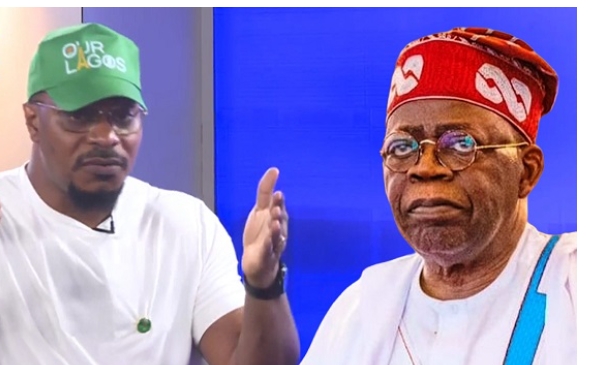
LAGOS: A prominent chieftain of the African Democratic Congress (ADC), Gbadebo Rhodes-Vivour, has declared that Nigeria’s President, Bola Ahmed Tinubu, has no realistic pathway to secure re-election in the 2027 presidential election.
Rhodes-Vivour, who was the 2023 governorship candidate of the Labour Party Nigeria in Lagos, made the assertion during an appearance on the political programme Politics Today on Channels Television on Wednesday.
According to him, recent data from independent polling organisations suggests that the current administration is facing declining support across key voting blocs that were crucial to Tinubu’s victory in the 2023 election.
Rhodes-Vivour said internal polling conducted by opposition groups and other independent bodies indicates that the president’s chances of winning another term are slim.
“I have looked at data and credible polling that is going on now. There is no pathway for the president to emerge victorious,” he said.
The Lagos-based politician argued that political developments across the northern region of Nigeria — which he said delivered a large portion of Tinubu’s votes in the last election — suggest a significant shift in voter sentiment.
When you look at the North that gave him about 62 per cent of his votes, you see the political tsunami that is happening there,” Rhodes-Vivour stated.
Rhodes-Vivour also criticised the composition and direction of the current administration, alleging that the government primarily serves a narrow circle of political allies rather than the broader national interest.
He described the administration as a “city boys’ government,” a phrase widely used in Nigerian political discourse to describe a close network of loyal political associates.
You have a president that created a government system that is just for the city boys,” he said. It is not even a proper South-West government; it is just his cronies who are in charge.
The comments reflect growing criticism from opposition figures who argue that the government’s policies and appointments favour political loyalists.
Rhodes-Vivour further accused the presidency of attempting to weaken opposition parties ahead of the next general election.
According to him, the alleged strategy involves creating internal crises within opposition parties to reduce electoral competition.
The best pathway he sees is to create an environment where he is the only candidate on the ballot for the presidency, Rhodes-Vivour said.
That is what he is trying to achieve, but he is not going to succeed.”
His remarks come amid an ongoing controversy involving the leadership of the African Democratic Congress and actions taken by Nigeria’s electoral body, the Independent National Electoral Commission (INEC).
Last week, INEC removed the names of former Senate President David Mark and former Osun State governor Rauf Aregbesola from its official portal as chairman and secretary of the ADC.
The electoral commission said the action was based on a court directive ordering parties to maintain the status quo pending the resolution of a legal dispute.
However, the ADC leadership rejected the decision, accusing INEC of misinterpreting the court order and interfering in the party’s internal affairs.
Tensions escalated earlier this week when several prominent opposition figures staged a protest at the headquarters of the Independent National Electoral Commission in Abuja.
The protest, organised under the banner “Save Nigeria Democracy,” brought together key political leaders from across the country.
Among those present were former presidential candidate Peter Obi, former Vice President Atiku Abubakar, former Rivers State governor Rotimi Amaechi, former Kano State governor Rabiu Musa Kwankwaso, former Senate President David Mark, former Sokoto State governor Aminu Tambuwal, and former Osun governor Rauf Aregbesola.
Hundreds of supporters also joined the demonstration, including members of the influential Kwankwasiyya Movement, a political group associated with Kwankwaso.
The protesters accused the electoral body of undermining democratic processes and demanded transparency in its dealings with political parties.
The developments signal the early intensification of political rivalry ahead of Nigeria’s 2027 general elections, even though the polls are still more than a year away.
Opposition leaders have increasingly voiced concerns about the state of democracy and electoral fairness, while the ruling party has dismissed claims that it is attempting to suppress political competition.
Supporters of President Tinubu have also rejected allegations that the administration is orchestrating crises within opposition parties.
Nevertheless, analysts say the growing alliances among opposition leaders — including figures who previously competed against one another — may indicate efforts to build a broad coalition capable of challenging the ruling party in the next presidential contest.
The political atmosphere in Nigeria has become increasingly charged as parties reposition themselves for the 2027 race.
While Rhodes-Vivour insists that the president lacks the electoral strength to win another term, supporters of the administration argue that ongoing economic reforms and infrastructure initiatives could eventually boost Tinubu’s political standing.
For now, the debate reflects deeper divisions within Nigeria’s political landscape — a contest that is expected to intensify as the country moves closer to another decisive election cycle.