


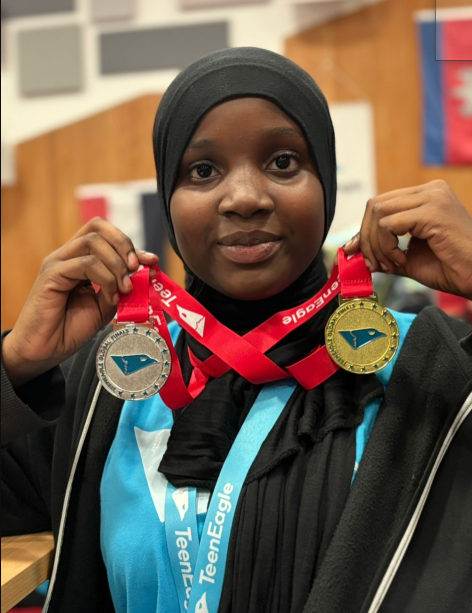
Nafisa Abdullah Aminu, a student at Nigerian Tulip International College (NTIC), was named the overall best performer in English Language Skills at the 2025 TeenEagle Global Finals in London.
She beat out more than 20,000 competitors from 69 countries, including students from nations where English is the first language — a detail that has made her win even sweeter for many Nigerians following the story.
Judges praised Aminu for her command of the language, her poise in communication, and the depth of her analysis, qualities that set her apart in a competition built to test far more than vocabulary. Teen Eagle is designed to push teenagers on critical thinking, confidence, and their ability to communicate on a world stage, not just how well they can recite grammar rules.
Aminu wasn’t the only Nigerian to come home with an award. Rukayya Muhammad Fema took the Best in Debate title, while Hadiza Kashim Kalli walked away with the Outstanding Talent Award and a gold medal. Three Nigerian girls dominating the podium at a global competition has become a story about more than academics. it’s being read as proof of what Nigerian girls can achieve when given the right platform.
News of the win triggered a wave of reactions from Nigeria’s political class. President Bola Ahmed Tinubu was among the first to weigh in, with his office describing the girls as world champions and pointing to their success as evidence that the country’s youth are capable of excellence on the biggest stages.
The Ministry of Education echoed that sentiment, with both the Minister and Minister of State calling the achievement historic and a source of inspiration, while reaffirming the government’s commitment to investing in quality education for young Nigerians.
Politicians outside government added their voices too. Former Vice President Atiku Abubakar highlighted the achievement as a reminder of what’s possible for Nigerian girls when they’re given quality education and real support.
Peter Obi went a step further, calling it a moment of national pride and pushing the federal government to reward the girls with fully funded scholarships, arguing that gesture alone could motivate a new generation of students to aim higher.
For Aminu’s family, the celebration is deeply personal. Her father, Hassan Salifu, credited the Yobe State Government’s investment in education for making his daughter’s success possible, singling out Governor Mai Mala Buni for prioritizing schooling in the state.
Her school and teachers have also received praise from the family for the role they played in shaping her into a global winner.
This win adds to a growing string of international academic wins for Nigerian students, and it arrives at a time when conversations about the state of education in the country are often dominated by bad news strikes, underfunding, insecurity in schools. Aminu, Fema, and Kalli’s success is a reminder that talent and opportunity, when they meet, can still produce world-beating results.
For three young girls, it was a personal triumph. For Nigeria, it’s being held up as proof that the country’s classrooms still have plenty to offer the world.


