


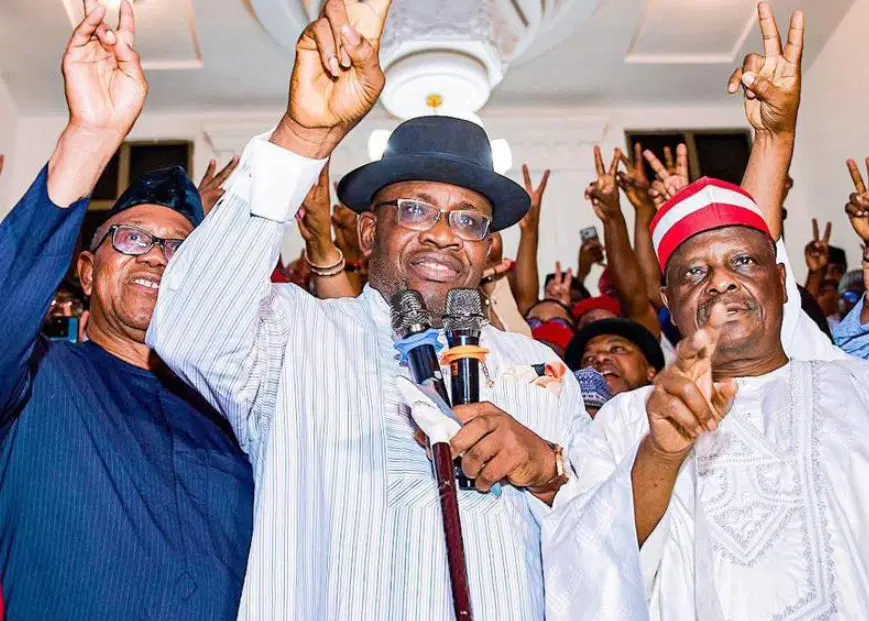
LAGOS: A fresh political controversy has erupted over the registration of the Nigeria Democratic Congress (NDC), as the party’s National Leader, Seriake Dickson, dismissed allegations of irregularities, while Umar Ardo vowed to challenge the process in court.
Dickson urged Nigerians to disregard what he described as propaganda surrounding the party’s registration by the Independent National Electoral Commission (INEC), insisting that due process was followed.
The former Bayelsa State governor maintained that the NDC’s formation dates back nearly a decade, countering claims that it was hastily registered without meeting legal requirements.
According to him, the party initially applied for registration in 2017 and received approval before the process was later halted. He explained that when INEC resumed party registration in 2025, the group revisited and updated its earlier application.
For the record, we initiated the registration process as far back as 2017. When registration resumed, we updated our application accordingly, Dickson stated.
He described the NDC as an ideological platform aimed at long-term national development, with strong emphasis on youth inclusion, women participation, and grassroots mobilization.
Dickson also highlighted what he called a growing national momentum, citing the influx of experienced political figures and grassroots supporters into the party.
The controversy comes amid major political realignments, following the defection of key figures such as Peter Obi and Rabiu Kwankwaso to the NDC.
Party officials claim that over 10 million Nigerians registered within 48 hours, a figure presented as evidence of widespread dissatisfaction with existing political structures.
The party has also moved quickly to consolidate its structure, conducting state congresses nationwide and electing executives in several states, including Delta, Ondo, and Nasarawa.
However, Ardo, a promoter of the All Democratic Alliance (ADA), has strongly disputed the legitimacy of the NDC’s registration.
He accused INEC of bypassing established procedures by registering a party that allegedly failed to meet constitutional and regulatory requirements.
Speaking during a media appearance, Ardo claimed that the NDC did not complete essential steps such as submitting a formal application, uploading required documents, or undergoing screening via INEC’s registration portal.
The NDC obtained registration without properly applying. It did not meet the legal requirements. This is clearly irregular, and we will challenge it in court,” he said.
Ardo argued that while his own association fulfilled all conditions and progressed through the registration stages, it was ultimately denied approval alongside other groups.
He expressed concern over what he described as inconsistencies in the process, noting that the NDC secured a court-backed registration within weeks, while other cases—including hishave lingered without resolution.
INEC had earlier stated that the NDC was registered in compliance with a court order, following assessments based on constitutional provisions and the Electoral Act.
The commission also noted that out of over 170 associations seeking registration, only a few met the necessary criteria.
Despite this explanation, Ardo insists the court ruling itself is flawed and has pledged to pursue an appeal involving both INEC and the NDC.
Ardo further suggested that the emergence of the NDC raises broader political concerns, alleging possible influence from the administration of President Bola Ahmed Tinubu—a claim he says warrants scrutiny.
If a party emerges through a flawed process, it raises questions about the kind of government it may produce, he argued.
However, he denied allegations that his actions are politically motivated or aimed at destabilizing the NDC ahead of the 2027 general elections.
Meanwhile, the African Democratic Congress (ADC) and allies of former Vice President Atiku Abubakar have dismissed reports of ongoing defection or alliance talks with the NDC.
Atiku’s media aide, Paul Ibe, described such claims as unfounded, while ADC’s spokesperson, Bolaji Abdullahi, bluntly rejected the reports. There is nothing like that,” party officials insisted.
Despite the controversy, the NDC appears to be pressing ahead with its expansion strategy.
Newly elected state leaders have pledged to build a formidable opposition platform ahead of the 2027 elections, with party officials expressing confidence in what they describe as a growing political movement.
In several states, defectors from other parties have already begun integrating their structures into the NDC, signaling a potentially significant shift in Nigeria’s political landscape.


