


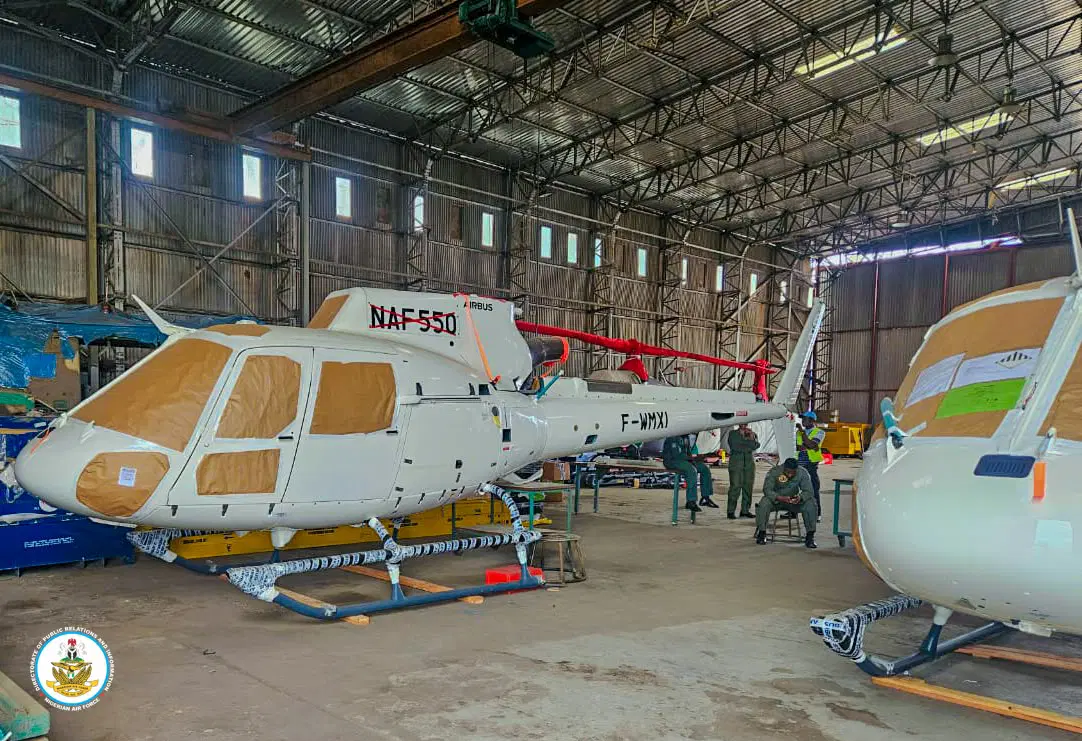
The Nigerian Air Force (NAF) has taken delivery of five new helicopters as the Federal Government steps up efforts to modernize the military and strengthen its capacity to tackle Nigeria’s evolving security challenges.
The latest acquisitions comprise three AW-109 Trekker B helicopters manufactured by Leonardo Helicopters of Italy and two H-125 helicopters produced by Airbus Helicopters.
The NAF Director of Public Relations and Information, Air Commodore Ehimen Ejodame, said the acquisition was part of the Federal Government’s continued investment in improving the operational capabilities of the Air Force.
According to Ejodame, the three AW-109 Trekker B helicopters arrived in Lagos on Tuesday, September 15, 2026, as part of a larger batch of 10 helicopters acquired by the Federal Government.
He said the remaining seven helicopters are expected to arrive before the end of 2026.
The two H-125 helicopters had already been delivered to the Nigerian Air Force, bringing the number of helicopters delivered under the latest acquisition to five.
The Chief of the Air Staff, Air Marshal Sunday Kelvin Aneke, described the arrival of the helicopters as another milestone in the ongoing modernisation and re-equipment of the Nigerian Air Force.
Aneke said the new aircraft would increase the availability of helicopters and give military commanders greater flexibility in deploying airpower to support troops involved in operations across the country.
He noted that the platforms would particularly strengthen the NAF’s ability to provide timely air support to ground troops operating in difficult and challenging environments.The arrival of these five helicopters provides greater flexibility in the employment of airpower in support of ground troops in ongoing operations, Aneke said.
The Air Chief also commended President Bola Ahmed Tinubu for his continued support for the transformation and modernisation of the Nigerian Air Force.
According to him, sustained government investment is enabling the service to progressively build the capabilities required to respond to Nigeria’s changing security environment.
Aneke said the three AW-109 Trekker B helicopters would significantly expand the NAF’s rotary-wing capabilities.
He explained that the aircraft would support a range of missions, including intelligence, surveillance and reconnaissance (ISR), close air support, armed escort and combat search and rescue.
The helicopters will also be deployed for other joint operations in support of ground forces.
“The versatility of the AW-109 platform is expected to provide commanders with additional options for rapidly deploying air assets in support of troops engaged in counter-terrorism, counter-insurgency and other internal security operations,” Aneke said.
He added that the new platforms would improve the Air Force’s ability to respond quickly to emerging threats, particularly in situations where speed, mobility and sustained aerial support are crucial.
The two H-125 helicopters are expected to complement the AW-109s by providing additional light-helicopter capabilities for various military requirements.
The NAF said the new helicopters would collectively improve its flexibility and capacity to respond to changing operational demands.
Their roles could include the movement of personnel and equipment, surveillance missions and support for joint forces operating in difficult-to-reach locations.
The NAF said the newly delivered helicopters were undergoing post-delivery assembly and other technical processes before their formal induction and deployment for operations.
The preparation process includes crew-readiness and technical checks designed to ensure the platforms are fully prepared for operational use.
Aneke stressed that acquiring new aircraft was only one part of strengthening the Air Force, noting that the service must ensure that government investment translates into tangible operational results.
He said the NAF would continue to prioritize effective deployment, maintenance and logistics support to maximize aircraft availability. We will continue to prioritise effective employment, maintenance and logistics sustainment so that every aircraft delivered adds measurable value to ongoing operations and the protection of the lives and property of Nigerians, he said.
The latest acquisition is expected to further strengthen the Nigerian Air Force’s airpower capabilities as the military continues operations against terrorism, insurgency and other security threats across the country.