


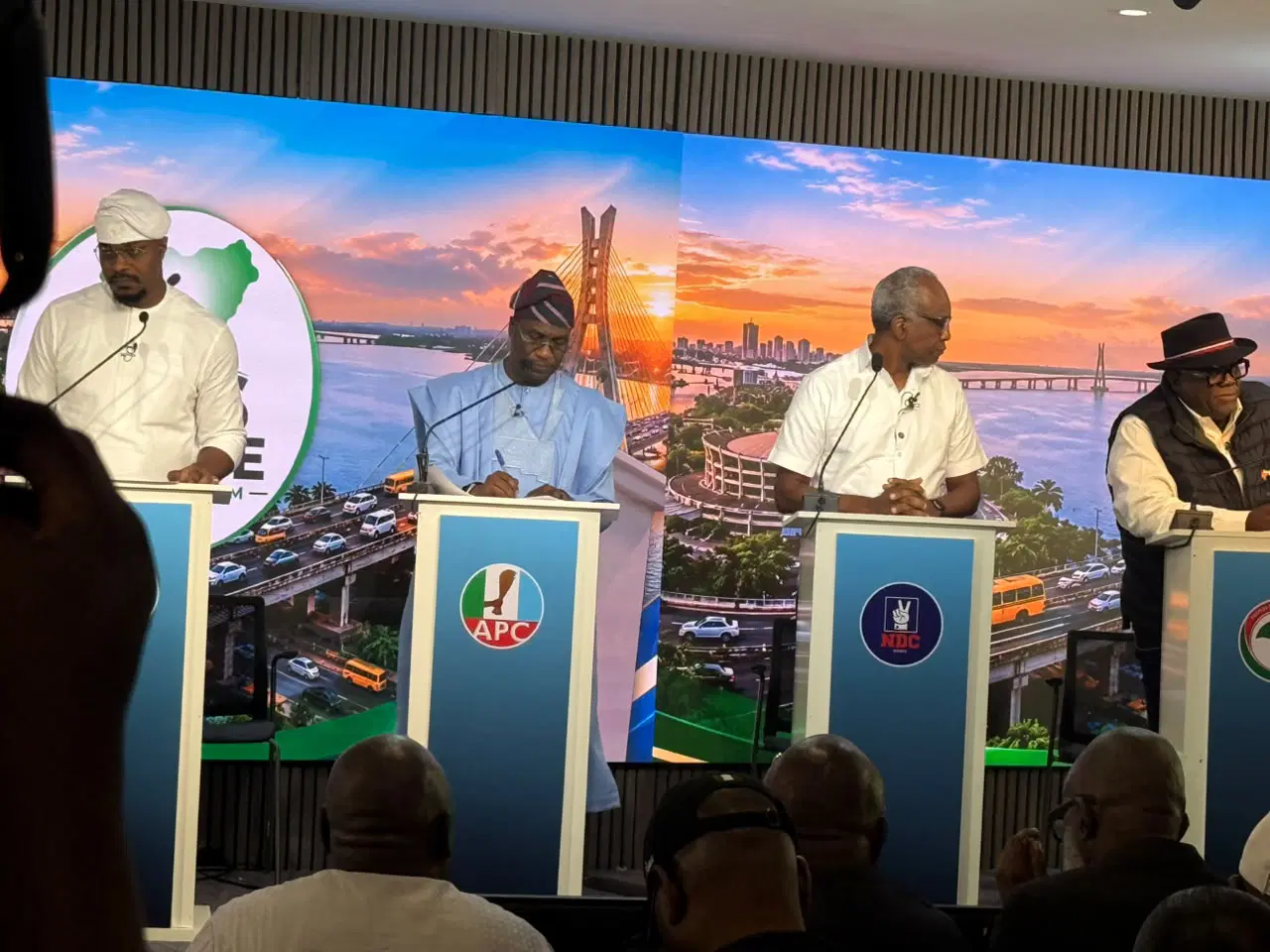
LAGOS: Governorship candidates of four major political parties in Lagos State have unveiled their development blueprints ahead of the 2027 governorship election, outlining their proposed approaches to tackling traffic congestion, housing shortages, transportation challenges, insecurity and infrastructure deficits.
The candidates, Dr Obafemi Hamzat of the All Progressives Congress (APC), Gbadebo Rhodes-Vivour of the African Democratic Congress (ADC), Funso Doherty of the Nigeria Democratic Congress (NDC), and Adedeji (Deji) Doherty of the Peoples Democratic Party (PDP), presented their policy proposals during a televised governorship debate held on Sunday, November 8, 2026.
The debate was organised by the Nigeria Debate Consortium, comprising Vanguard Newspapers, Channels Television, TVC News, Punch Newspapers and The Cable.
The programme provided an opportunity for the candidates to explain their qualifications, governing philosophies and development priorities while presenting their proposed solutions to some of the challenges confronting Africa’s largest commercial city.
The discussions focused particularly on transportation, housing affordability, urban development, economic management, governance and the future of public infrastructure in Lagos.
One of the major talking points during the debate came from the NDC governorship candidate, Funso Doherty, who questioned the political and economic interests surrounding Lagos State’s public transportation system.
Doherty argued that the persistent traffic congestion experienced by residents was not simply caused by inadequate road infrastructure but also by poor management and the failure to modernise the public transportation network.
He alleged that vested interests benefiting from the existing informal transport arrangement had contributed to the slow pace of reform in the sector.
According to him, Lagos continues to depend heavily on ageing commercial buses operating in an uncoordinated manner, creating additional pressure on roads and making daily commuting difficult for residents.
He questioned why successive administrations had failed to replace the ageing vehicles with a more organised and efficient transportation system.
Lagos continues to rely on dilapidated commercial buses operating chaotically, contributing to gridlock and making commuting difficult for residents.
Our public transportation system is not modernised. Thousands of rickety buses are moving around. We must ask ourselves: are these what our people deserve? Why has it taken so long to modernise public transportation?” he asked.
The NDC candidate specifically referenced the informal transport network popularly associated with agberos, arguing that the interests surrounding the system had made meaningful reform politically difficult.
In my opinion, the lack of modern transportation is not by accident. There are vested interests in operating the bus system the way it is. Many of us understand the agbero system; there is an ecosystem around it, and there is no political will to deal with that problem, Doherty stated.
He further maintained that his administration would have the political independence to reform the sector because its mandate would come from voters rather than entrenched transport interests.
We would modernise public transportation because we would be elected by the people and not by the agbero network, he added.
Responding to the transportation challenge, the APC candidate, Dr Obafemi Hamzat, emphasised continuity and expansion of existing infrastructure, proposing a significant increase in the state’s Bus Rapid Transit (BRT) fleet.
Hamzat proposed expanding the BRT system from approximately 1,000 buses to 4,000 buses, with a target of transporting one million passengers daily.
He said the expansion would involve the deployment of Compressed Natural Gas (CNG)-powered buses and the development of dedicated BRT corridors across major routes.
The APC candidate also advocated an integrated transportation system connecting road, rail and water transportation networks to provide commuters with alternative means of movement and reduce pressure on major roads.
He identified the expansion of the Blue and Red rail lines, alongside investments in water transportation, as important components of Lagos’ long-term mobility strategy.
Hamzat also disclosed that the state’s development plans included procuring between 3,000 and 4,000 CNG buses to improve public transportation and reduce the challenges associated with daily commuting.
Housing affordability and urban development also featured prominently during the debate, with the ADC candidate, Gbadebo Rhodes-Vivour, proposing an ambitious housing programme.
Rhodes-Vivour pledged to deliver 100,000 housing units within his first four years in office if elected governor.
He proposed financing the initiative through a combination of luxury taxation to support social housing, development of the eastern foreshore and intergenerational areas, and decentralisation of development across the state.
The ADC candidate argued that Lagos required a comprehensive approach to urban development, insisting that housing, transportation, healthcare, education, waste management and urban planning were interconnected challenges that should not be addressed independently.
He also called for a departure from what he described as two decades of bad governance, arguing that the state should work for all residents rather than a privileged few.
According to him, his political activism and proposed manifesto had consistently prioritised the interests and welfare of ordinary Lagos residents.
In his response, Hamzat highlighted the housing achievements of the current Lagos State administration, claiming that approximately 18,000 housing units had been delivered over the last eight years.
He said the government was exploring additional measures to improve access to affordable homeownership, particularly through mortgage financing arrangements.
Under the proposed arrangement, prospective homeowners would be required to make an initial payment of between 10 and 25 per cent, while the outstanding balance would be spread over an extended repayment period.
Hamzat maintained that expanding access to mortgage financing would help more residents acquire homes without the burden of paying the entire cost upfront.
The PDP governorship candidate, Adedeji Doherty, popularly known as Deji Doherty, presented a different approach to the housing crisis.
He proposed that the Lagos State Government should become a major property developer, directly constructing residential buildings that would be rented to residents.
Rather than relying entirely on private landlords, he argued that government-owned rental housing could introduce greater competition into the property market and potentially improve affordability.
Explaining his proposal, he said:
There is no landlord, and there is no government that can control a landlord. What we are going to do is very simple. We are going to rent those houses ourselves, and then you can come and rent from us if you want to. If they cannot compete with the landlords, then let us forget it.”
His proposal centred on the government taking a more direct role in the provision of residential accommodation instead of relying exclusively on private-sector developers.
Presenting his credentials, Hamzat described the governorship debate as a job interview, insisting that his professional background and experience in public service had prepared him for the responsibility of leading Lagos State.
He said voters should examine what each candidate had accomplished before seeking public office and assess their preparedness for the responsibilities of governance.
“I take tonight as a job interview. The first question you ask anybody who wants this type of responsibility is, what have you done to prepare for this job?” he stated.
The APC candidate identified respect for citizens, hard work and truthfulness as the principles that would guide his administration.
He also unveiled his development blueprint, tagged ‘Jacob’s Promise,’ which he said was built around seven pillars, seven broad areas of action and 100 pledges.
Hamzat urged voters to evaluate candidates based on the substance of their development plans and their records rather than political announcements and campaign promises.
Rhodes-Vivour used the debate to reiterate his position that Lagos needed a fundamental change in its approach to governance.
He argued that the state should prioritise inclusive development, insisting that public resources and opportunities should benefit ordinary residents rather than a privileged section of society.
His proposed 100,000-unit housing programme and emphasis on decentralised development formed part of his broader argument for a different approach to managing the state’s urban growth.
He maintained that the interconnected challenges of housing, transportation, healthcare, education and waste management required an integrated development strategy.
Addressing the economic situation in the country, Hamzat described Nigeria as undergoing a financial corrective phase, noting that the prevailing economic conditions had made transportation, housing and food affordability major concerns for Lagos residents.
He acknowledged that the Lagos State Government had limited control over certain national economic variables but argued that it could intervene in critical sectors to reduce the burden on residents.
He identified housing, agriculture and transportation as areas where the state government could implement policies to improve living conditions.
According to him, expanding rail transportation, water transportation and the deployment of CNG buses would help improve mobility, reduce commuting pressure and support economic activities across the state.
In another major policy proposal, Deji Doherty promised to abolish taxes imposed on teachers and doctors if elected governor in 2027.
Unveiling his campaign agenda, tagged ‘Awaken Lagos,’ the PDP candidate said his administration would prioritise the welfare of professionals working in the education and healthcare sectors.
He argued that tax relief for teachers and doctors would form part of his administration’s efforts to recognise their contributions to society and improve their welfare.
I am cancelling teachers’ tax. Doctors, I am cancelling their tax. My campaign is Awaken Lagos, he declared.
The debate provided an early opportunity for Lagos voters to hear the policy positions of the APC, ADC, NDC and PDP governorship candidates ahead of the 2027 election.
Although the candidates identified similar challenges confronting the state, their proposed approaches differed considerably.
While Hamzat emphasised continuity, infrastructure expansion, CNG buses, rail transportation and mortgage financing, Rhodes-Vivour proposed a large-scale affordable housing programme and a departure from what he described as two decades of bad governance.
Funso Doherty focused on modernising public transportation and addressing the interests he alleged were obstructing reform, while Deji Doherty proposed direct government participation in rental housing and tax relief for teachers and doctors.
With Lagos continuing to face pressure from population growth, rising housing costs, traffic congestion and demands for improved public services, the candidates’ proposals are expected to remain central to political discussions as the 2027 governorship election approaches.
For voters, the key issues will include the feasibility of the promises, their funding arrangements, implementation timelines and the capacity of the candidates to translate their proposals into measurable improvements in the lives of residents.