


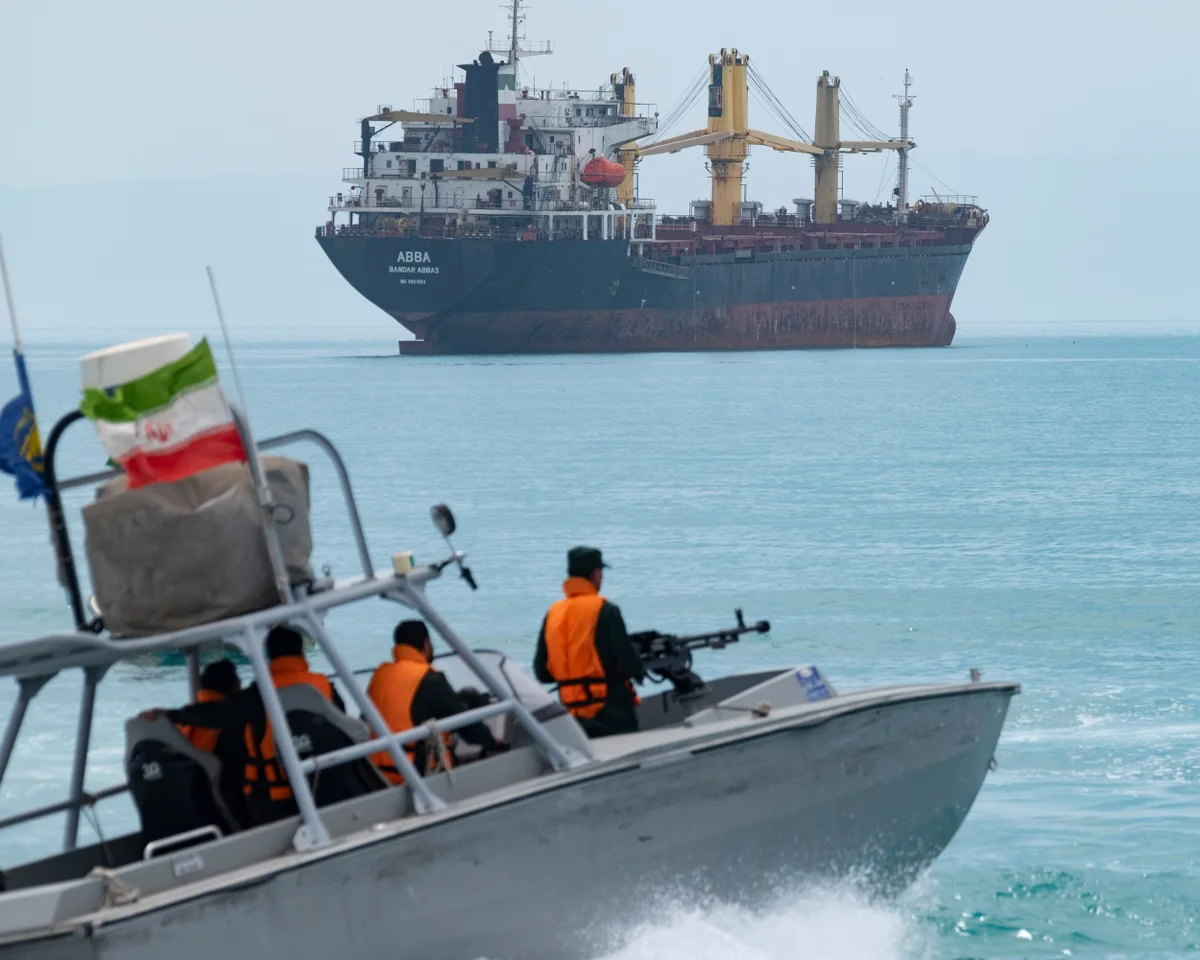
Tensions in the Middle East have taken a new turn as Iran warned that foreign vessels attempting to pass through the strategic Strait of Hormuz without its authorization could face severe consequences.
According to reports, Iranian officials issued a stark warning on Wednesday, April 8, stating that ships would be “destroyed” if they attempted to navigate the narrow waterway without first obtaining approval from Iranian naval authorities.
The warning was reportedly captured in an audio message obtained by the Wall Street Journal, in which an Iranian official could be heard telling a ship’s crew that permission from the Iranian Sepah Navy was mandatory before any vessel could transit the strait.
You must receive permission from the Iranian Sepah Navy for passing through the Strait. If any vessel tries to transit without permission, it will be destroyed,” the official reportedly said in the recording.
The warning comes at a delicate moment, just hours after U.S. President Donald Trump announced that Iran had agreed to reopen the crucial maritime route following weeks of escalating military tensions.
Trump had earlier declared that Tehran had accepted the “complete, immediate and safe opening of the waterway as part of a temporary ceasefire agreement aimed at calming the conflict between Iran and a coalition led by the United States and Israel.
The Strait of Hormuz is one of the most strategically important shipping lanes in the world. The narrow passage connects the Persian Gulf to the Gulf of Oman and ultimately to the open ocean. It is estimated that more than one-fifth of the world’s seaborne oil supply passes through the strait each year, making it a vital artery for the global energy market.
Any disruption in this corridor immediately reverberates across global economies, often triggering sharp increases in oil prices and raising fears of supply shortages.
In recent weeks, the strait had become the centre of geopolitical tensions after Iran reportedly deployed missiles and drones in the region following joint military strikes carried out by the United States and Israel against Iranian targets.
Those attacks were seen as part of the escalating conflict that began on February 28 and quickly drew international concern over the possibility of a wider regional war.
Iran’s actions in the strait were widely interpreted as retaliation designed to pressure global powers by threatening one of the world’s most critical energy routes.
The closure or restriction of the strait has already contributed to rising fuel prices worldwide, adding pressure on economies still struggling with inflation and supply disruptions.
Under the ceasefire terms announced by Washington, both sides agreed to pause hostilities for two weeks while negotiators work toward a broader diplomatic solution to end the conflict.
However, despite the ceasefire announcement, signals from Tehran suggest that the reopening of the strait may not be unconditional.
A senior Iranian official involved in the negotiations told reporters that the passage could reopen in a “limited” manner, but under strict oversight by Iranian forces.
According to the official, ships may be allowed to move through the strait as early as Thursday or Friday, provided they coordinate their movements with Iranian military authorities.
If an understanding on a framework for talks is reached, the strait could be opened in a limited way under Iran’s control, the official reportedly said.
The official also warned that while Iran prefers a lasting peace, the fragile ceasefire could quickly collapse if tensions flare again.
Still, the ceasefire is fragile. We prefer lasting peace, but Iran has no fear of returning to war if the United States chooses that path,” the official added.
Meanwhile, officials in Washington have attempted to reassure global markets that shipping in the region will continue.
Speaking during a press briefing on Wednesday, U.S. Secretary of Defense Pete Hegseth insisted that the maritime route remained open and that international commerce would continue to flow through the waterway.
“What has been agreed to, what’s been stated, is the strait is open,” Hegseth told reporters.
“Our military is watching, sure, their military is watching, but commerce will flow.”
He added that U.S. forces would remain present in the region to monitor the situation and ensure compliance with the ceasefire arrangement.
The United States maintains a significant naval presence in the Gulf region, where it routinely conducts operations to protect commercial shipping routes and deter threats to maritime security.
Still, analysts warn that the latest statements from Tehran underscore how fragile the situation remains.
Even minor confrontations in the narrow corridor could quickly escalate into a broader crisis, particularly given the concentration of military forces from multiple countries operating in the area.
For energy markets and shipping companies, the uncertainty surrounding the Strait of Hormuz remains a major concern.
With a large portion of the world’s oil shipments passing through the waterway, any threat to its security has the potential to ripple across global trade, energy prices and international diplomacy.
For now, the world watches closely as diplomatic efforts continue in hopes that the ceasefire will hold and that one of the world’s most critical maritime chokepoints remains open to international commerce


