


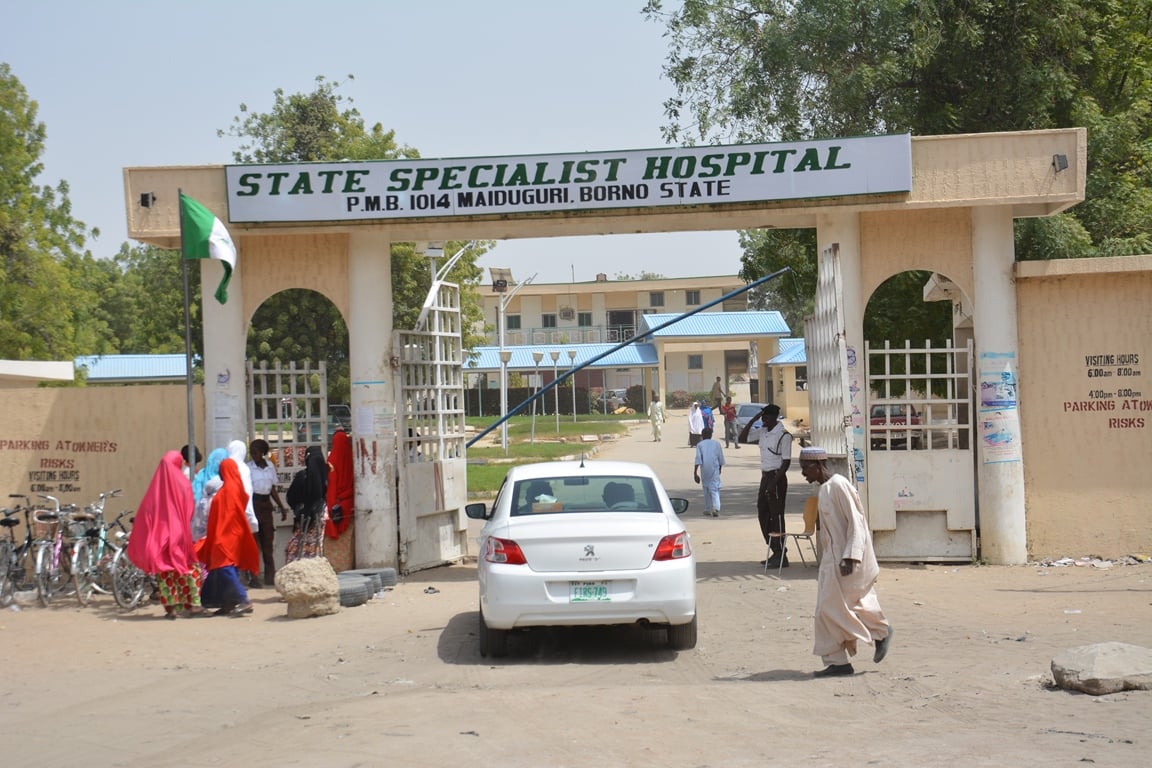
MADUGURI: Fresh details have emerged on how three teenagers allegedly attempted to detonate explosives at the University of Maiduguri Teaching Hospital in Maiduguri, Borno State, using a food flask to conceal a bomb before security personnel intercepted them at the hospital entrance.
The attempted attack, which occurred on March 16, was part of a series of coordinated explosions in the city that left at least 23 people dead, and more than 108 others injured.
Security sources said the suspected attackers had planned to enter the hospital complex and detonate the explosive device within the main building, where hundreds of patients, visitors and medical workers were present at the time.
However, the quick action of security personnel stationed at the hospital gate prevented what officials described as a potentially catastrophic tragedy.
One of the hospital security guards, Ali Musa, narrated how the teenagers arrived at the facility in a tricycle popularly known as Keke Napep, pretending to be relatives bringing food to patients admitted at the hospital.
According to him, the young suspects appeared poorly dressed and suspicious when they approached the entrance of the hospital.
He explained that security at the hospital had already been tightened after earlier reports of an explosion near the city’s post office earlier that day.
Musa said only two security personnel were manning the entrance at the time because other colleagues had temporarily left for a break.
Despite the limited manpower, the guard said he immediately noticed unusual behaviour from the approaching tricycle.
They were three of them two boys and the tricycle rider. They looked like teenagers, probably around 13 or 14 years old.
Their appearance was very rough and unkempt, which immediately raised suspicion, he said.
According to Musa, visitors approaching the hospital gate are normally required to slow down for routine security checks.
However, the suspects reportedly drove towards the gate at high speed, attempting to force their way into the hospital premises.
Alarmed by their actions, Musa quickly stopped them and ordered them to reverse the tricycle for proper inspection.
Initially, the suspects resisted the instruction but eventually began reversing the vehicle after repeated warnings from the guard.
Musa said their behaviour and the way they stared at him made him even more suspicious.
They kept looking at me in a strange and frightening way. At that moment I felt something was wrong, but I could not immediately tell what they were hiding,” he said.
While reversing the tricycle, one of the teenagers reportedly threw a food flask towards the security guard.
Unknown to him at the time, the container had been packed with explosive materials intended to be detonated inside the hospital compound.
Musa said instinctively he kicked the flask away from himself.
Seconds later, a loud explosion occurred.
The boy threw the flask at me while they were reversing. I kicked it back and it fell to the ground. Immediately after that, there was a loud blast, he said.
The guard said he quickly dropped to the ground to shield himself from the impact of the explosion.
Although he survived the blast, he sustained injuries to his hand during the incident.
Despite the first explosion, Musa said he attempted to rush towards a female colleague stationed nearby to check on her safety.
However, he discovered that she had already suffered serious injuries.
She had a broken leg. I also saw an Almajiri boy lying on the ground close to the scene,” he said.
While trying to drag his injured colleague to safety, another explosive device detonated close to the entrance area.
The second explosion forced Musa to jump into a nearby flower garden to protect himself from the blast.
Both of my legs were affected from the explosion, he added.
Authorities later confirmed that the attacks carried out across different locations in Maiduguri that day resulted in the deaths of at least 23 people.
More than 108 others sustained injuries ranging from minor wounds to severe burns and fractures.
Emergency responders and hospital workers worked through the night to treat victims brought into the facility.
However, officials said it was difficult to determine the exact number of casualties linked specifically to the attempted hospital bombing because several explosions occurred across the city within a short period.
A shop owner operating near the hospital, who requested anonymity, confirmed that the attackers were attempting to detonate explosives within the hospital building.
According to her, security intervention at the gate prevented the suspects from entering the facility.
They wanted to blow up parts of the hospital. If they had succeeded in entering, the casualties could have been much worse, she said.
Investigations also revealed that another explosion occurred later that evening at the popular Monday Market in Maiduguri around 7:05 pm.
Eyewitnesses believe the attack may have been carried out by another suicide bomber wearing an explosive vest.
A sales representative identified as Fati described the terrifying moment when the blast occurred.
“That night was terrifying. I have never experienced anything like it in my life,” she said.
According to her, the explosion caused panic among traders and residents in the area.
She said she fled the scene immediately after hearing the blast.
I rushed home immediately. Later we heard that they found the body of a boy completely destroyed by the explosion, and people suspected he was the bomber,” she said.
Following the attacks, President Bola Ahmed Tinubu ordered Nigeria’s service chiefs to relocate to Borno State to coordinate intensified security operations.
The directive came amid renewed concerns over the resurgence of insurgent activities in the North-East.
In compliance with the order, the Chief of Defence Staff, Olufemi Oluyede, and the Chief of Army Staff, Waidi Shaibu, arrived in Maiduguri on March 18 to assess the security situation and oversee military responses.
The attempted hospital bombing has raised fresh concerns about the use of teenagers by insurgent groups to carry out suicide missions.
Security experts say extremist groups operating in the region have increasingly recruited minors to evade suspicion and bypass security checks.
Authorities have since strengthened security measures at major public facilities across Borno State, including hospitals, markets and government buildings.
Security operatives are also intensifying intelligence gathering efforts to identify the network responsible for the attacks and prevent further incidents.
For many residents of Maiduguri, the events serve as a painful reminder of the persistent security challenges facing communities in Nigeria’s North-East despite years of military operations against insurgent groups.


