


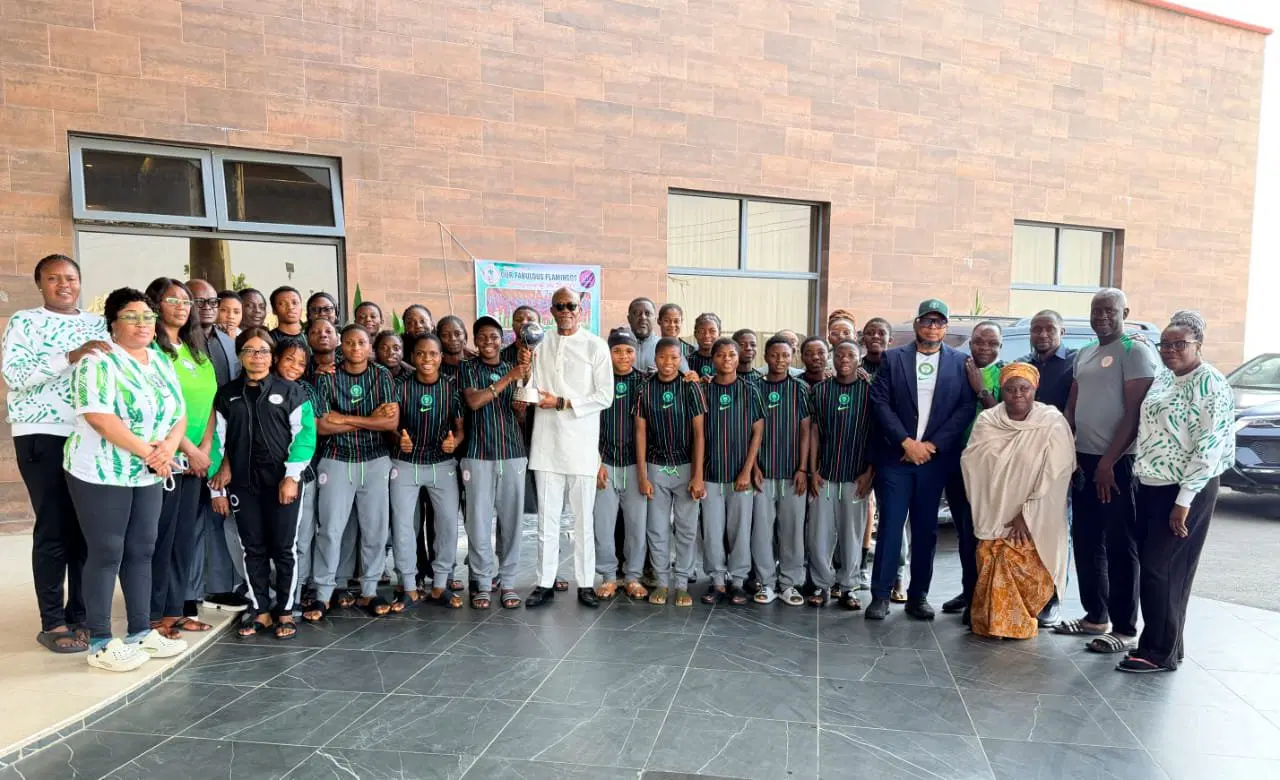
ABUJA: A political controversy has erupted between the Presidency and the presidential candidate of the Nigeria Democratic Congress (NDC), Peter Obi, following allegations that officials of the Nigeria Football Federation (NFF) prevented him from greeting Nigeria’s victorious Under-17 women’s national team, the Flamingos, at the Nnamdi Azikiwe International Airport in Abuja.
The disagreement emerged after Obi’s media office alleged that NFF officials stopped the former Anambra State governor from approaching the players when they arrived from Morocco with the FIFA U-17 Women’s World Cup trophy.
The Presidency, however, rejected Obi’s account, accusing opposition politicians of attempting to politicise national sports and institutions. Minister of Aviation and Aerospace Development, Festus Keyamo, also joined the controversy, describing Obi’s position as hypocritical.
According to a statement issued by the spokesperson of the Peter Obi Media Office (POMO), Idris Zekeri, Obi was at the airport around 7 a.m. on Monday, November 9, 2026, preparing to board a flight to Enugu when he noticed the returning Flamingos.
The statement explained that Obi, who was reportedly excited to see the victorious players, instructed his protocol officer, Jackie Wayas, to find out whether he could approach the team to congratulate and welcome them.
However, he was allegedly informed that officials of the NFF had objected to his approaching the players, reportedly warning that they could lose their jobs if he was allowed to greet the team.
The media office said Obi respected the position communicated to him but subsequently expressed disappointment over what he described as an emerging culture of political intolerance in the country.
Reacting to the incident, Obi described the alleged restriction as another example of what he considers the growing influence of political divisions in Nigeria.
He recalled that a similar experience occurred on March 25, 2025, when he attended a World Cup qualifying match in Uyo, Akwa Ibom State.
According to him, although the state governor warmly received him at the VIP stand, he was allegedly prevented from greeting the players after the match because officials reportedly feared losing their jobs.
Obi argued that political differences should not prevent Nigerians from celebrating national achievements or showing solidarity with representatives of the country.
He maintained that the Nigeria he hopes to see should be built on unity, mutual respect and shared national interests rather than hostility or discrimination based on political affiliation.
The NDC presidential hopeful also called for a country where citizens can interact freely and celebrate national accomplishments without unnecessary political interference.
The Presidency swiftly responded to Obi’s allegations, dismissing his interpretation of the airport encounter.
In a statement issued by the Special Assistant to the President on Social Media, Dada Olusegun, the Presidency maintained that national sports teams represent every Nigerian rather than any political party or individual.
Olusegun explained that established protocol arrangements for national teams were designed to protect young athletes from political exploitation, commercial distractions and unnecessary media attention while performing official duties.
He argued that interpreting standard security and administrative procedures as political victimisation could undermine the unifying role of sports in the country.
The presidential aide also accused Obi of relying on unverified information to construct a narrative of political persecution, urging him to allow the young athletes to concentrate on representing Nigeria.
He stressed that the Flamingos’ historic achievement belonged to the entire country and should not be turned into an argument between political interests.
Former presidential aide and National Director of Media Monitoring and Rapid Response of the City Boy Movement, Bashir Ahmad, also disagreed with Obi’s description of the incident.
Ahmad argued that being prevented from greeting the players did not automatically establish political persecution, noting that security, administrative and protocol considerations could have influenced the decision.
He urged the former Anambra governor to exercise caution and establish the facts surrounding the encounter before drawing political conclusions.
According to Ahmad, national unity should take precedence over individual political interests and partisan disagreements.
He further maintained that building a new Nigeria should not be driven by what he described as persistent political antagonism.
Adding another dimension to the controversy, Minister of Aviation and Aerospace Development, Festus Keyamo, SAN, accused Obi of hypocrisy over his alleged attempt to associate with the victorious Flamingos.
In a post on his X account, Keyamo questioned why Obi was eager to identify with what he described as a national success story and an achievement of the present administration, despite his frequent criticisms of the country.
The minister suggested that Obi’s interest in greeting the players might have been motivated by the opportunity to obtain publicity through photographs with the victorious team.
Mr Peter Obi, in all your public vituperations, you often say things akin to the fact that ‘Nigeria is finished’. So, why are you now so anxious to associate with a success story of the country or this government? Just for photo ops? You see the hypocrisy?
His reaction further intensified the political exchange, turning what began as an airport encounter into a broader disagreement involving the Presidency, opposition figures and supporters of the ruling political establishment.
The controversy comes against the backdrop of a historic achievement by Nigeria’s Under-17 women’s national team.
The Flamingos defeated Japan 2-1 in Saturday’s final to win the FIFA U-17 Women’s World Cup in Morocco, becoming the first African country to win the women’s Under-17 global tournament.
The team returned to Nigeria on Monday with the trophy, attracting national attention and celebrations following its remarkable performance.
Their achievement has been widely regarded as a significant milestone for Nigerian women’s football and African sports.
However, the disagreement over Obi’s alleged encounter with the players has shifted attention from the team’s historic accomplishment to questions about political neutrality, access to national athletes and the management of official protocol.
As reactions continue, the central issues remain whether the restriction was based on established security and administrative procedures, as the Presidency maintains, or whether political considerations influenced the decision, as Obi’s media office alleges.
Neither the NFF nor the specific officials accused of issuing the alleged warning were quoted in the report as having publicly provided their own account of the encounter.


