


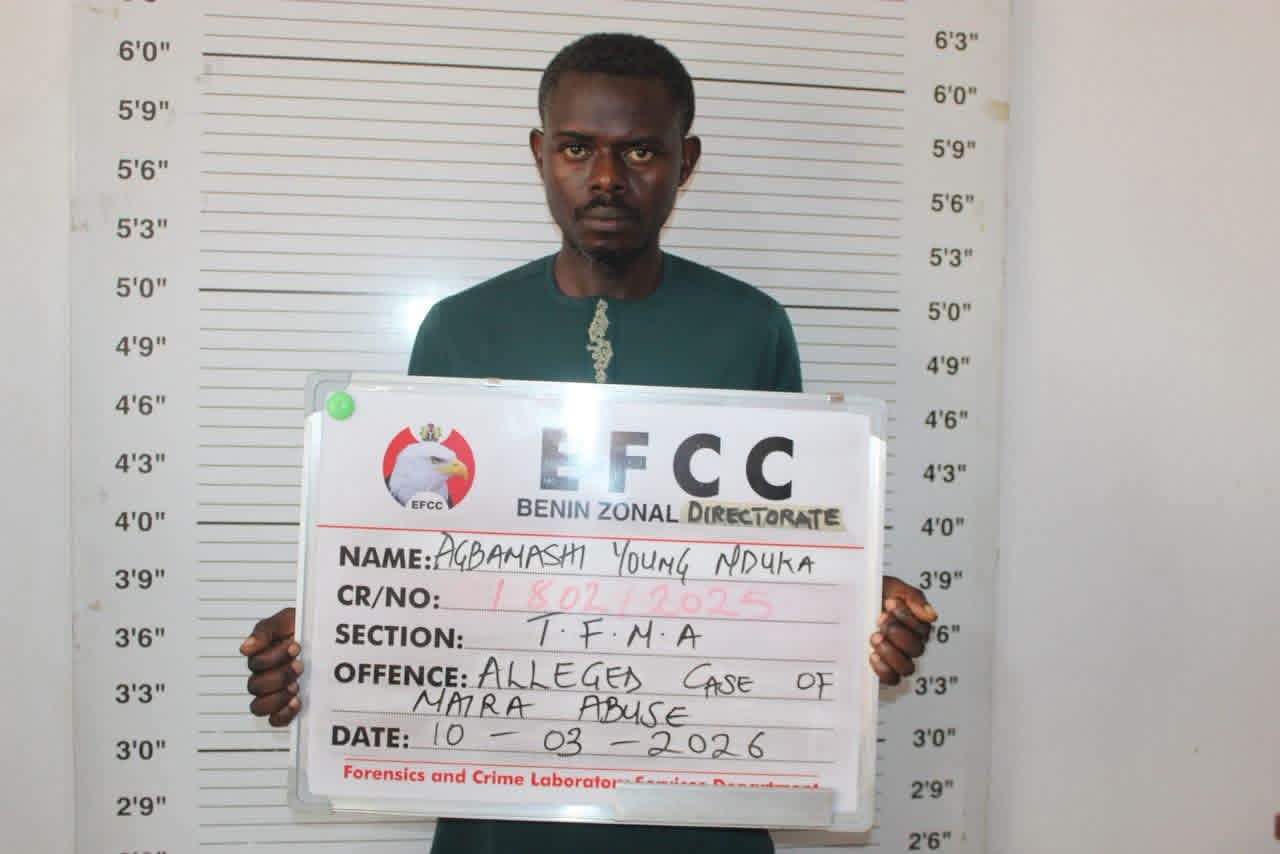
ASABA: A Federal High Court sitting in Asaba has sentenced a Delta State resident, Agbanashi Young, to six months in a correctional facility for abusing the Nigerian currency during a cultural celebration.
The judgment was delivered by Justice F. A. Olubanjo following the prosecution of the defendant by the Economic and Financial Crimes Commission (EFCC).
Young was convicted on a one-count charge bordering on the abuse of the Nigerian currency by spraying and trampling on naira notes at a public event.
According to the charge sheet presented before the court, the offence occurred on November 10, 2023, during a cultural celebration known as “Afor Day” held in Akari Etiti community in Ndokwa East Local Government Area of Delta State.
The court heard that the defendant sprayed a total of N10,000 in N200 denomination notes while dancing at the event. He was also accused of stepping on the notes, an act regarded as abuse of the national currency.
The offence violates provisions of the Central Bank of Nigeria Act 2007, specifically Section 21(3), which criminalises the mutilation, spraying, or improper handling of the naira.
Part of the charge read in court stated that the defendant tampered with the sum of N10,000 issued by the Central Bank of Nigeria by spraying and stepping on the currency during the celebration.
When the charge was read before the court, Young pleaded guilty to the offence.
Following the guilty plea, the prosecution counsel, Francis Jirbo, urged the court to convict and sentence the defendant in accordance with the law.
However, defence counsel appealed to the court to temper justice with mercy, explaining that the defendant had shown remorse and regretted his actions.
In her ruling, Justice Olubanjo convicted Young and sentenced him to six months imprisonment with the option of a N500,000 fine.
The court further directed the defendant to submit a written undertaking to be of good behaviour and refrain from engaging in similar conduct in the future.
The judgment comes amid increasing enforcement actions by the EFCC against the abuse of the Nigerian currency at social and cultural gatherings across the country.
Authorities have repeatedly warned that spraying, mutilating, or stepping on naira notes during parties or celebrations constitutes a criminal offence under Nigerian law.
The anti-graft agency has in recent years intensified its campaign to discourage such practices, stressing that protecting the dignity of the national currency is a legal and civic responsibility.
The case serves as yet another reminder that offenders found guilty of abusing the naira risk prosecution, fines, or jail terms under the provisions of the Central Bank Act