


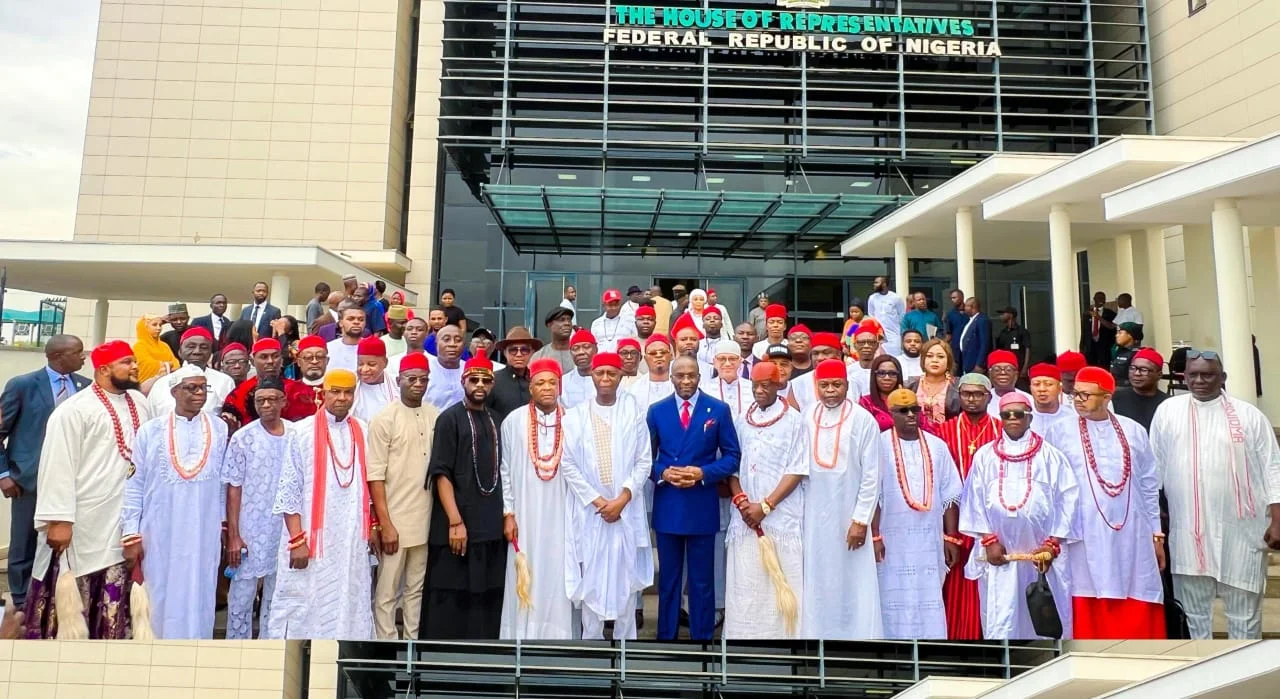
ABUJA: A high-powered delegation of traditional rulers, political leaders and prominent stakeholders from the Anioma region of Delta State on Wednesday visited the leadership of the National Assembly of Nigeria to advance discussions on the proposed creation of Anioma State.
The delegation, which included several royal fathers from Delta North as well as a representative of the revered Olu of Warri, met with lawmakers in Abuja as part of efforts to strengthen support for the long-standing demand for the creation of Anioma State within the ongoing constitutional amendment process.
The visit followed a recent declaration by the President of the Senate, Godswill Akpabio, who had publicly stated that proposals for the creation of Anioma State with Asaba as its capital and another state known as New Delta State with Warri as its capital were among issues being considered in the ongoing constitutional review exercise.
Addressing lawmakers during the meeting, members of the delegation emphasized that the agitation for Anioma State was not a recent political campaign but a historic movement that had lasted for more than seven decades.
According to the stakeholders, the demand for the state is rooted in the quest for equity, cultural recognition and balanced development for the Anioma people.
They stressed that the agitation predates contemporary political actors and enjoys widespread support across communities in the Anioma region.
The delegation also sought to correct what it described as a growing misconception that the campaign for the state was being driven solely by one individual.
In particular, they dismissed suggestions that the agitation was championed only by Senator Ned Nwoko, who currently represents the Delta North Senatorial District in the Senate.
Instead, they insisted that the movement had deep grassroots backing and had long been supported by traditional institutions, community leaders and various socio-cultural organizations across Anioma communities.
Members of the delegation told lawmakers that restructuring the present Delta State into two separate administrative entities—Anioma State and New Delta State—would accelerate development and promote more efficient governance.
They argued that the creation of the new states would help bring government closer to the people, improve administrative effectiveness and ensure that resources are more equitably distributed across the region.
According to them, the existing structure has often made it difficult for communities in the northern part of Delta State to receive adequate attention in terms of infrastructure, economic opportunities and social services.
They maintained that the creation of Anioma State would provide an opportunity for targeted development that reflects the cultural identity, needs and aspirations of the Anioma people.
The stakeholders also expressed appreciation to members of the House of Representatives for their willingness to engage with the delegation and listen to their perspectives on the issue.
They expressed optimism that the National Assembly would give due consideration to the proposal during the constitutional amendment process.
Responding to the delegation, the Deputy Speaker of the House of Representatives, Benjamin Kalu, welcomed the group and reiterated the commitment of the legislature to open dialogue and inclusive participation in addressing national issues.
Speaking on behalf of the leadership of the House, Kalu described the National Assembly as a fortress of democratic engagement where diverse views and proposals can be discussed and evaluated in the interest of the country.
He also conveyed the goodwill of the Speaker of the House of Representatives to the visiting delegation.
According to the Deputy Speaker, the process of creating new states in Nigeria is a complex political undertaking that requires the cooperation and input of various stakeholders.
These include traditional rulers, elected lawmakers, political leaders, civil society organizations and the general public.
Kalu explained that any proposal for state creation must undergo rigorous scrutiny and meet specific constitutional requirements before it can be approved.
The Deputy Speaker noted that the proposal for Anioma State would be assessed based on several important parameters.
Among the factors that lawmakers would consider are geographical balance, historical and cultural ties among communities, economic viability of the proposed state and broader political realities.
He emphasized that achieving successful outcomes in the state creation process requires sustained dialogue, strong partnerships and a willingness among stakeholders to work together toward common goals.
According to him, constructive engagement such as the meeting with the Anioma delegation plays an important role in helping lawmakers understand the aspirations and concerns of different communities.
The delegation included a number of prominent traditional rulers and respected community leaders from across Anioma land.
Among those present were His Royal Majesty Henry Kikachukwu, His Royal Majesty Charles Chukwunwike Anyasi III, His Royal Majesty Michael Mbanefo Ogbolu and His Royal Majesty Ayo Isinyemeze.
Other royal fathers in the delegation included His Royal Majesty Daniel Ogbudo, His Royal Majesty Paul Solomon Ifeneziuche and His Royal Majesty Chukwuma Jikeme I, alongside representatives from several other Anioma communities.
Also present at the meeting was former member of the House of Representatives Daniel Reyenieju, who attended on behalf of the Olu of Warri.
Other notable participants included Chief Leroy Edozien, the Ubili ka Nkwu of Asaba, Dr. Kingsley Ojei, the National President of Izu Anioma, as well as members of the Anioma State Creation Technical Committee and other influential stakeholders.
Their presence underscored what many observers describe as growing momentum behind the agitation for the creation of the new state.
The renewed push for Anioma State has gained increased attention in recent months, particularly following comments by Senate President Godswill Akpabio indicating that the proposal could be considered as part of the broader constitutional amendment process.
Supporters of the proposal believe that the creation of Anioma State would address longstanding concerns about political representation and developmental balance within Delta State.
They argue that establishing the new state with Asaba as its capital would create opportunities for improved governance and economic growth in the region.
At the same time, the proposed creation of New Delta State with Warri as its capital is expected to strengthen administrative efficiency in other parts of the existing Delta State.
Although the creation of a new state in Nigeria requires extensive constitutional procedures, the visit by the Anioma delegation to the National Assembly represents a significant step in advancing the conversation.
Political analysts note that successful state creation proposals often depend on sustained advocacy, broad public support and cooperation among lawmakers across different regions.
For many Anioma leaders, the current constitutional amendment process presents a rare opportunity to finally achieve a goal that has been pursued for decades.
As discussions continue within the National Assembly of Nigeria, supporters of the proposal remain hopeful that the long-standing quest for Anioma State will eventually become a reality, reshaping the political and administrative landscape of Delta State and the wider Niger Delta region.


