


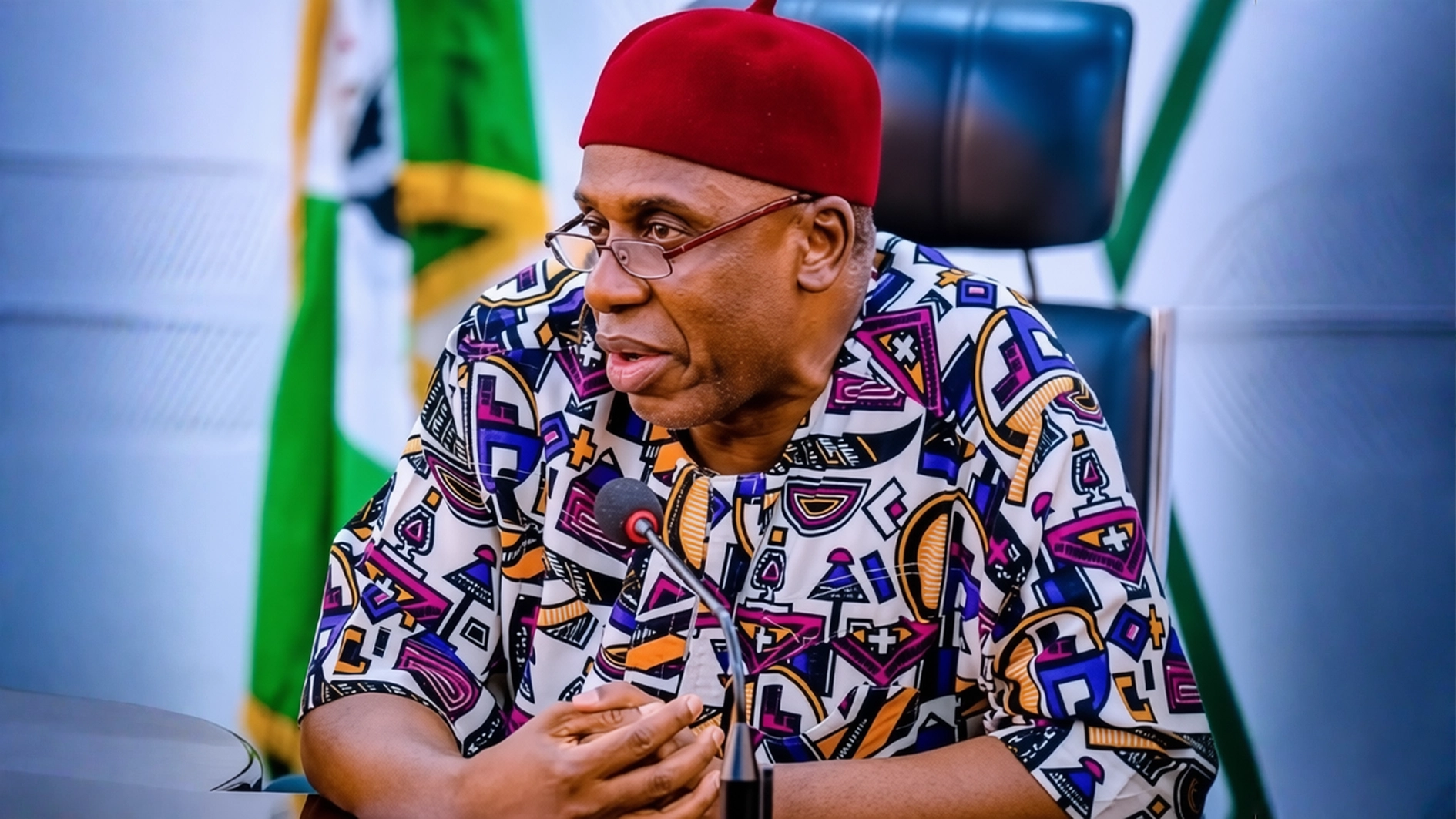
Former Minister of Transportation and African Democratic Congress (ADC) vice-presidential candidate, Rotimi Amaechi, has warned that the recent Federal High Court judgment affecting the leadership structure of his party could trigger serious political unrest if not properly managed.
Amaechi gave the warning during an interview on Mainland 98.3 FM, where he expressed concern over the possible consequences of the ruling that nullified the National Working Committee led by former Senate President David Mark.
According to him, the ADC leadership moved quickly to prevent the development from escalating into a wider political crisis, urging party members and supporters to remain calm while the matter is addressed.“It could cause a civil war if not properly managed,” Amaechi said.
He disclosed that shortly after news of the judgment emerged, he met with the party’s presidential candidate and its chairman to discuss the situation and the need to reduce political tension.
Amaechi maintained that there was no internal leadership crisis within the ADC, alleging instead that external political interests were responsible for attempts to destabilise the party
The controversy followed a Federal High Court judgment delivered last Thursday in Abuja by Justice Peter Lifu.
The court nullified the National Working Committee led by David Mark and invalidated decisions taken by the leadership, including the process that produced former Vice-President Atiku Abubakar as the party’s presidential candidate for the 2027 elections.
The ruling also affected the emergence of former Minister of Interior, Rauf Aregbesola, as National Secretary, as well as other decisions concerning the nomination of candidates for elective positions.
The court further directed the Independent National Electoral Commission (INEC) not to recognise or act on decisions taken at the ADC’s 99th National Executive Committee meeting held on July 27, 2025.
The judgment followed a suit marked FHC/ABJ/CS/1819/2025, filed by former ADC Deputy National Chairman (North-East), Nafiu Gombe, who challenged the process through which Mark and other members of the caretaker committee assumed control of the party.
Reacting to the development, Amaechi disputed the basis of the challenge, claiming that documents and video footage existed to show that Gombe had voluntarily resigned and participated in the handover process.
He alleged that individuals were exploiting the judicial process to create uncertainty within the opposition party. These claims were presented by Amaechi during the interview and were not independently established in the report.
Amaechi also alleged that the ruling All Progressives Congress (APC) was uncomfortable with the ADC’s emergence as a major opposition platform ahead of the 2027 general election.
He argued that the political situation had become more competitive, particularly because of the number of presidential contenders expected to contest in different parts of the country.
According to him, the ADC represents a significant opposition platform, and attempts to create uncertainty could discourage voters and weaken opposition mobilisation.
Amaechi referenced political developments in Sokoto and argued that the presence of multiple presidential contenders across the country’s geopolitical zones could affect the electoral calculations of different parties.
He specifically mentioned former Anambra State Governor Peter Obi’s political influence in the South-East, Oyo State Governor Seyi Makinde’s political position in the South-West and Atiku Abubakar’s presence in the North.
Amaechi also pointed to his own political roots in the South-South, saying the region would be important in the forthcoming electoral contest.
His comments reflected the ADC’s concerns about the implications of the court ruling for its preparations and political mobilisation ahead of 2027
Beyond the ADC leadership controversy, Amaechi revisited his defeat in the 2023 APC presidential primary, where President Bola Tinubu emerged as the party’s candidate.
The former Rivers State governor said his major mistake was relying on assurances allegedly given to him by the late President Muhammadu Buhari.
According to Amaechi, Buhari had advised him not to embark on an extensive campaign because he would eventually announce him as his preferred candidate.
He said he accepted the advice because Buhari was his superior in the political structure at the time.
“The only mistake I made was listening to the late President Muhammadu Buhari, who told me: ‘Don’t campaign, don’t do anything; I will announce you as my candidate’,” Amaechi said.
He claimed that Buhari had even put the assurance in writing, adding that he believed the arrangement would give him an advantage during the presidential primary.
Amaechi further argued that he had the support of several state governors and believed he could have won the contest if he had actively campaigned and mobilised delegates.
He contrasted his approach with Tinubu’s campaign strategy, alleging that the eventual winner engaged in political negotiations and used religious considerations to build support.
The ADC vice-presidential candidate also criticised the use of religious identity in electoral mobilisation, insisting that he would not exploit faith to secure political power.
He recalled an alleged political mobilisation effort involving Southern Muslim leaders and Northern governors, which he said encouraged support for Tinubu on religious grounds.
Amaechi also referred to comments previously attributed to former Kaduna State Governor Nasir El-Rufai, who he claimed had publicly discussed the religious dimension of the political contest.
He argued that campaigns built around religious identity could deepen divisions among Nigerians, particularly in a country with diverse Christian and Muslim communities.
Using the Catholic population as an example, Amaechi said he would not encourage religious leaders to mobilise voters exclusively on the basis of shared faith.
“I wouldn’t do anything at all cost because I want power,” he said.
His position, as expressed during the interview, was that political leadership should not come at the expense of national cohesion or religious harmony.
The court judgment has introduced fresh uncertainty into the ADC’s preparations for the 2027 general election, particularly concerning its national leadership, candidate nomination processes and relationship with INEC.
Amaechi’s warning has added to the debate over the political implications of the ruling, while his comments suggest that the party’s leadership is concerned about the possibility of the dispute affecting its electoral plans.
The legal and political developments are expected to remain significant as the ADC and other political parties position themselves ahead of the next general election.
For now, Amaechi has called for restraint, warning that political disagreements and disputes over party leadership must not be allowed to develop into violence or wider instability.


