


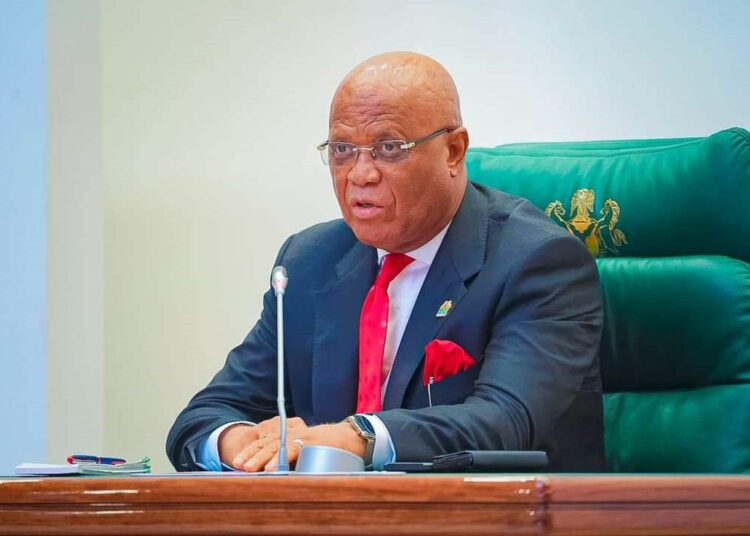
UYO: Political tension is rising in Akwa Ibom State after Governor Umo Eno reportedly abandoned the long-standing zoning arrangement for elective positions and announced automatic return tickets for all incumbent officeholders ahead of the 2027 elections.
The development has triggered strong protests from political stakeholders and community leaders who argue that the rotational system has historically ensured fairness and inclusion across the state’s political zones.
According to sources within the ruling All Progressives Congress (APC), the arrangement would allow all current elected officials including the governor, National Assembly members, and state lawmakers to retain their seats without facing internal competition.
The decision is believed to be part of a political compromise designed to reward members of the Peoples Democratic Party (PDP) who defected alongside Governor Eno when he aligned with the ruling party at the federal level.
However, the plan has unsettled many local political actors who had expected the existing zoning tradition to rotate positions among the state’s three senatorial districts and multiple federal constituencies.
The proposal has already sparked opposition in several constituencies.
In the Ukanafun/Oruk Anam federal constituency, residents of Oruk Anam Local Government Area have rejected a third-term ambition by Unyime Idem, who currently represents the constituency in the House of Representatives.
Community leaders argue that the political slot should rotate to their area after Ukanafun has held it for two terms.
Similarly, leaders in the Eket/Esit Eket/Onna/Ibeno federal constituency are resisting efforts to return Opolupm Etteh to the National Assembly for another term, insisting that the seat should rotate to another local government area.
Stakeholders in Esit Eket say the rotational arrangement has been respected since Nigeria’s return to democracy in 1999 and should not be altered for political convenience.
The controversy extends to other parts of the state.
In the Ikot Abasi federal constituency, the incumbent lawmaker Uduak Odudoh is reportedly facing opposition from rival political groups accusing him of attempting to monopolise the constituency’s political representation.
Meanwhile, in the Akwa Ibom South (Eket) Senatorial District, the potential continuation of Ekong Sampson has generated criticism from political stakeholders across the district’s 12 local government areas.
At the state legislative level, the Speaker of the Akwa Ibom State House of Assembly, Udeme Otong, is also facing resistance from constituents in Abak State Constituency who have rejected his bid for a third term.
Opponents accuse him of poor performance and political exclusion, claims that his supporters have dismissed.
Responding to the controversy, Governor Eno insisted that the agreement reached with political officeholders who defected alongside him remains binding.
Speaking during the monthly Government House prayer service, the governor warned political aspirants against purchasing nomination forms for the 2027 elections.
According to him, there will be no vacant elective positions to contest under the new political arrangement.
Everyone should read the political temperature in the state; there is nothing like zoning again. Things have changed,” the governor said.
He further stressed that anyone choosing to contest for an office would be doing so at their own risk, adding that the agreements reached among political actors must be respected.
Political observers say the decision could significantly reshape the political landscape in Akwa Ibom ahead of the 2027 elections.
While supporters argue that automatic tickets will prevent internal party conflicts and reward loyal political allies, critics warn that scrapping zoning could deepen divisions and alienate communities that rely on rotational arrangements for political inclusion.
With mounting resistance from grassroots stakeholders and local leaders, the unfolding dispute may become one of the defining political battles in Akwa Ibom as the 2027 electoral cycle approaches.


