


KANO: Fresh political realignments may be underway ahead of Nigeria’s 2027 general elections as key opposition figures held strategic meetings over the weekend, underscoring the deepening crisis within the People’s Democratic Party (PDP).
At the centre of the emerging political consultations are Seyi Makinde, governor of Oyo State; Bala Mohammed, governor of Bauchi State and chairman of the PDP Governors’ Forum; former Kano State governor Rabiu Kwankwaso; and former Bayelsa State governor Seriake Dickson. Also present at parts of the discussions was the Labour Party’s 2023 presidential candidate, Peter Obi.
The high-level consultations come as reconciliation efforts between the PDP governors’ bloc and the faction aligned with the Minister of the Federal Capital Territory, Nyesom Wike, appear to have stalled, raising fresh concerns about the future cohesion of Nigeria’s main opposition party.
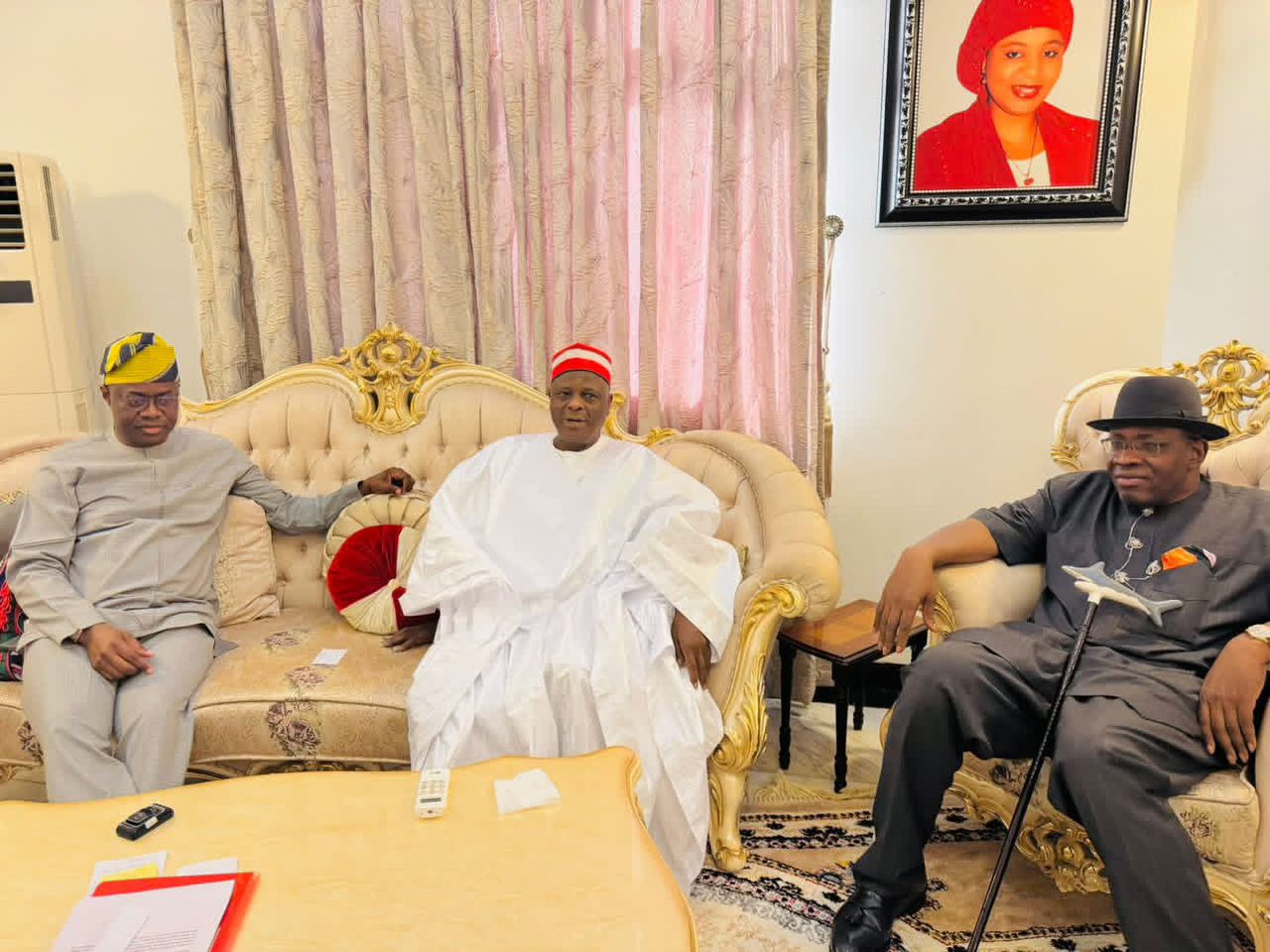
On Sunday, Makinde and Mohammed met privately with Dickson in Bauchi State. Shortly after the meeting, Makinde and Dickson travelled to Kano where they joined Kwankwaso and other political associates.
Although the visit was publicly framed as part of the celebration of the upcoming Eid-el-Fitr festivities, political observers believe the gathering may have carried deeper political undertones connected to the 2027 presidential contest.
Sources close to Kwankwaso disclosed that the meeting was not merely ceremonial but part of ongoing consultations among influential opposition figures seeking to reposition themselves before the next election cycle.
According to the source, discussions centred on possible alliances, political realignments, and the future direction of opposition politics in Nigeria.
“You can see the calibre of people involved,” the source said. “We have leaders from different political tendencies meeting together. This is not just about festivities; it is part of consultations about the 2027 elections and the direction of Nigerian politics.”
The meetings coincided with the 10th annual Dandalin Kwankwasiyya, an event organised by supporters of Kwankwaso and his political movement.
Held at Kwankwaso’s residence on Miller Road in Kano, the gathering attracted political loyalists, stakeholders, and supporters from across the country.
The event traditionally provides a platform for members of the Kwankwasiyya movement to interact, reflect on political developments, and strengthen grassroots mobilisation ahead of future political engagements.
However, this year’s edition took on added political significance given the presence of prominent opposition figures and the growing tensions within the PDP.
Observers believe the meeting signals the possibility of broader cooperation among opposition forces as the political landscape begins to shift toward the 2027 election cycle
The consultations come against the backdrop of a prolonged leadership dispute within the PDP, which has effectively split the party into rival factions.
For nearly a year, the party has been embroiled in internal turmoil, with two competing camps laying claim to the leadership structure of the opposition party.
One faction is backed by several PDP governors and produced a new leadership team during a convention held in Ibadan in November 2025. At that convention, former Minister of Special Duties Kabiru Tanimu Turaki was elected alongside other members of the National Working Committee.
However, the Wike-aligned camp rejected the outcome of the Ibadan convention and subsequently set up a 13-member National Caretaker Working Committee to run the affairs of the party pending a fresh convention.
The caretaker committee named Abdulrahman Mohammed as acting national chairman and Samuel Anyanwu as acting national secretary, among other appointments.
The crisis took a dramatic turn after the Court of Appeal of Nigeria ruled on the legality of the Ibadan convention.
The appellate court upheld an earlier decision by the Federal High Court of Nigeria which declared that the processes leading to the convention violated both the Nigerian Constitution and the PDP’s internal rules.
Consequently, the court nullified the convention and invalidated the election of Turaki and other members of the party’s National Working Committee.
The judgment effectively strengthened the authority of the caretaker committee, further intensifying the internal contest for control of the party structure.
At the same time, another panel of the Court of Appeal encouraged all parties involved in the dispute to seek an amicable political resolution in order to preserve the unity of the opposition party.
Amid the growing tensions, Makinde has openly criticised attempts to reconcile with the Wike-aligned faction, arguing that such collaboration would amount to indirectly supporting the ruling All Progressives Congress (APC) and President Bola Tinubu.
Makinde insisted that those aligning with Wike were effectively supporting Tinubu’s re-election bid in 2027.
I came into the public domain to state that I was in a meeting with Wike and Mr President, and he promised to hold the PDP for Mr. President in 2027, Makinde said.
“Anyone dealing with Wike and his group means you have also agreed to support President Tinubu for 2027. We leave Nigerians to judge.
He further argued that while the Wike faction might have the backing of powerful institutions, the governors’ bloc enjoys broader grassroots support across the country.
“They may have the government, the judiciary and INEC behind them,” Makinde said. “But we have the people behind us.
Despite the internal crisis, the caretaker leadership has insisted that the party’s national convention scheduled for March 29 and 30 will go ahead as planned.
The National Publicity Secretary of the caretaker committee, Jungudo Mohammed, said court rulings have clearly affirmed the legitimacy of the caretaker leadership.
He warned that attempts by the opposing faction to halt the convention through legal actions would amount to an abuse of court processes.
According to him, the party leadership had made several efforts to open reconciliation talks but those overtures were allegedly ignored by members of the rival camp.
“We urge all members of the party and the general public to be guided by the court judgments which recognize the caretaker committee as the legitimate leadership,” Mohammed said.
However, the Turaki-backed faction dismissed the allegations, describing them as political blackmail.
Speaking on behalf of the governors’ camp, the faction’s spokesman, Ini Ememobong, insisted that his group remains committed to reconciliation and has not initiated any legal action to block the convention.
He accused the caretaker leadership of spreading misinformation while genuine reconciliation efforts were still ongoing.
It is unfortunate that some people are weaponizing communication instead of focusing on dialogue, Ememobong said.
We have consistently shown our commitment to reconciliation, and we remain hopeful that a political solution will eventually emerge.
Beyond the internal disputes, political analysts believe the emerging consultations among Makinde, Kwankwaso, Obi and other opposition figures could signal the early stages of a broader political alliance aimed at challenging the ruling party in 2027.
With the PDP still struggling to resolve its internal leadership battle, several opposition leaders are believed to be exploring alternative political arrangements that could reshape Nigeria’s political landscape ahead of the next presidential election.
While no formal alliance has yet been announced, the meetings in Bauchi and Kano have intensified speculation about the possible emergence of a new opposition coalition.
If such a coalition materialises, analysts say it could significantly alter the balance of power in Nigeria’s political arena as the race toward 2027 gradually begins to take shape.