


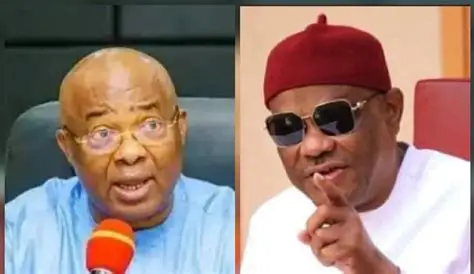
The political disagreement between some All Progressives Congress (APC) governors and the Minister of the Federal Capital Territory (FCT), Nyesom Wike, has intensified ahead of the 2027 general elections, with APC leaders in the South-East declaring support for the party’s governors and candidates.
The South-East APC leadership also rejected the emerging Rainbow Coalition associated with Wike, arguing that political arrangements outside the party could affect the fortunes of APC candidates in the 2027 elections, including President Bola Tinubu.
The development comes amid increasingly public exchanges between Wike and some APC governors over the political direction of the country ahead of the next general election.
Wike, who remains a member of the Peoples Democratic Party (PDP) while serving in President Tinubu’s cabinet, has maintained that the coalition he is helping to build is fully committed to Tinubu’s re-election.
He has also criticised some APC governors, accusing them of failing to do enough to support Tinubu during the 2023 presidential election.
Wike specifically questioned the performance of some governors in states where the APC secured legislative victories but President Tinubu did not record comparable support during the presidential election.
The South-East position was contained in a joint statement issued by the APC National Vice Chairman for the South-East, Dr Ijeomah Arodiogbu, alongside the chairmen of the party in Abia, Anambra, Ebonyi, Enugu and Imo states.
The leaders said the position of the Progressive Governors’ Forum (PGF) was important to the party’s preparations for the 2027 elections.
They also condemned Wike’s recent criticisms of members of the forum, describing the attacks as unacceptable.
According to the South-East APC leaders, the governors targeted by Wike had recorded developmental achievements in their respective states and secured more than 25 per cent of the presidential vote in the 2023 election.
They argued that the governors should be recognised for their political and administrative roles within the party.
The leaders further accused Wike of working against the political interests of some sitting APC governors ahead of the 2027 elections.
They maintained that elected governors should be allowed to exercise their constitutional and political responsibilities without interference from ministers.
The South-East APC leadership called on Wike to withdraw what it described as his attacks and return to what it termed party discipline, mutual respect and collective responsibility.
The APC leaders also rejected the political coalition linked to Wike, describing it as a “rainbow” coalition and warning against any attempt to weaken the party’s structure in the region.
They declared that the South-East APC would support the party’s candidates across the various levels of the 2027 elections.
The leaders said the APC was bigger than any individual and called on party members to remain committed to its candidates, from the presidential level to the State Houses of Assembly.
Their position places the South-East APC leadership firmly behind the party’s existing structures as preparations for the 2027 elections gather momentum.
Meanwhile, Farouk Aliyu, a founding member of the APC in Jigawa State and former minority leader of the House of Representatives, has criticised Wike’s description of some APC governors as lazy.
Speaking during an interview on Arise TV, Aliyu said the ruling party rejected the characterisation of its governors.
He acknowledged Wike’s role in the political developments surrounding the 2023 election but argued that the minister’s continued public criticism of APC leaders was creating tension within the political environment.
According to Aliyu, Wike had already been “adequately compensated” for his political support for Tinubu in 2023 through his appointment as FCT Minister.
Aliyu also praised Wike’s performance in the ministerial position while urging him to avoid personal attacks against APC leaders.
He specifically referred to Wike’s recent comments involving Imo State Governor Hope Uzodimma and Kwara State Governor AbdulRahman AbdulRazaq.
Aliyu appealed to APC members to avoid allowing the disagreement with Wike to distract them from governing and preparing for future elections.
He urged Wike to adopt a more conciliatory approach in his dealings with members of the ruling party.
According to him, political disagreements should not be allowed to escalate to the point of creating unnecessary tension across the country.
He also argued that the APC needed to maintain a coordinated campaign structure ahead of future elections, with governors retaining their political responsibilities within their respective states.
Aliyu’s comments reflect the growing debate within the ruling party over how to manage Wike’s political role while he remains a PDP member serving in the Tinubu administration.
However, APC chieftain and federal lawmaker Abdulmumin Jibrin has taken a different position, warning APC governors against publicly embarrassing Wike.
Jibrin, a former chairman of the House Committee on Appropriation, spoke on Channels Television’s Politics Today, where he defended the FCT Minister amid the criticism coming from some APC governors.
He argued that Wike had played a significant role in the political efforts that contributed to Tinubu’s emergence and election victory.
Jibrin said members of the APC had benefited, directly or indirectly, from Wike’s efforts to support the administration and the president.
He described Wike as an important political figure and argued that the minister should not be subjected to public attacks by members of the ruling party.
Wike is an asset to APC, he has sacrificed so much for the President and the APC,” Jibrin said, while urging party members to recognise his contributions.
Jibrin’s intervention followed criticisms from some APC governors over Wike’s involvement in the proposed Rainbow Coalition.
The criticism has partly centred on Wike’s decision to remain a PDP member while simultaneously working with political actors to support President Tinubu’s re-election bid.
Some APC figures have questioned the arrangement, while Jibrin argued that the focus should instead be on Wike’s contribution to the president’s political fortunes.
The disagreement has therefore opened a broader conversation within the ruling party about political alliances, party membership and the roles of individuals working across existing party structures ahead of 2027.
Amid the political exchanges, the office of Vice President Kashim Shettima has also clarified comments attributed to him concerning Northern governors and their support for President Tinubu.
In a statement issued by Stanley Nkwocha, Senior Special Adviser to the President on Media and Communication in the Office of the Vice President, the administration explained that Shettima’s reference to six Northern governors was specifically related to political consultations and alignments before the APC presidential primary in June 2022.
The statement stressed that the Vice President was not referring to the position of Northern APC governors after Tinubu emerged as the party’s presidential candidate.
It also said the comments were not intended to question the support provided by Northern governors during the 2023 presidential election.
According to the clarification, Northern APC governors rallied around Tinubu after the presidential primary and played significant roles in the party’s campaign and electoral efforts leading to his victory in the 2023 general election.
The Vice President’s office said Shettima holds Northern governors and other APC leaders in high regard and recognises their individual and collective contributions to the party and Tinubu’s emergence as president.
The statement added that Shettima regretted any interpretation of his earlier remarks that suggested otherwise.
The clarification also urged the media to maintain accuracy and provide appropriate context when reporting public statements, particularly as Nigeria moves closer to another major election season.
The latest exchanges highlight the increasingly complex political alignments emerging ahead of the 2027 general elections.
While some APC leaders are calling for greater party cohesion and support for the party’s existing structures, Wike and his political allies continue to promote a broader coalition that he says is aimed at supporting President Tinubu’s re-election.
The contrasting positions have generated debate over the relationship between the APC’s formal party structures and politicians operating across party lines.
With the 2027 elections approaching, the handling of these disagreements could remain an important issue within the ruling party and among the various political coalitions seeking influence ahead of the polls.