


The United States and Iran have exchanged attacks for the first time in more than a month, raising fresh fears that the six-month conflict could escalate again after weeks of relative military calm.
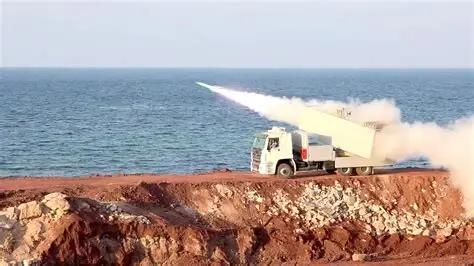
The latest confrontation began after the United States launched a strike on Iran’s Larak Island, targeting rocket launchers that Washington said were being prepared to deploy sea mines in the strategically vital Strait of Hormuz.
Iran subsequently launched missiles toward US military positions in Jordan and the United Arab Emirates in retaliation, marking the most significant direct military exchange between Washington and Tehran since late July.
The renewed hostilities have intensified concerns over the security of the Strait of Hormuz, one of the world’s most important energy corridors and a crucial route for international oil shipments.
US Central Command (CENTCOM) said American forces carried out what it described as a “limited, precise action” against Iranian forces preparing to deploy mines in the waterway.
According to Capt. Tim Hawkins, a CENTCOM spokesperson, US forces observed Iranian personnel preparing to launch rockets carrying sea mines into the Strait of Hormuz.
The American military said the operation was designed to eliminate what it considered an imminent threat to commercial shipping and civilian vessels using the strategic waterway.
Iran created the threat and the US military eliminated it to protect civilian mariners, commercial shipping, and the free flow of global commerce,” CENTCOM said.
The US strike targeted two Iranian rocket launchers on Larak Island, a small island located off the coast of Bandar Abbas in southern Iran.
Iranian state media reported explosions near the island and claimed that both Iranian forces and civilians were among those affected.
US President Donald Trump subsequently warned that Washington would respond forcefully to any further Iranian attacks.
In a post on Truth Social, Trump again described Iran as a “failed nation”, claiming that its leadership was in disarray.
We’re going to hit them hard,” Trump told Fox News on Monday, adding that there would be a response.
The comments came only days after Trump announced that the Strait of Hormuz had been cleared of sea mines and warned Iran against attempting to place new mines in the waterway.
The Trump administration has said US forces completed the clearance of mines from international shipping routes in the strait last week.
Trump previously warned that any Iranian vessel involved in laying new mines would be destroyed.
Iranian President Masoud Pezeshkian said Tehran was not seeking war but warned that Iran would respond to what it described as American aggression.
We are not seeking war… But in the face of aggression, we will never sit idly by, and we are capable of delivering a decisive response,” Pezeshkian said, according to Iranian state broadcaster IRIB.
Iran’s powerful Islamic Revolutionary Guard Corps (IRGC) described the US operation as a strategic and deadly mistake” and vowed retaliation.
Iran subsequently claimed that its forces had targeted US military bases in Jordan and the UAE.
Jordanian authorities said their air defence systems intercepted and destroyed eight missiles that entered the country’s airspace.
Jordan’s military said the missiles were neutralised before they could threaten civilians or property.
The United Arab Emirates also reported detecting a drone over its territorial waters following Iranian claims that the IRGC had targeted a facility hosting American personnel in the country.
The UAE denied that the reported base had been targeted but condemned the development as a dangerous escalation.
Abu Dhabi said it reserved the right to respond.
The UAE had been one of the countries most frequently targeted during the height of the conflict earlier in the year, although attacks against the country had declined significantly in recent months.
The Strait of Hormuz has emerged as one of the most important flashpoints in the conflict between Washington and Tehran.
The narrow waterway connects the Persian Gulf with the Gulf of Oman and serves as a critical passage for global energy supplies.
Iran has asserted its right to control maritime activity in the area, while the United States has insisted that international shipping must continue freely.
Washington has deployed military assets to protect commercial vessels and maintain access to the waterway while imposing pressure on Iran.
Any prolonged disruption could have significant consequences for international energy markets because large volumes of oil and other commodities pass through the strait.
The latest military confrontation comes as diplomatic efforts between Washington and Tehran remain largely stalled.
The White House said last week that there were no ongoing negotiations between the two countries.
However, Iran and Oman have continued discussions over a possible arrangement aimed at restoring maritime traffic through the Strait of Hormuz.
Qatar and other regional actors have also supported diplomatic efforts to prevent the conflict from escalating further.
Anwar Gargash, an adviser to the UAE president, said the current situation could not continue indefinitely.
“The state of neither war nor peace cannot be a sustainable solution,” he said.
Gargash called for realistic and sustainable political solutions capable of addressing both the political and economic dimensions of the crisis.
Sunday’s strike was the first direct US attack on Iran since July 29, when Washington carried out a major wave of strikes following an attempted attack on American military positions.
In recent weeks, the Trump administration had increasingly focused on economic pressure rather than direct military action.
The United States has threatened additional sanctions against countries and companies maintaining economic ties with Iran.
The US Treasury Department has also warned that countries refusing to reduce their economic relationships with Tehran could face secondary sanctions.
Treasury Secretary Scott Bessent said Washington was preparing to impose new secondary sanctions on Iran-linked financial institutions.
“You’re going to see a lot more of these every week,” Bessent told Reuters, indicating that banks would be among the initial targets.
The renewed military confrontation immediately affected global oil markets.
Brent crude, the international benchmark, rose 2.8 per cent to $90.57 a barrel, while US crude increased 2.7 per cent to $85.64 a barrel.
The price movement reflects growing concerns that renewed attacks around the Strait of Hormuz could disrupt global energy supplies.
With the US and Iran now exchanging direct attacks again, international markets and governments are closely watching developments around the strategic waterway.
The latest escalation also places renewed pressure on diplomatic efforts to prevent the wider conflict from developing into another prolonged regional war.
For now, both sides appear determined to maintain their respective positions, leaving the Strait of Hormuz at the centre of an increasingly dangerous confrontation with potentially far-reaching consequences for global security, trade and energy prices.