

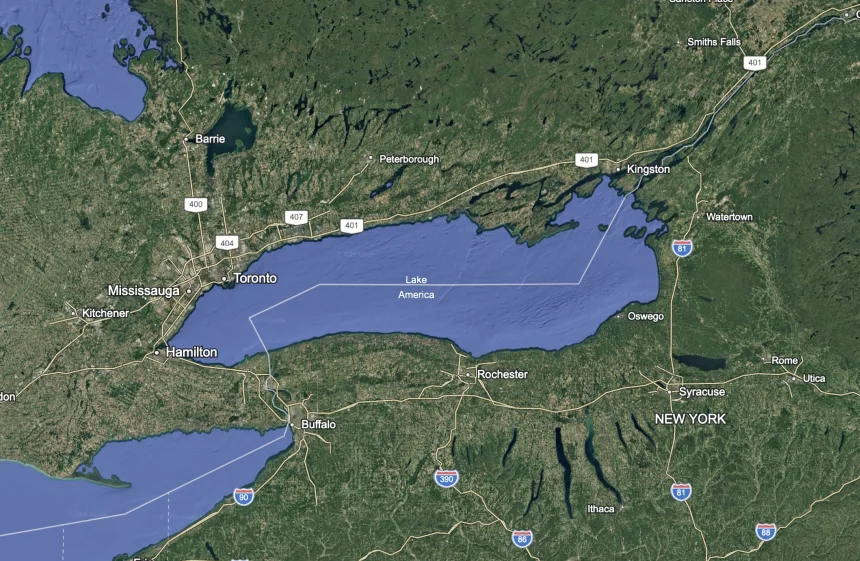
Google Maps has changed the name of Lake Ontario to “Lake America” for users in the United States, following an executive order by President Donald Trump directing the US government to adopt the new name.
The change has sparked fresh controversy between the United States and Canada, with Canadian officials making clear that they have no intention of abandoning the lake’s traditional name.
Google confirmed that its mapping service now reflects the new designation in the United States after the US Geographic Names Information System (GNIS) formally updated its database.
The U.S. Geographic Names Information System (GNIS) has formally changed the name for ‘Lake Ontario’ to ‘Lake America’ in the United States, Google said in a statement.
The technology company explained that Google Maps routinely updates geographic names based on official government sources.
Since wepdate Google Maps to reflect name changes in official government sources, which is GNIS for the U.S., people using Maps in the U.S. will see ‘Lake America, Google said.
However, the name has not been changed globally.
Users accessing Google Maps from Canada will continue to see Lake Ontario, while users outside both countries will see Lake Ontario with Lake America displayed in parentheses.
The change follows an executive order signed by Trump amid renewed tensions between Washington and Ottawa.
The lake is one of North America’s Great Lakes and lies between the Canadian province of Ontario and the US states of New York and Pennsylvania.
Trump’s decision to rename the lake does not automatically compel Canada to adopt the new designation.
The waterway is shared by the two countries and is governed by longstanding agreements regulating the use and management of their boundary waters.
The Boundary Waters Treaty of 1909 established mechanisms for addressing disputes concerning shared waters between the United States and Canada.
While the US president has authority over how the American federal government identifies geographic features, that authority does not extend to Canadian institutions or governments.
Canadian leaders have strongly rejected the proposed renaming.
Prime Minister Mark Carney has said Canada will continue to refer to the body of water as Lake Ontario, signalling that the disagreement is unlikely to be resolved simply through the American government’s naming decision.
Ontario Premier Doug Ford has also publicly pushed back against Trump’s move.
Ford unveiled a sign on the Canadian side of the lake bearing the words “Lake Ontario” prominently, followed by the message “Now and Always.”
In a video posted on social media, Ford argued that the lake’s name predates Trump’s presidency and would continue long after his administration.
“Long before President Trump, this lake was called Lake Ontario. And long after President Trump is gone, it will still be called Lake Ontario,” Ford said.
The response underlines the political sensitivity surrounding geographic names, particularly when they involve landmarks shared by neighbouring countries.
The Lake Ontario renaming is not Trump’s first attempt to change the internationally recognised name of a major body of water.
After returning to office, Trump ordered the US government to refer to the Gulf of Mexico as the “Gulf of America.”
Google subsequently updated Google Maps for US users to reflect the US government’s official designation, while maintaining the existing name in other countries.
The company has described its approach as part of a longstanding policy for geographic features whose names differ between countries.
The policy allows Google Maps to display different names depending on where the user is accessing the service.
The Lake Ontario dispute means Google Maps users can now see different names for the same body of water depending on their location.
United States: Lake America
Canada: Lake Ontario
Other countries: Lake Ontario, with Lake America displayed in parentheses
Google said the approach reflects the different official naming systems used by governments.
The company has therefore avoided applying the American government’s preferred designation universally.
Other mapping platforms keep Lake Ontario
Google’s decision has not been followed by every major mapping service.
As of Sunday, Apple Maps and Waze continued to identify the body of water as Lake Ontario.
MapQuest also indicated that it would not make the change.
The different approaches mean that users searching for the lake on competing mapping services could encounter different names.
Why the name matters
Geographic names can carry political, historical and cultural significance, particularly when the feature is shared by multiple countries.
Lake Ontario is one of the five Great Lakes and has long been recognised by its current name on both sides of the US-Canada border.
The dispute therefore goes beyond a simple change on a digital map.
For Canada, continuing to use Lake Ontario represents a rejection of an American decision concerning a shared geographic feature.
For the Trump administration, the adoption of “Lake America” by US government agencies represents the implementation of a presidential directive.
Google’s decision to display the names differently depending on the user’s location reflects the reality that geographic naming can vary between jurisdictions.
A new flashpoint in US-Canada relations
The dispute comes against the backdrop of broader tensions between Washington and Ottawa.
The two countries share one of the world’s longest international borders and maintain deeply interconnected economies.
Trade disputes, tariffs and political disagreements have placed additional strain on the relationship in recent years.
The Lake Ontario naming controversy adds another symbolic issue to the already complicated relationship.
Although the renaming has no direct impact on the lake’s physical boundaries or the legal arrangements governing its waters, the competing names highlight the broader political differences between the two countries.
For now, Americans searching Google Maps will see Lake America, while Canadians will continue to see Lake Ontario.
And with Canadian officials firmly rejecting Trump’s decision, the lake is likely to remain known by two different names on opposite sides of the border.