


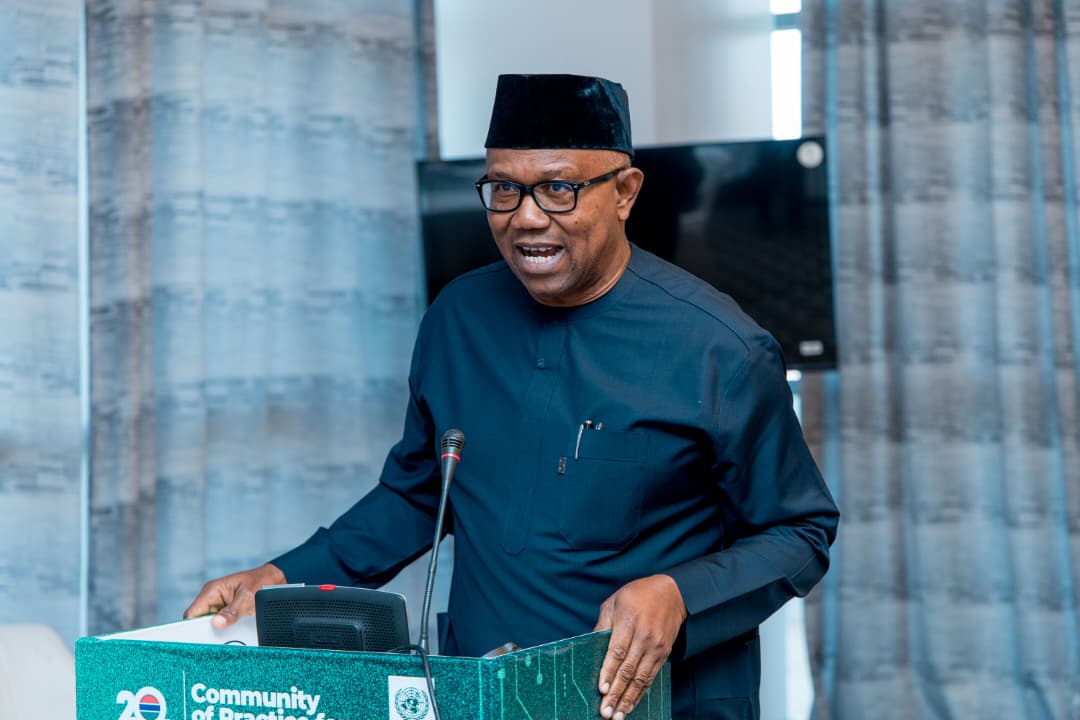
A Southeast-based political support group, the Renewed Hope for Greater Nigeria (RHGN), has urged former Anambra State Governor and presidential candidate of the Nigerian Democratic Congress (NDC), Peter Obi, to withdraw from the 2027 presidential race and support President Bola Ahmed Tinubu’s re-election bid.
The group said such a move would, in its view, provide an opportunity for the Southeast to negotiate a broader political arrangement capable of advancing the region’s long-term interest in Nigeria’s presidency.
The Southeast chapter of RHGN, led by Mazi Franklin Ngoforo, disclosed the position in Owerri while briefing journalists after a meeting of the organisation’s regional leadership.
Ngoforo said the meeting focused principally on strategies to secure support for President Tinubu across the five Southeast states during the 2027 presidential election.
According to him, the group plans to approach prominent Igbo leaders and statesmen to persuade Obi to reconsider his presidential ambition and explore the possibility of joining the All Progressives Congress (APC) and supporting Tinubu.
Ngoforo said RHGN intends to engage the leadership of Ohanaeze Ndigbo under Senator John Azuta Mbata, as well as respected elder statesmen including Chief Emeka Anyaoku and Commodore Ebitu Ukiwe.
He said the organisation would encourage the leaders to form a delegation that could meet with Obi and discuss what it described as the strategic political interests of the Southeast.
The group stressed that the proposed engagement was not aimed at undermining Obi or questioning his political influence.
Rather, Ngoforo said the objective was to persuade the former Anambra governor to consider the 2027 election from a broader regional and national perspective.
He argued that Obi’s political capital could be deployed toward negotiating a stronger political arrangement for the Southeast rather than pursuing another presidential contest on what the group considers a challenging opposition platform.
One of the major reasons cited by the group was the alleged crisis within the NDC.
Ngoforo pointed to disputes surrounding the selection of candidates in various constituencies across the Southeast, arguing that the disagreements had created dissatisfaction and weakened the party’s organisational structure.
He maintained that a presidential candidate requires a strong political machinery capable of mobilising voters, coordinating campaigns and protecting electoral interests across the country.
According to him, the difficulties confronting the NDC could therefore raise questions about the strength of the platform available to Obi ahead of the 2027 presidential election.
“Presidential ambition is only as strong as the political structure behind it,” the group argued, insisting that Obi should carefully assess whether remaining on what it described as a weakened opposition platform would serve his political interests.
RHGN also cited the political dynamics in Northern Nigeria as another reason Obi should reconsider his presidential bid.
Ngoforo said consultations with northern political actors had strengthened the group’s belief that Obi’s reported commitment to serving only one term would not automatically translate into northern support.
He argued that presidential politics involves complex calculations surrounding power, succession, regional interests and political security.
According to him, the promise of a single four-year tenure should not be assumed to be sufficient to secure the backing of northern political stakeholders.
He said the Southeast must therefore approach the 2027 election with a realistic understanding of the political calculations taking place across Nigeria’s geopolitical zones.
The group said its immediate objective was to mobilise support for President Tinubu ahead of the 2027 presidential election.
RHGN said it would intensify its engagement with political stakeholders, community leaders and voters across the Southeast as part of its campaign for Tinubu.
The organisation believes that supporting the incumbent could create room for political negotiations that would potentially strengthen the Southeast’s position in future presidential contests.
Ngoforo said the proposed appeal to Obi should therefore be viewed as part of a broader political conversation about how the Southeast could secure greater influence within Nigeria’s political system.
The call comes as political activities intensify ahead of the 2027 presidential election, with major political parties and presidential hopefuls positioning themselves for the contest.
Obi remains a prominent figure in Nigeria’s opposition politics, having attracted significant support during the 2023 presidential election.
His supporters have continued to campaign for greater political participation and reforms, while various political groups have sought to influence his decision regarding the 2027 contest.
RHGN, however, believes that the Southeast should consider alternative political strategies and alliances rather than relying exclusively on an individual presidential candidacy.
The group said its planned consultations with Igbo leaders would provide an opportunity for stakeholders to examine the political options available to the region before the election.
Ngoforo maintained that the political interests of the Southeast should extend beyond the immediate presidential election.
He said the region needed a strategy that could strengthen its bargaining power at the national level and improve its prospects of producing a president in the future.
He argued that political alliances, negotiations and strategic partnerships were essential components of democratic politics and should not necessarily be interpreted as abandoning regional aspirations.
The RHGN leader said the organisation would continue consultations with stakeholders as it works toward its objective of securing support for Tinubu across the Southeast in 2027.
The group’s proposal, however, is expected to generate further debate among Obi’s supporters and other political stakeholders in the region as Nigeria moves closer to the 2027 presidential election.