


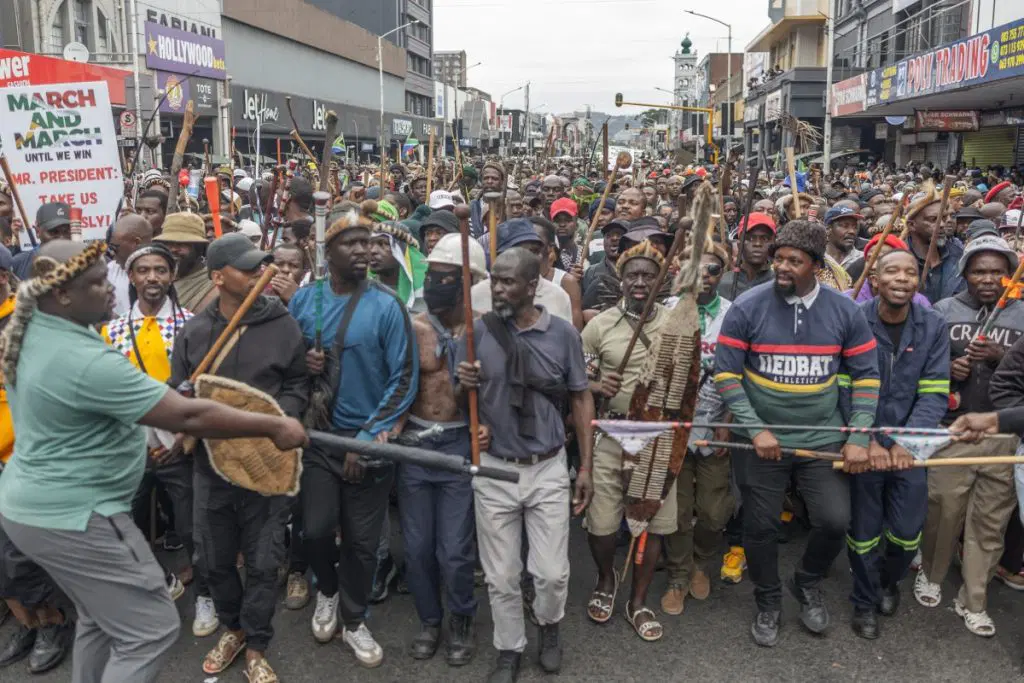
Thousands of South Africans marched through major cities on Tuesday after the expiration of an unofficial June 30 deadline demanding undocumented foreign nationals leave the country, marking the climax of weeks of anti-immigrant protests that have already displaced thousands and left at least four people dead.
The nationwide demonstrations were organised by citizen-led anti-immigration groups calling for mass deportations, while police mounted a massive security operation to prevent widespread violence.
Although isolated incidents of looting, stone-throwing and confrontations were reported, authorities largely succeeded in preventing the unrest from escalating into the kind of deadly violence South Africa experienced in previous xenophobic outbreaks.
Law enforcement officers were heavily deployed across major cities, monitoring demonstrations and intervening where necessary.
Near Johannesburg, security forces escorted a small group of foreign nationals away from an angry crowd carrying large sticks, preventing what could have become a violent confrontation.
In Johannesburg, South Africa’s commercial hub, many businesses remained closed while public transport activity slowed significantly as residents stayed indoors over security concerns.
Protesters marched through the city carrying South African flags and placards under the watch of riot police equipped with protective gear.
In Durban, the heartland of the Zulu nation, demonstrators appeared in traditional warrior attire, carrying spears, shields and whips, with some dressed in leopard skins.
Many participants blamed undocumented migrants for worsening unemployment, crime and pressure on public services.
One protester, Brightness Gumbi, said she struggled to rent commercial property for her business while foreign nationals continued operating shops.
She accused undocumented migrants of engaging in criminal activities and urged President Cyril Ramaphosa to introduce stricter immigration enforcement.
Unlike Johannesburg and Durban, Cape Town witnessed a relatively smaller demonstration, with about 100 protesters marching through the city centre.
The march was met by a counter-protest organised by activists campaigning against xenophobia and Afrophobia, highlighting deep divisions over immigration in South Africa.
The demonstrations were spearheaded by anti-immigration movement March and March, whose leader, Jacinta Ngobese-Zuma, accused undocumented migrants of taking jobs away from South Africans.
Addressing supporters in Durban, she claimed local workers had been displaced by illegal immigrants and called on the government to begin mass deportations immediately.
Ngobese-Zuma demanded that authorities remove undocumented migrants who failed to leave voluntarily within the next six months.
South Africa remains one of Africa’s largest economies and continues to attract migrants seeking employment opportunities.
However, the country is also battling an unemployment rate exceeding 30 percent, rising crime and deteriorating public services.
Analysts argue that immigrants are often unfairly blamed for long-standing economic and governance challenges, saying political leaders and activist groups have increasingly used immigration as a campaign issue ahead of local government elections scheduled for November.
Labour analyst Dale McKinley described the growing anti-migrant movement as being “politically weaponised” during the election season.
Police confirmed that at least four foreign nationals have lost their lives during the latest wave of anti-immigrant violence.
The victims include two Mozambicans, one Ethiopian and one Malawian.
The killings have heightened fears among migrant communities and prompted several African governments to begin emergency evacuation programmes for their citizens.
Governments including Nigeria, Malawi, Zimbabwe, Ghana and Mozambique have organised voluntary evacuation flights and buses to assist citizens wishing to leave South Africa.
Authorities say more than 25,000 people have already been processed for departure in recent weeks, making it one of the largest coordinated repatriation efforts seen during a South African xenophobia crisis.
As demonstrations continued across multiple cities, hundreds of migrants gathered at evacuation centres while awaiting transportation back to their home countries.
Many said landlords had evicted them, employers had dismissed them and communities had warned them to leave before violence intensified.
A 23-year-old Zimbabwean woman waiting for transport said she feared for her safety because many South Africans no longer wanted foreigners in the country.
Similarly, Malawian migrant Adam John explained that neighbours advised him to leave immediately, convincing him it was safer to return home before conditions worsened.
Mindful of the devastating riots that rocked South Africa five years ago, when around 350 people died during widespread looting and violence, authorities launched one of the country’s largest domestic security operations.
President Cyril Ramaphosa appealed for calm while announcing tougher measures to combat illegal immigration.
He also urged traditional rulers and community leaders to use their influence to reduce tensions and discourage violence against foreign nationals.
The latest protests add to South Africa’s long history of xenophobic attacks targeting foreign nationals.
One of the country’s deadliest outbreaks occurred in 2008, when violence claimed 62 lives and displaced thousands of migrants.
While this year’s demonstrations have so far remained relatively controlled due to heavy security deployment, concerns remain that tensions could escalate if immigration issues remain unresolved and political rhetoric continues to intensify.


